
Economics 2024 Jamb Examination
Economics 2024 Jamb Examination

Question 61
What add funds to the circular flow?
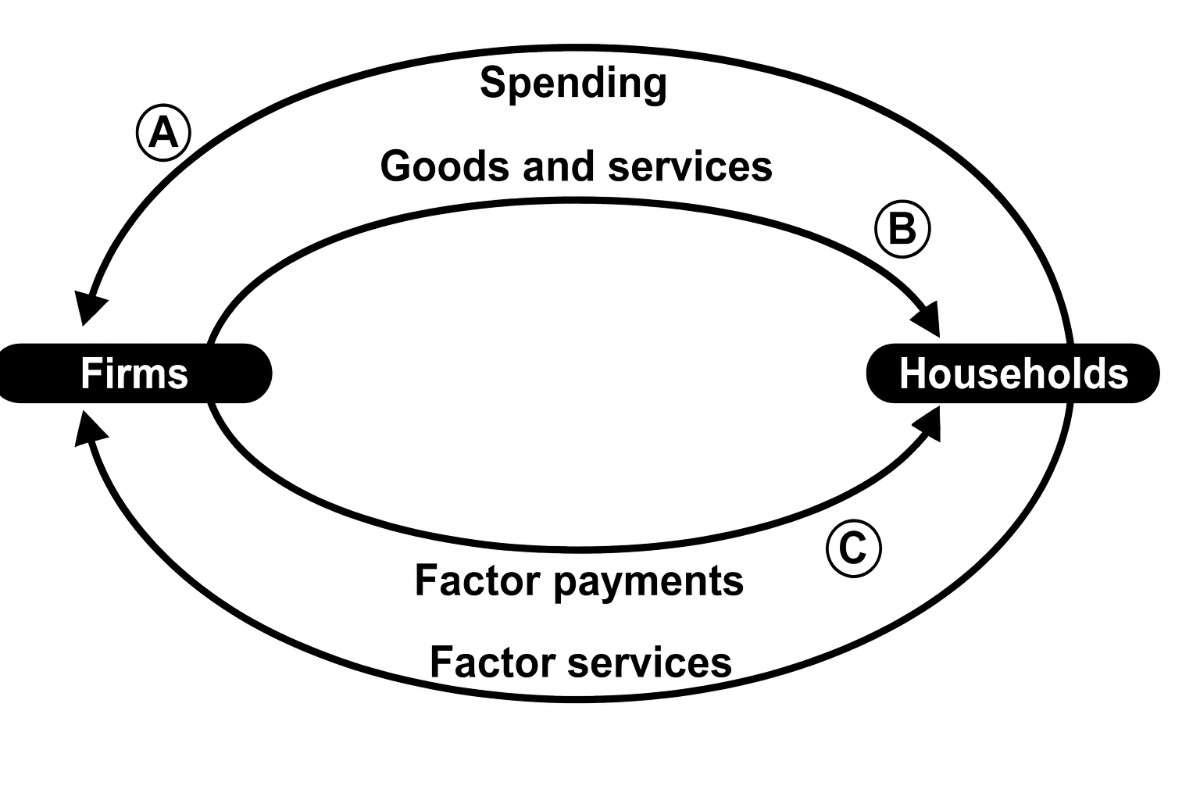
In the circular flow of income, funds leave the flow through leakages such as savings, taxes, and imports.
Funds enter or are added to the flow through injections, including investment, government spending, and exports.
Withdrawals and leakages reduce the flow rather than increase it.
The expenditure approach is a method of calculating national income, not a component that adds funds to the circular flow.
Thus, injections are what add funds to the circular flow.
Not clear enough?
Question 62
If two bags of rice were sold for \#1,250 a month ago and two weeks later, the same amount was used to procure one bag. This simply means that the value of money is
When the same amount of money buys fewer goods than before, it indicates that the purchasing power of money has fallen.
In this case, #1,250 previously bought two bags of rice, but now it buys only one bag. This implies that money has lost value because prices have risen.
An increase in the price of goods relative to money means that the value of money is decreasing, not constant or increasing.
Fluctuation refers to continual rises and falls, but the situation here shows a clear decline in value.
Not clear enough?
Question 63
The demand for factors of production is said to be
Factors of production such as labour, land, and capital are demanded not for their own sake but because they help in producing goods and services desired by consumers.
This makes their demand a derived demand, since it depends on the demand for the final output they help to create.
Joint demand refers to goods demanded together, such as pen and ink, while complementary demand also involves goods that work together.
Composite demand describes a good that has multiple uses. None of these apply to factors of production.
Not clear enough?
Question 64
The trade-off between two commodities along the Production Possibility Curve (PPC) shows
A Production Possibility Curve illustrates the maximum combination of two goods that can be produced given scarce resources.
Moving along the PPC requires sacrificing part of one good to produce more of the other, which reflects the concept of opportunity cost—the value of the next best alternative forgone.
Unattainable combinations lie outside the curve and are not shown by movements along it.
While the PPC demonstrates scarcity generally, the specific trade-off along the curve is best explained by opportunity cost.
Not clear enough?
Question 65
A major characteristics of a firm operating at a long-run equilibrium position is that
In the long run, all factors of production are adjustable because firms have enough time to expand or reduce their scale of operation.
This means all costs—both fixed and variable—can be varied in the long run.
Fixed costs exist only in the short run and disappear in the long run, so options stating fixed costs cannot change are incorrect.
Average variable cost is not fixed either because input usage can change freely.
This means all costs—both fixed and variable—can be varied in the long run.
Fixed costs exist only in the short run and disappear in the long run, so options stating fixed costs cannot change are incorrect.
Average variable cost is not fixed either because input usage can change freely.
Not clear enough?
Question 66
An economy in which decision of what to produce is taken partly by private individuals and the state is referred to as ______ Economy.
A mixed economy combines elements of both market and command systems. In such an economy, private individuals participate in production decisions while the government also intervenes to regulate and provide certain goods and services.
A communist or socialist economy relies heavily on state control, while a capitalist economy relies mainly on private decision-making.
The description fits the structure of a mixed economy.
A communist or socialist economy relies heavily on state control, while a capitalist economy relies mainly on private decision-making.
The description fits the structure of a mixed economy.
Not clear enough?
Question 67
Economic problem arises as a result of
Economic problems occur because resources are limited while human wants are unlimited.
Scarcity refers to the insufficiency of resources to satisfy all human wants. Because of scarcity, society must make choices on how resources should be allocated, and every choice has an opportunity cost.
However, the root cause of the economic problem is scarcity, since without scarcity neither choice nor opportunity cost would arise.
Not clear enough?
Question 68
The following are rewards for factors of production EXCEPT
Each factor of production has a specific reward: labour earns wages, land earns rent, capital earns interest, and entrepreneurship earns profit.
A subsidy is not a reward for any factor of production. It is a government financial assistance given to firms to reduce production costs or encourage certain activities. Therefore, it does not represent a payment arising from the use of a productive factor.
A subsidy is not a reward for any factor of production. It is a government financial assistance given to firms to reduce production costs or encourage certain activities. Therefore, it does not represent a payment arising from the use of a productive factor.
Not clear enough?
Question 69
When an increase in the price of a commodity leads to a fall in the demand for another, the demand for the two commodities are said to be
A rise in the price of one good causing a fall in the demand for another indicates that the two goods are used together. Such commodities are complements, and their demand is joint.
For example, an increase in the price of cars will reduce the demand for petrol because both goods are consumed together. This relationship characterises joint demand.
For example, an increase in the price of cars will reduce the demand for petrol because both goods are consumed together. This relationship characterises joint demand.
Not clear enough?
Question 70
Which of the following is NOT a function of the IMF?
The International Monetary Fund supports global financial stability by monitoring exchange rates, fostering international monetary cooperation, and providing financial assistance to members facing balance of payment crises.
It does not engage in currency printing or the physical issuance of money for member nations. That responsibility lies solely with national central banks. Hence, assisting countries in printing or issuing currency is not among IMF functions.
It does not engage in currency printing or the physical issuance of money for member nations. That responsibility lies solely with national central banks. Hence, assisting countries in printing or issuing currency is not among IMF functions.