
Economics 2024 Jamb Examination
Economics 2024 Jamb Examination

Question 51
Which of the following is a disadvantage of localisation of industries?
Localisation of industries refers to the concentration of similar industries in a specific area.
This concentration often brings benefits such as reduced production costs, development of skilled labour, and growth of feeder or subsidiary industries.
However, when industries cluster in one region, other regions may suffer economic neglect, creating geographical imbalances that can lead to structural unemployment in less-developed areas.
Thus, structural unemployment is a disadvantage of localisation.
Not clear enough?
Question 52
Stock exchange market deals with
A stock exchange is a formal marketplace where existing (second-hand) securities such as shares, bonds, and debentures are traded among investors.
It does not deal in foreign exchange, which is handled by the foreign exchange market, nor does it trade physical goods such as stock fish.
Treasury bills are traded in the money market, not the stock exchange.
Second-hand securities represent previously issued financial instruments being resold, which is the core function of the stock exchange.
Not clear enough?
Question 53
Which of the following is NOT a major role of OPEC in production and marketing of petroleum?
OPEC is primarily concerned with coordinating petroleum policies of member countries, regulating production quotas, stabilising prices, and ensuring regular supply of crude oil to the global market.
It does not directly refine petroleum products; refining is carried out by individual member states or private companies within their territories.
Since refining is not a collective operational function of OPEC, this makes option B the correct choice.
It does not directly refine petroleum products; refining is carried out by individual member states or private companies within their territories.
Since refining is not a collective operational function of OPEC, this makes option B the correct choice.
Not clear enough?
Question 54
The satisfaction derived from the consumption of a commodity is referred to as
In economics, utility refers to the level of satisfaction or pleasure obtained from consuming a good or service.
Consumption is the act of using goods and services, while demand is the willingness and ability to purchase them.
Production involves the creation of goods and services.
Therefore, the concept that captures satisfaction derived from consumption is utility.
Consumption is the act of using goods and services, while demand is the willingness and ability to purchase them.
Production involves the creation of goods and services.
Therefore, the concept that captures satisfaction derived from consumption is utility.
Not clear enough?
Question 55
An industry engaged in the extraction of raw materials and their conversion into semi-finished goods is called ______ industry.
A processing industry is responsible for transforming raw materials into semi-finished goods that can be used as inputs for further production.
Mining concerns only extraction, not conversion.
Manufacturing deals with producing finished goods rather than semi-finished ones.
The term 'conversion industry' is not a standard classification in economics.
Therefore, the description fits the processing industry.
Mining concerns only extraction, not conversion.
Manufacturing deals with producing finished goods rather than semi-finished ones.
The term 'conversion industry' is not a standard classification in economics.
Therefore, the description fits the processing industry.
Not clear enough?
Question 56
An industry operating in a perfectly competitive market situation will maximise profit when
In perfect competition, a firm maximises profit at the point where marginal cost (MC) equals marginal revenue (MR).
MC = MR ensures that producing an additional unit neither increases nor decreases profit, representing the optimal output level.
DD < SS describes an excess supply situation and does not directly relate to profit maximisation.
MC > AC concerns cost structure but not the optimal profit point.
MC < AR is insufficient because AR equals MR in perfect competition, but the equality condition is essential for maximising profit.
Not clear enough?
Question 57
Which of the following is NOT a function of marketing boards in Nigeria?
Marketing boards are established to regulate and stabilise the marketing of agricultural produce within a country. Their functions include grading produce, ensuring fair pricing, and organising the sale of agricultural goods.
They do not engage in the importation of farm produce, as their focus is on domestic production and marketing. Importation falls under trade and customs authorities, not marketing boards.
Since importation is outside the mandate of marketing boards, option B is correct.
They do not engage in the importation of farm produce, as their focus is on domestic production and marketing. Importation falls under trade and customs authorities, not marketing boards.
Since importation is outside the mandate of marketing boards, option B is correct.
Not clear enough?
Question 58
Persistent fall in the general price level is known as
A continuous decline in the overall price level of goods and services in an economy is known as deflation.
Devaluation refers to a deliberate reduction in the value of a country's currency relative to others.
A general price increase describes inflation, not a fall in prices.
Inflation is the opposite of deflation, involving rising prices over time.
Therefore, the term that describes persistent falling prices is deflation.
Not clear enough?
Question 59
Which of the following will NOT bring about an increase in labour force?
A country's labour force increases when more people become available for work. This can be due to lower death rates, improved health services, or immigration, all of which increase the population or retain more people.
Emigration, on the other hand, reduces the number of people within a country because individuals leave to live elsewhere.
Since emigration reduces rather than increases the labour force, option D is correct.
Emigration, on the other hand, reduces the number of people within a country because individuals leave to live elsewhere.
Since emigration reduces rather than increases the labour force, option D is correct.
Not clear enough?
Question 60
The diagram below represent
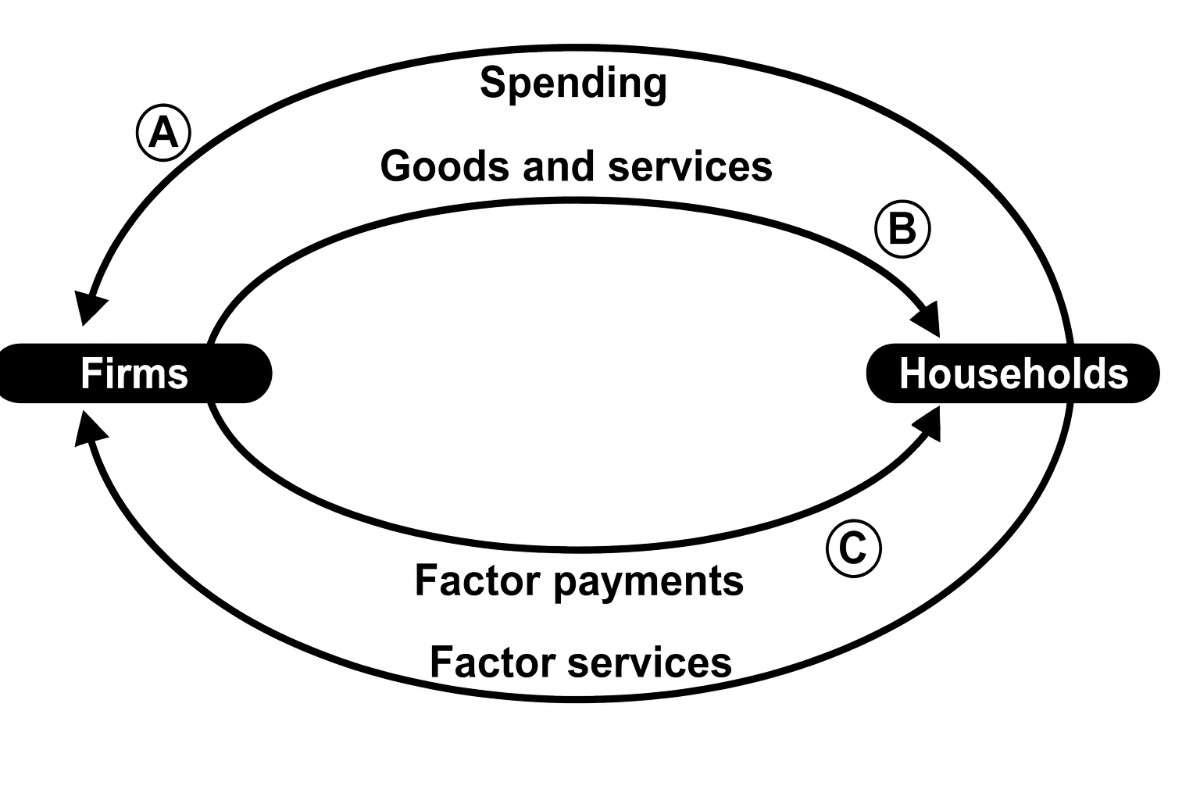
The diagram shows a continuous flow between households and firms, displaying the movement of income, goods, services, and resources.
This representation indicates how money flows in an economy between producers and consumers, which is the hallmark of the circular flow of income.
A business cycle involves expansion and contraction phases, which are not shown here.
An inflationary gap refers to excess aggregate demand, and national income is a measure, not a diagrammatic flow.
The structure clearly depicts the circular flow of income.