
Mathematics 2009 Jamb Examination
Mathematics 2009 Jamb Examination

Question 31
What is the value of r if the distance between the points (4, 2) and (1, r) is 3 units?
The distance between two points \((x_1, y_1)\) and \((x_2, y_2)\) is given by:\[d = \sqrt{(x_2 - x_1)^2 + (y_2 - y_1)^2}\]Substituting the given points:\[3 = \sqrt{(4 - 1)^2 + (2 - r)^2}\]\[3 = \sqrt{9 + (2 - r)^2}\]Squaring both sides:\[9 = 9 + (2 - r)^2\]\[(2 - r)^2 = 0\]\[2 - r = 0\]\[r = 2\]This value makes the distance between the two points exactly 3 units.
Not clear enough?
Question 32
If \(y = 3\cos 4x\), find \(\dfrac{dy}{dx}\).
Differentiation is carried out using the chain rule.
The derivative of \(\cos u\) is \(-\sin u\), multiplied by the derivative of \(u\).
Given:\[y = 3\cos 4x\]\[\dfrac{dy}{dx} = 3 \times (-\sin 4x) \times 4\]\[\dfrac{dy}{dx} = -12\sin 4x\]This follows directly from standard trigonometric differentiation rules.
The derivative of \(\cos u\) is \(-\sin u\), multiplied by the derivative of \(u\).
Given:\[y = 3\cos 4x\]\[\dfrac{dy}{dx} = 3 \times (-\sin 4x) \times 4\]\[\dfrac{dy}{dx} = -12\sin 4x\]This follows directly from standard trigonometric differentiation rules.
Not clear enough?
Question 33
Find the value of \(\sin 45^\circ - \cos 30^\circ\).
Using standard trigonometric values:\[\sin 45^\circ = \dfrac{\sqrt{2}}{2}\]\[\cos 30^\circ = \dfrac{\sqrt{3}}{2}\]Subtracting:\[\sin 45^\circ - \cos 30^\circ = \dfrac{\sqrt{2}}{2} - \dfrac{\sqrt{3}}{2}\]\[= \dfrac{\sqrt{2} - \sqrt{3}}{2}\]This is obtained by expressing both terms with a common denominator.
Not clear enough?
Question 34
A cliff on the bank of a river is 300 m high. If the angle of depression of a point on the opposite side of the river is 60°, find the width of the river.
The angle of depression is equal to the angle of elevation.
From the right-angled triangle formed:\[\tan 60^\circ = \dfrac{\text{opposite}}{\text{adjacent}} = \dfrac{300}{\text{width}}\]Since \(\tan 60^\circ = \sqrt{3}\):\[\sqrt{3} = \dfrac{300}{\text{width}}\]\[\text{width} = \dfrac{300}{\sqrt{3}}\]\[\text{width} = 100\sqrt{3}\,\text{m}\]This result follows from basic trigonometric ratios.
From the right-angled triangle formed:\[\tan 60^\circ = \dfrac{\text{opposite}}{\text{adjacent}} = \dfrac{300}{\text{width}}\]Since \(\tan 60^\circ = \sqrt{3}\):\[\sqrt{3} = \dfrac{300}{\text{width}}\]\[\text{width} = \dfrac{300}{\sqrt{3}}\]\[\text{width} = 100\sqrt{3}\,\text{m}\]This result follows from basic trigonometric ratios.
Not clear enough?
Question 35
If \(s = (2 + 3t)(5t - 4)\), find \(\dfrac{ds}{dt}\) when \(t = \dfrac{4}{5}\) seconds.
First expand the expression for \(s\):\[s = (2 + 3t)(5t - 4)\]\[s = 15t^2 - 2t - 8\]Differentiate with respect to \(t\):\[\dfrac{ds}{dt} = 30t - 2\]Substitute \(t = \dfrac{4}{5}\):\[\dfrac{ds}{dt} = 30 \times \dfrac{4}{5} - 2\]\[= 24 - 2\]\[= 22\,\text{units per sec}\]This gives the rate of change of \(s\) with respect to time at the given instant.
Not clear enough?
Question 36
The distance travelled by a particle from a fixed point is given by
\(s = (t^3 - t^2 - t + 5)\) cm.
Find the minimum distance that the particle can cover from the fixed point.
\(s = (t^3 - t^2 - t + 5)\) cm.
Find the minimum distance that the particle can cover from the fixed point.
To find the minimum distance, differentiate \(s\) with respect to \(t\):\[\dfrac{ds}{dt} = 3t^2 - 2t - 1\]Set the derivative equal to zero:\[3t^2 - 2t - 1 = 0\]Solving:\[t = \dfrac{2 \pm \sqrt{4 + 12}}{6} = \dfrac{2 \pm 4}{6}\]This gives \(t = 1\) or \(t = -\dfrac{1}{3}\).
Using the second derivative \(\dfrac{d^2s}{dt^2} = 6t - 2\), at \(t = 1\) this value is positive, so the distance is minimum.
Substitute \(t = 1\) into \(s\):\[s = 1 - 1 - 1 + 5 = 4\,\text{cm}\]This is the least possible distance from the fixed point.
Using the second derivative \(\dfrac{d^2s}{dt^2} = 6t - 2\), at \(t = 1\) this value is positive, so the distance is minimum.
Substitute \(t = 1\) into \(s\):\[s = 1 - 1 - 1 + 5 = 4\,\text{cm}\]This is the least possible distance from the fixed point.
Not clear enough?
Question 37
Evaluate \(\displaystyle \int \sec^2 \theta\, d\theta\).
From standard trigonometric integration rules:\[\dfrac{d}{d\theta}(\tan \theta) = \sec^2 \theta\]This means that the integral of \(\sec^2 \theta\) is simply \(\tan \theta\).
Therefore:\[\int \sec^2 \theta\, d\theta = \tan \theta + k\]where \(k\) is the constant of integration.
Therefore:\[\int \sec^2 \theta\, d\theta = \tan \theta + k\]where \(k\) is the constant of integration.
Not clear enough?
Question 38
The distribution below shows the number of days a group of 260 students were absent from school in a particular term. How many students were absent for at least four days in the term?
| No. of Days | 1 | 2 | 3 | 4 | 5 | 6 |
|---|---|---|---|---|---|---|
| No. of students | 20 | 2x | 60 | 40 | x | 50 |
The total number of students is 260.
Adding all frequencies:\[20 + 2x + 60 + 40 + x + 50 = 260\]\[170 + 3x = 260\]\[3x = 90 \Rightarrow x = 30\]Students absent for at least four days are those absent for 4, 5, and 6 days:\[40 + 30 + 50 = 120\]This gives the required number of students.
Adding all frequencies:\[20 + 2x + 60 + 40 + x + 50 = 260\]\[170 + 3x = 260\]\[3x = 90 \Rightarrow x = 30\]Students absent for at least four days are those absent for 4, 5, and 6 days:\[40 + 30 + 50 = 120\]This gives the required number of students.
Not clear enough?
Question 39
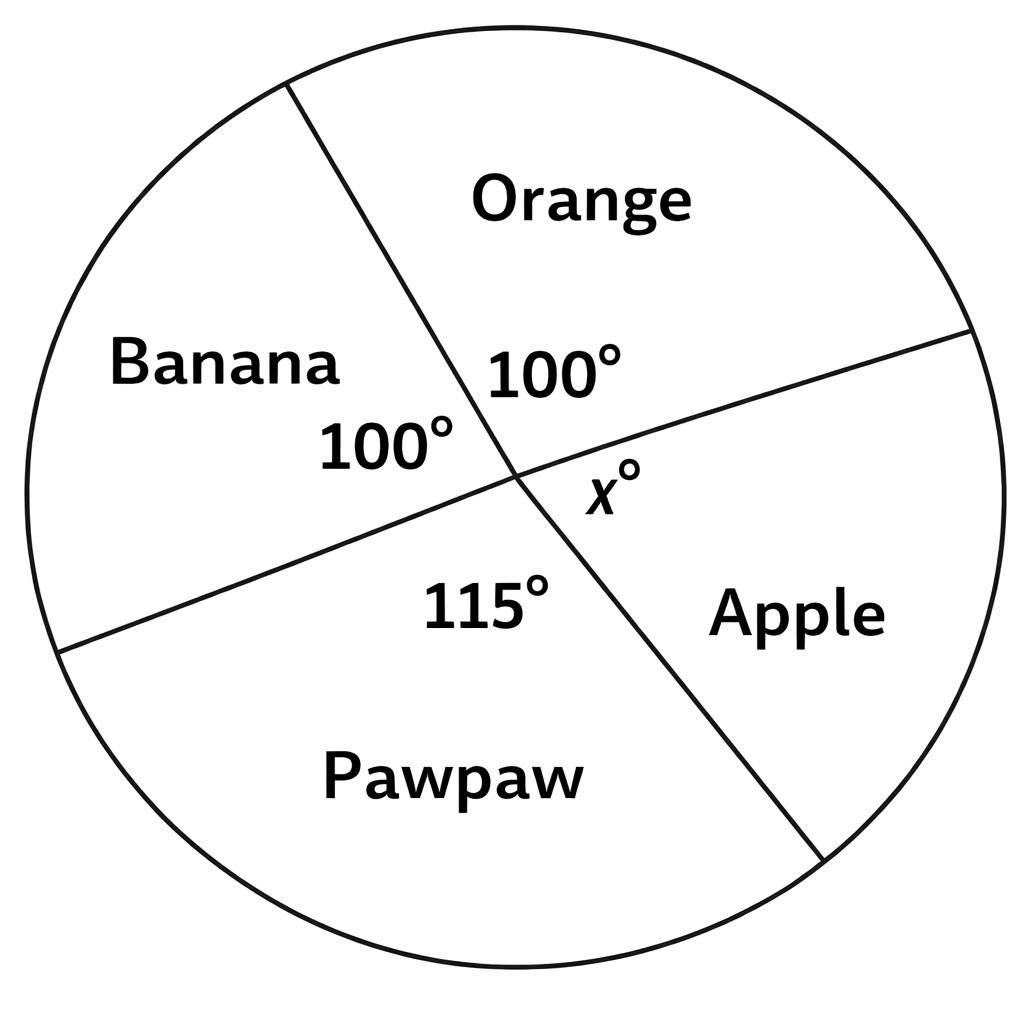
The pie chart above represents 400 fruits on display in a grocery store. How many apples are in the store?
The total angle in a full circle is 360°.
From the pie chart, the sector representing apples covers
360° - 100° - 100° - 115° = 45°.
The fraction representing apples is therefore:\[\dfrac{45}{360}\]The number of apples is:\[\dfrac{45}{360} \times 400 = 50\]This corresponds to the number of apples shown by the chart.
From the pie chart, the sector representing apples covers
360° - 100° - 100° - 115° = 45°.
The fraction representing apples is therefore:\[\dfrac{45}{360}\]The number of apples is:\[\dfrac{45}{360} \times 400 = 50\]This corresponds to the number of apples shown by the chart.
Not clear enough?
Question 40
The probability of a student passing any examination is \(\dfrac{2}{3}\). If the student takes three examinations, what is the probability that he will not pass any of them?
The probability of failing one examination is:\[1 - \dfrac{2}{3} = \dfrac{1}{3}\]If the examinations are independent, the probability of failing all three is:\[\left(\dfrac{1}{3}\right)^3 = \dfrac{1}{27}\]This represents the chance that the student does not pass any of the examinations.
Not clear enough?
You might like
What is the probability that an integer x (\(1 \le x \le 25\)) chosen at random is divisible by both 2 and 3?
Under the Hausa pre-colonial administration, the office of the Prime Minister is usually occupied by
The interior angle of a regular polygon is five times the size of its exterior angle. Identify the polygon.
The fashion resale market, in which consumers purchase secondhand clothing from stores and online sellers, generated nearly $30 billion globally in 2019. Expecting to see continued growth, some analysts _______ that revenues will more than double by 2028.
Which choice completes the text with the most logical and precise word or phrase?