Mathematics 2010 Jamb Examination

Mathematics 2010 Jamb Examination

Available Sections
2. Career
4. Job
12345

Question 1

Evaluate \( \left(\frac{81}{16}\right)^{-\frac{1}{4}} \times 2^{-1} \)
Show explanation Expand Question
To solve this problem, we apply the laws of indices, specifically the power of a quotient and the negative index rule. First, we deal with the negative fractional exponent by taking the reciprocal of the base. \[ \left(\frac{81}{16}\right)^{-\frac{1}{4}} = \left(\frac{16}{81}\right)^{\frac{1}{4}} \]Next, we express 16 and 81 as powers of 2 and 3 respectively: \[ 16 = 2^4, \quad 81 = 3^4 \]Substituting these back into the equation: \[ \left(\frac{2^4}{3^4}\right)^{\frac{1}{4}} = \frac{(2^4)^{\frac{1}{4}}}{(3^4)^{\frac{1}{4}}} = \frac{2^1}{3^1} = \frac{2}{3} \]Now, we evaluate the second part of the product: \[ 2^{-1} = \frac{1}{2} \]Finally, we multiply the two results: \[ \frac{2}{3} \times \frac{1}{2} = \frac{1}{3} \]
Not clear enough?

Question 2

Rationalise \( \dfrac{2\sqrt{3} + \sqrt{5}}{\sqrt{5} - \sqrt{3}} \)
Show explanation Expand Question
Rationalising the denominator involves multiplying both the numerator and the denominator by the conjugate of the denominator. The conjugate of \( \sqrt{5} - \sqrt{3} \) is \( \sqrt{5} + \sqrt{3} \). \[ \frac{2\sqrt{3} + \sqrt{5}}{\sqrt{5} - \sqrt{3}} \times \frac{\sqrt{5} + \sqrt{3}}{\sqrt{5} + \sqrt{3}} \]Expanding the numerator: \[ (2\sqrt{3})(\sqrt{5}) + (2\sqrt{3})(\sqrt{3}) + (\sqrt{5})(\sqrt{5}) + (\sqrt{5})(\sqrt{3}) \]\[ = 2\sqrt{15} + 2(3) + 5 + \sqrt{15} = 3\sqrt{15} + 6 + 5 = 3\sqrt{15} + 11 \]Expanding the denominator (difference of two squares): \[ (\sqrt{5})^2 - (\sqrt{3})^2 = 5 - 3 = 2 \]Combining the results: \[ \frac{3\sqrt{15} + 11}{2} \]
Not clear enough?

Question 3

Express the product of 0.21 and 0.34 in standard form
Show explanation Expand Question
Standard form is written as \( a \times 10^n \), where \( 1 \le a < 10 \). First, find the product of the two decimals: \[ 0.21 \times 0.34 = 0.0714 \]To convert 0.0714 to standard form, move the decimal point to the right until there is one non-zero digit to its left. We move the decimal point two places to the right: \[ 0.0714 = 7.14 \times 10^{-2} \]The exponent is negative because we started with a number less than one and moved the decimal point to the right.
Not clear enough?

Question 4

In a survey of 50 newspaper readers, 40 read Champion and 30 read Guardian, how many read both papers?
Show explanation Expand Question
This problem can be solved using the principle of set theory for the union of two sets. Let \( n(U) \) be the total number of readers, \( n(C) \) be readers of Champion, and \( n(G) \) be readers of Guardian. \[ n(U) = 50, \quad n(C) = 40, \quad n(G) = 30 \]Using the formula for the union of two sets: \[ n(C \cup G) = n(C) + n(G) - n(C \cap G) \]Assuming every reader in the survey reads at least one of the papers, \( n(C \cup G) = 50 \). Let the number of readers who read both be \( x \): \[ 50 = 40 + 30 - x \]\[ 50 = 70 - x \]\[ x = 70 - 50 = 20 \]
Not clear enough?

Question 5

Factorise completely \( \dfrac{x^3 + 3x^2 - 10x}{2x^2 - 8} \)
Show explanation Expand Question
To factorise the expression, we examine the numerator and the denominator separately. Numerator: \( x^3 + 3x^2 - 10x \) First, factor out the common term \( x \): \[ x(x^2 + 3x - 10) \]Next, factor the quadratic expression \( x^2 + 3x - 10 \). We need factors of -10 that add up to 3 (which are 5 and -2): \[ x(x+5)(x-2) \] Denominator: \( 2x^2 - 8 \) First, factor out the common term 2: \[ 2(x^2 - 4) \]This is a difference of two squares: \[ 2(x+2)(x-2) \] Combining the factorised parts: \[ \frac{x(x+5)(x-2)}{2(x+2)(x-2)} \]Cancelling the common term \( (x-2) \) results in: \[ \frac{x(x+5)}{2(x+2)} \]
Not clear enough?

Question 6

If \( y \) varies directly as the square root of \( x \) and \( y = 3 \) when \( x = 16 \). Calculate \( y \) when \( x = 64 \)
Show explanation Expand Question
This is a direct variation problem involving a square root. The relationship is given as: \[ y \propto \sqrt{x} \quad \Rightarrow \quad y = k\sqrt{x} \]Where \( k \) is the constant of variation. Using the initial conditions \( y = 3 \) and \( x = 16 \): \[ 3 = k\sqrt{16} \quad \Rightarrow \quad 3 = 4k \quad \Rightarrow \quad k = \frac{3}{4} \]Now, find \( y \) when \( x = 64 \) using the value of \( k \): \[ y = \frac{3}{4}\sqrt{64} = \frac{3}{4}(8) \]\[ y = 3 \times 2 = 6 \]
Not clear enough?

Question 7

If \( x * y = x + y^2 \), find the value of \( (2*3)*5 \)
Show explanation Expand Question
This is a problem on binary operations. We evaluate the expression in parentheses first. Given the rule \( x * y = x + y^2 \): Step 1: Evaluate \( (2 * 3) \) \[ 2 * 3 = 2 + 3^2 = 2 + 9 = 11 \] Step 2: Substitute this result back into the main expression: \[ (11) * 5 \]Applying the rule again: \[ 11 * 5 = 11 + 5^2 = 11 + 25 = 36 \]
Not clear enough?

Question 8

If \( p \) and \( q \) are two non-zero numbers and \( 18(p+q) = (18+p)q \), which of the following must be true?
Show explanation Expand Question
To find the relationship between \( p \) and \( q \), we expand both sides of the given equation: \[ 18p + 18q = 18q + pq \]Subtracting \( 18q \) from both sides: \[ 18p = pq \]Since \( p \) and \( q \) are non-zero numbers, we can divide both sides by \( p \): \[ 18 = q \]Therefore, for the equation to hold, \( q \) must be equal to 18.
Not clear enough?

Question 9

If \( \begin{vmatrix} x & 2 \\ 3 & 7 \end{vmatrix} = 15 \), find the value of \( x \)
Show explanation Expand Question
The expression represents a 2x2 determinant. The determinant of a matrix \( \begin{pmatrix} a & b \\ c & d \end{pmatrix} \) is calculated as \( ad - bc \). Applying this to the given equation: \[ (x \times 7) - (2 \times 3) = 15 \]\[ 7x - 6 = 15 \]Adding 6 to both sides: \[ 7x = 21 \]Dividing by 7: \[ x = 3 \]
Not clear enough?

Question 10

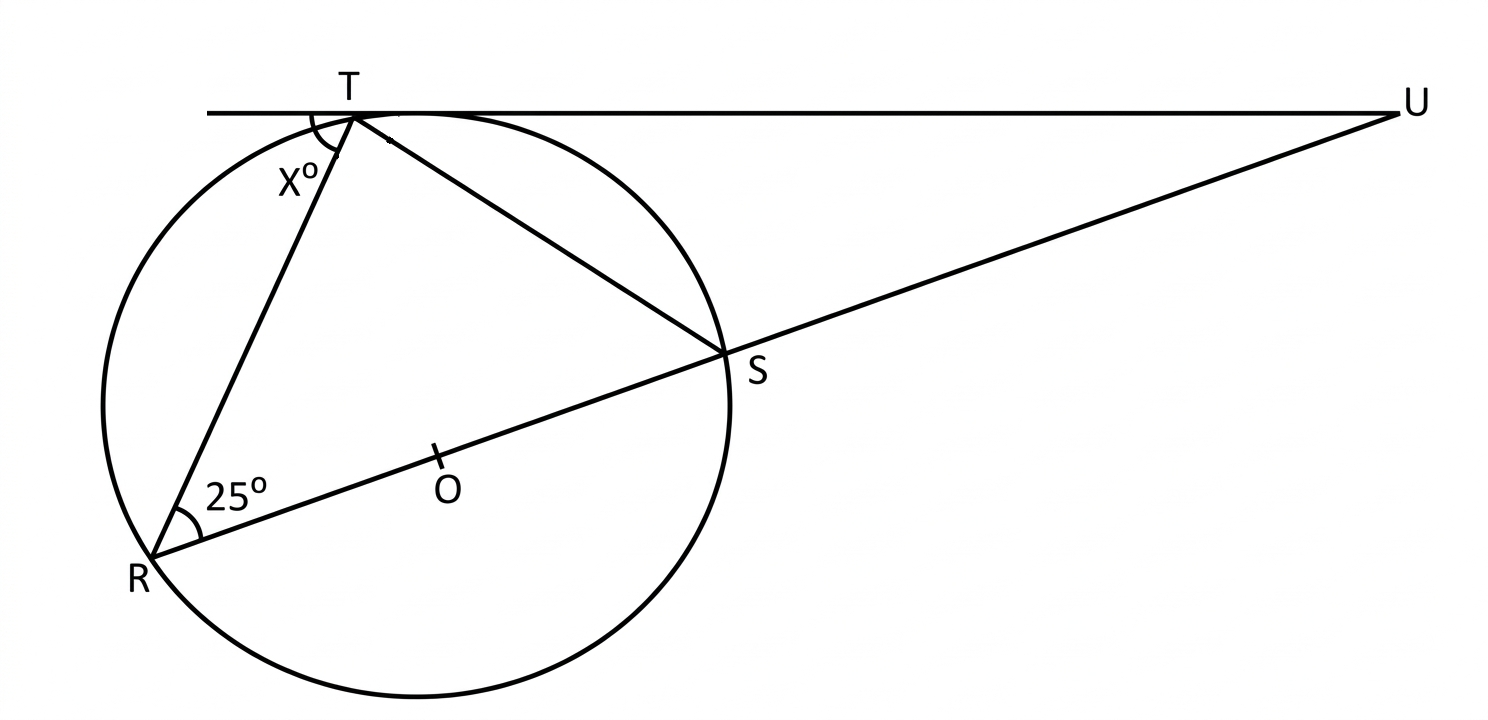
From the diagram above, find x
Show explanation Expand Question

∠RTS = 90 (∠ in semi circle)
∠UTS = 25 (∠ in alternate segment)
X + 90 + 25 = 180(sum of ∠s on a str line)
X + 115 = 180
X = 180 - 115
X = 65

Not clear enough?

12345
In this page
Mathematics 2010 Jamb Examination
Open Model!