
Mathematics 2010 Jamb Examination
Mathematics 2010 Jamb Examination

Question 11
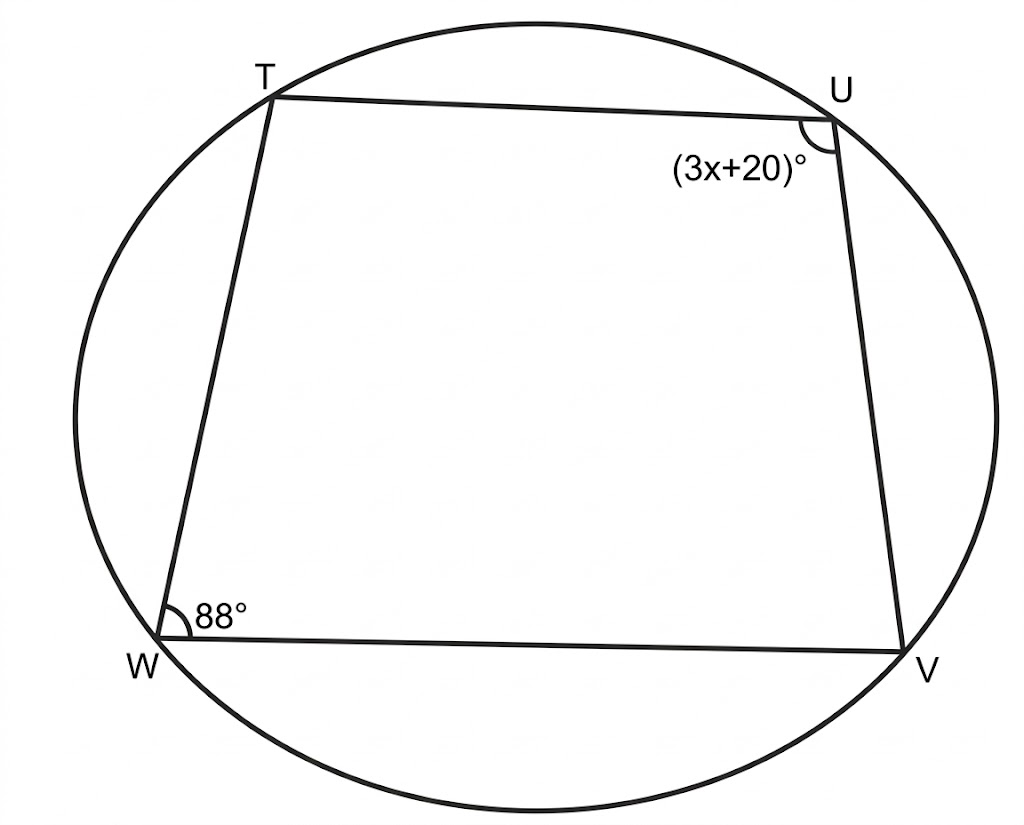
From the cyclic quadrilateral TUVW above, find the value of x
TUVW is a cyclic quad
3x + 20 + 88 = 180 (opp ∠ s of a cyclic quad are supplementary)
3x + 108 = 180
3x = 180 - 108
3x = 72
x = 72/3
x = 24o
3x + 20 + 88 = 180 (opp ∠ s of a cyclic quad are supplementary)
3x + 108 = 180
3x = 180 - 108
3x = 72
x = 72/3
x = 24o
Not clear enough?
Question 12
If two smaller sides of a right angled triangle are 4cm and 5cm, find its area
In a right-angled triangle, the two smaller sides are the base and the perpendicular height (the legs), while the longest side is the hypotenuse. The area of any triangle is calculated as half the product of the base and the vertical height. For a right-angled triangle, this is expressed as: \[ \text{Area} = \frac{1}{2} \times \text{base} \times \text{height} \] Given the sides: \[ \text{base} = 4\text{ cm} \] \[ \text{height} = 5\text{ cm} \] Substituting these values into the formula: \[ \text{Area} = \frac{1}{2} \times 4 \times 5 \] \[ \text{Area} = 2 \times 5 \] \[ \text{Area} = 10\text{ cm}^2 \] This calculation confirms that the space enclosed by the triangle is exactly 10 square centimetres.
Not clear enough?
Question 13
An arc subtends an angle of 50º at the center of circle of radius 6cm. Calculate the area of the sector formed
The area of a sector of a circle is a fraction of the total area of the circle, determined by the ratio of the central angle to the full 360 degrees of the circle. The formula for the area of a sector is:
\[ \text{Area} = \frac{\theta}{360} \times \pi r^2 \]
Given:
\[ \theta = 50^\circ \]
\[ r = 6\text{ cm} \]
\[ \pi \approx \frac{22}{7} \]
Plugging the values into the equation:
\[ \text{Area} = \frac{50}{360} \times \frac{22}{7} \times 6^2 \]
\[ \text{Area} = \frac{5}{36} \times \frac{22}{7} \times 36 \]
\[ \text{Area} = 5 \times \frac{22}{7} \]
\[ \text{Area} = \frac{110}{7} \]
Thus, the area of the sector is 110/7 square centimetres.
Not clear enough?
Question 14
What is the locus of point that is equidistant from points P(1,3) and Q(3,5)?
The locus of points equidistant from two fixed points P and Q is the perpendicular bisector of the line segment PQ.
First, we find the midpoint of PQ:
\[ \text{Midpoint} = \left( \frac{x_1 + x_2}{2}, \frac{y_1 + y_2}{2} \right) = \left( \frac{1 + 3}{2}, \frac{3 + 5}{2} \right) = (2, 4) \]
Next, we find the gradient (slope) of line PQ:
\[ m_1 = \frac{y_2 - y_1}{x_2 - x_1} = \frac{5 - 3}{3 - 1} = \frac{2}{2} = 1 \]
The gradient of the perpendicular bisector (\( m_2 \)) must satisfy \( m_1 \times m_2 = -1 \):
\[ 1 \times m_2 = -1 \Rightarrow m_2 = -1 \]
Now, using the point-slope form with the midpoint (2, 4) and gradient -1:
\[ y - y_1 = m(x - x_1) \]
\[ y - 4 = -1(x - 2) \]
\[ y - 4 = -x + 2 \]
\[ y = -x + 6 \]
The resulting linear equation defines all points that maintain an equal distance from both P and Q.
Not clear enough?
Question 15
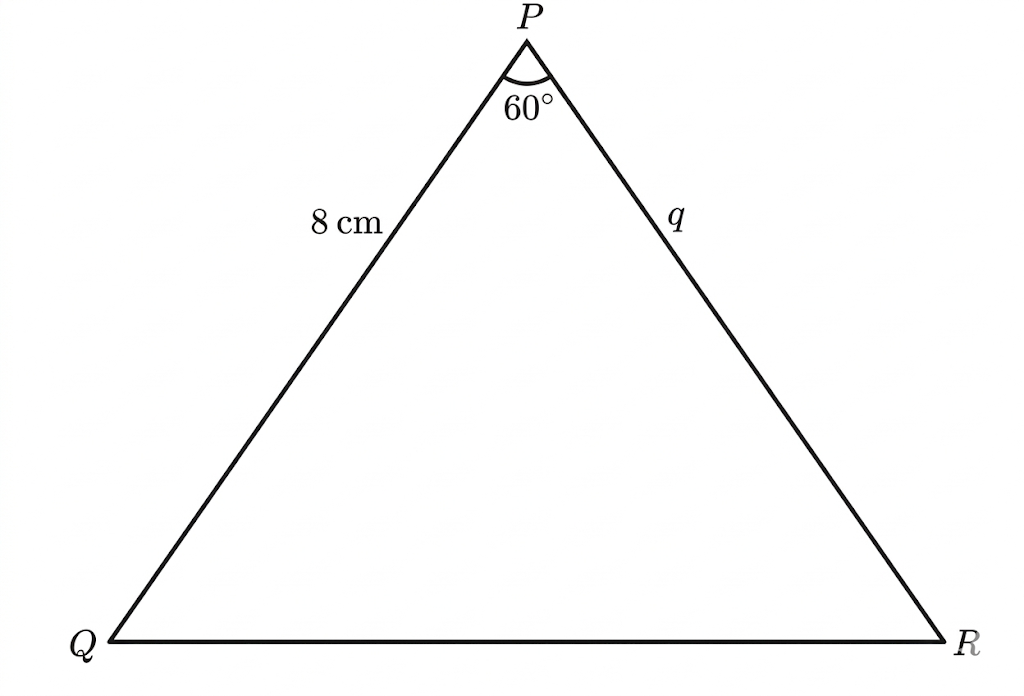
If the area of ΔPQR above is \( 12\sqrt{3} \; \text{cm}^2 \), find the value of q?
Area of a triangle = \(\frac{1}{2}\) ab Sinθ
12√3 = 12 x 8 x q sin 60
12√3 = 4 x q x 3√2
12√3 = 2q√3
q = \(\frac{12√3}{2√3}\)
q = 6cm.
Not clear enough?
Question 16
If \( y = (2x + 1)^3 \) find \( \frac{dy}{dx} \)
To differentiate the function \( y = (2x + 1)^3 \), we must use the Chain Rule. The Chain Rule states that if we have a composite function \( y = f(g(x)) \), then the derivative is:
\[ \frac{dy}{dx} = f'(g(x)) \cdot g'(x) \]
Let \( u = 2x + 1 \). Then \( y = u^3 \).
First, find the derivative of the outer function with respect to \( u \):
\[ \frac{dy}{du} = 3u^2 \]
Next, find the derivative of the inner function \( u \) with respect to \( x \):
\[ \frac{du}{dx} = 2 \]
Now, multiply the two derivatives together:
\[ \frac{dy}{dx} = \frac{dy}{du} \times \frac{du}{dx} \]
\[ \frac{dy}{dx} = 3u^2 \times 2 \]
\[ \frac{dy}{dx} = 6u^2 \]
Substituting back \( u = 2x + 1 \):
\[ \frac{dy}{dx} = 6(2x + 1)^2 \]
This result matches the standard power rule application for composite linear functions.
Not clear enough?
Question 17
Find \( \int(\sin x + 2)dx \)
To solve the integral \( \int(\sin x + 2)dx \), we can use the sum rule for integration, which allows us to integrate each term separately:
\[ \int(\sin x + 2)dx = \int \sin x \, dx + \int 2 \, dx \]
Integrating the first term:
The derivative of \( \cos x \) is \( -\sin x \), so the integral of \( \sin x \) is \( -\cos x \).
\[ \int \sin x \, dx = -\cos x \]
Integrating the second term:
The integral of a constant \( a \) with respect to \( x \) is \( ax \).
\[ \int 2 \, dx = 2x \]
Combining these results and adding the constant of integration \( K \):
\[ \int(\sin x + 2)dx = -\cos x + 2x + K \]
This provides the complete general antiderivative of the function.
Not clear enough?
Question 18
| Marks | 2 | 3 | 4 | 5 | 6 | 7 | 8 |
|---|---|---|---|---|---|---|---|
| No. of students | 3 | 1 | 5 | 2 | 4 | 2 | 3 |
From the table above, if the pass mark is 5, how many students failed the test?
In this context, the pass mark is defined as 5. This means that any student who obtained a mark less than 5 is considered to have failed the test. To find the total number of students who failed, we must sum the frequencies (number of students) for all marks below 5.
Looking at the table, the marks below 5 are:
1. Mark 2: 3 students
2. Mark 3: 1 student
3. Mark 4: 5 students
We add these frequencies together:
\[ \text{Total failed} = 3 + 1 + 5 \]
\[ \text{Total failed} = 9 \]
Therefore, 9 students did not reach the minimum pass mark of 5.
Not clear enough?
Question 19
| Marks | 1 | 2 | 3 | 4 | 5 |
|---|---|---|---|---|---|
| Frequency | 2 | 2 | 8 | 4 | 4 |
The table above shows the marks obtained in a given test.
How many students took the test?
To determine the total number of students who took the test, we need to calculate the sum of the frequencies provided in the table. Each frequency represents the number of students who achieved a specific mark.
The frequencies are as follows:
- For mark 1: 2 students
- For mark 2: 2 students
- For mark 3: 8 students
- For mark 4: 4 students
- For mark 5: 4 students
Summing these values together:
\[ \sum f = 2 + 2 + 8 + 4 + 4 \]
\[ \sum f = 4 + 8 + 4 + 4 \]
\[ \sum f = 12 + 8 \]
\[ \sum f = 20 \]
The total frequency corresponds to the total population of students in the dataset, which is 20.
Not clear enough?
Question 20
| Marks | 1 | 2 | 3 | 4 | 5 |
|---|---|---|---|---|---|
| Frequency | 2 | 2 | 8 | 4 | 4 |
The table above shows the marks obtained in a given test.
Find the mean mark
The mean of a frequency distribution is calculated using the formula:
\[ \bar{x} = \frac{\sum f x}{\sum f} \]
Where \( x \) is the mark and \( f \) is the frequency of that mark.
First, we calculate the sum of the products of marks and frequencies (\( \sum f x \)):
\[ (1 \times 2) + (2 \times 2) + (3 \times 8) + (4 \times 4) + (5 \times 4) \]
\[ = 2 + 4 + 24 + 16 + 20 \]
\[ = 6 + 24 + 16 + 20 \]
\[ = 30 + 16 + 20 \]
\[ = 66 \]
Next, we calculate the total number of students (\( \sum f \)):
\[ 2 + 2 + 8 + 4 + 4 = 20 \]
Finally, divide the total sum of marks by the number of students:
\[ \text{Mean} = \frac{66}{20} \]
\[ \text{Mean} = 3.3 \]
This value represents the average performance of the students in the test.
Not clear enough?
You might like
The basic principle underlying location of industry is the tendency for production of a commodity to be located on the basis of ______
Each of the questions below consists of two words that have a certain relationship to each other.
Select the pair of words.
FOOTBALL : GRIDIRON
A piano wire 50 cm long has a total mass of 10 g and its stretched with a tension of 800 N. Find the frequency of the wire when it sounds its third overtone note.
Clifford pays rent of ₦200 per month for premises. He paid ₦2,800 within the year. Compute the prepayment.