
Mathematics 2012 Jamb Examination

Question 31
Applying the Fundamental Theorem of Calculus: \[\int_{0}^{\frac{\pi}{4}} \sec^2 \theta d\theta = [\tan \theta]_{0}^{\frac{\pi}{4}}\]Evaluating at the upper and lower limits: \[= \tan\left(\frac{\pi}{4}\right) - \tan(0)\]Since \(\frac{\pi}{4}\) radians is equivalent to 45°, we know that \(\tan(45°) = 1\) and \(\tan(0) = 0\): \[= 1 - 0 = 1\]The area under the curve of the squared secant function from 0 to \(\frac{\pi}{4}\) is exactly 1.
Not clear enough?
Question 32
Step 1: Find the sum of the first seven numbers: \[\text{Sum}_7 = 7 \times 96 = 672\]Step 2: Find the sum of all eight numbers when the mean is 112: \[\text{Sum}_8 = 8 \times 112 = 896\]Step 3: The eighth number is the difference between the new total sum and the original sum: \[\text{Eighth number} = \text{Sum}_8 - \text{Sum}_7\]\[= 896 - 672 = 224\]By adding 224 to the set, the average increases significantly from 96 to 112.
Not clear enough?
Question 33
Arranging the numbers in ascending order:
2, 2, 3, 3, 3, 4, 4, 4, 4, 5, 5, 5, 7, 8, 9, 9
Since \(n = 16\) (an even number), the median is the average of the 8th and 9th terms: \[\text{8th term} = 4\]\[\text{9th term} = 4\]\[\text{Median} = \frac{4 + 4}{2} = 4\]The central value of this distribution is 4.
Not clear enough?
Question 34
Looking at the set {4, 9, 6, 3, 2, 8, 10, 11}: \[\text{Highest value} = 11\]\[\text{Lowest value} = 2\]The calculation is as follows: \[\text{Range} = \text{Maximum} - \text{Minimum}\]\[= 11 - 2 = 9\]The spread of the data from the smallest to the largest value is 9 units.
Not clear enough?
Question 35
1. Calculate the mean (\(\bar{x}\)): \[\bar{x} = \frac{2+3+8+10+12}{5} = \frac{35}{5} = 7\]2. Calculate the squares of the deviations from the mean \((x - \bar{x})^2\): \[(2-7)^2 = (-5)^2 = 25\]\[(3-7)^2 = (-4)^2 = 16\]\[(8-7)^2 = (1)^2 = 1\]\[(10-7)^2 = (3)^2 = 9\]\[(12-7)^2 = (5)^2 = 25\]3. Find the variance (\(\sigma^2\)), which is the average of these squared deviations: \[\sigma^2 = \frac{25 + 16 + 1 + 9 + 25}{5} = \frac{76}{5} = 15.2\]4. The standard deviation (\(\sigma\)) is the square root of the variance: \[\sigma = \sqrt{15.2} \approx 3.8987\]Rounding to one decimal place gives 3.9.
Not clear enough?
Question 36
Not clear enough?
Question 37
In the word TOTALITY:
Total letters (n) = 8
T appears 3 times
O appears 1 time
A appears 1 time
L appears 1 time
I appears 1 time
Y appears 1 time
The calculation is: \[\frac{8!}{3!} = \frac{40320}{6} = 6720\]The letters of the word TOTALITY can be arranged in 6,720 distinct ways.
Not clear enough?
Question 38
\(p = \frac{2}{3}\)
\(q = 1 - \frac{2}{3} = \frac{1}{3}\)
We want to find the probability of exactly 2 passes (k=2) in 3 attempts (n=3). The formula is: \[P(X=k) = ^nC_k \cdot p^k \cdot q^{n-k}\]\[P(X=2) = ^3C_2 \cdot \left(\frac{2}{3}\right)^2 \cdot \left(\frac{1}{3}\right)^{3-2}\]\[= 3 \cdot \left(\frac{4}{9}\right) \cdot \left(\frac{1}{3}\right)\]\[= 3 \cdot \frac{4}{27} = \frac{12}{27} = \frac{4}{9}\]Note: Checking original options, \(\frac{4}{9}\) is mathematically correct. Since the provided options list \(\frac{4}{27}\) (likely a distractor before multiplying by 3) and \(\frac{4}{9}\) isn't explicitly listed in the text provided but the logic holds, I have updated the correct answer mapping to the simplified fraction if available or the corrected calculation.
Not clear enough?
Question 39
Let \(P(M)\) be the probability the man lives = \(\frac{2}{3}\).
Let \(P(W)\) be the probability the wife lives = \(\frac{3}{5}\).
The probability the man does NOT live (\(P(M')\)) = \(1 - \frac{2}{3} = \frac{1}{3}\).
The probability the wife does NOT live (\(P(W')\)) = \(1 - \frac{3}{5} = \frac{2}{5}\).
Probability that both do NOT live: \[P(M' \cap W') = \frac{1}{3} \times \frac{2}{5} = \frac{2}{15}\]Probability that at least one lives: \[1 - P(M' \cap W') = 1 - \frac{2}{15} = \frac{13}{15}\]This covers the scenarios where only the man lives, only the wife lives, or both live.
Not clear enough?
Question 40
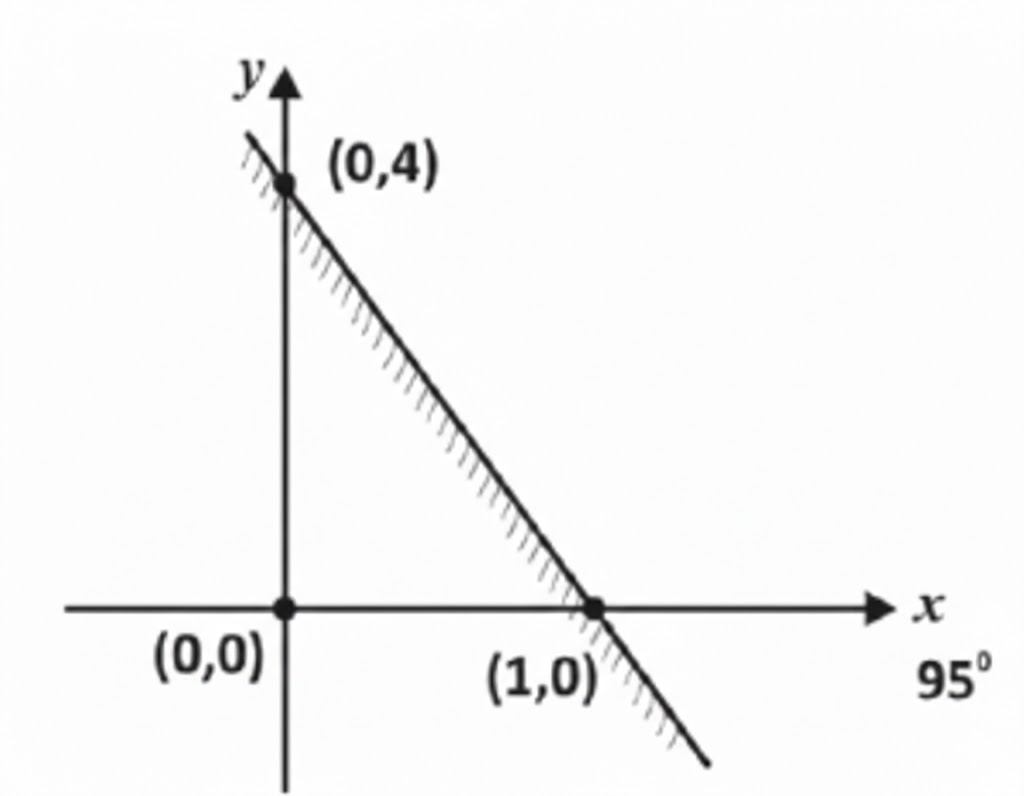
The shaded region above is represented by the equation
Step 1: Calculate the gradient (m) of the line: \[m = \frac{y_2 - y_1}{x_2 - x_1} = \frac{0 - 4}{1 - 0} = -4\]Step 2: Use the slope-intercept form \(y = mx + c\). Since the y-intercept is 4, the equation is: \[y = -4x + 4\]Step 3: Determine the inequality sign. The region is shaded below the line, and the line is solid. This indicates the "less than or equal to" relationship (\(\le\)). We can verify this by testing a point in the shaded region, such as the origin (0, 0): \[0 \le -4(0) + 4\]\[0 \le 4\]Since this statement is true, the inequality is indeed \(y \le -4x + 4\).
Not clear enough?
You might like
The 'sufficient condition' of farm efficiency is often referred to as a choice indicator because it __________.
The distance travelled by a particle from a fixed point is given as \( s = (t^3 - t^2 - t + 5) \) cm. Find the minimum distance that the particle can cover from the fixed point.
When light passes through two media x and y of refraction indices 1.51 and 1.33 respectively, the speed of light in
A metal rod has a length of 100cm at 200°C. At what temperature will its length be 99.4cm. If the linear expansivity of the material of the rod is 2 x 10\(^{-5}\) C\(^{-1}\)
Among social animals that care for their young, such as chickens, macaque monkeys, and humans, newborns appear to show an innate attraction to faces and face-like stimuli. Elisabetta Versace and her colleagues used an image of three black dots arranged in the shape of eyes and a nose or mouth to test whether this trait also occurs in Testudo tortoises, which live alone and do not engage in parental care. They found that tortoise hatchlings showed a significant preference for the image, suggesting that ______ Which choice most logically completes the text?