
Mathematics 2012 Jamb Examination
Mathematics 2012 Jamb Examination

Question 41
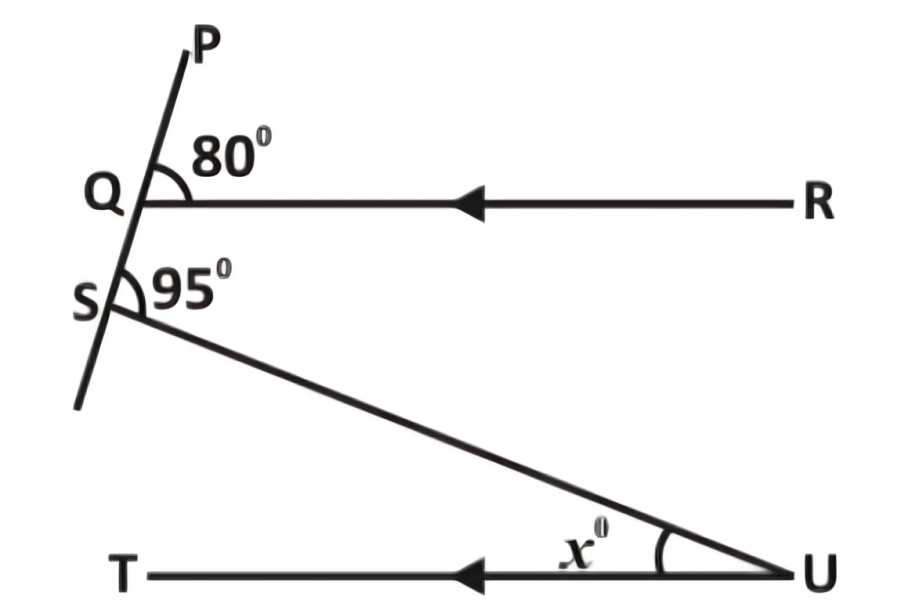
In diagram above, QR//TU, ∠ PQR = 80° and ∠ PSU = 95°. Calculate ∠ SUT.
< PQR = < PTU = 80°
< TSU = 85°
x = 180° - (80° + 85°)
= 15°
Not clear enough?
Question 42
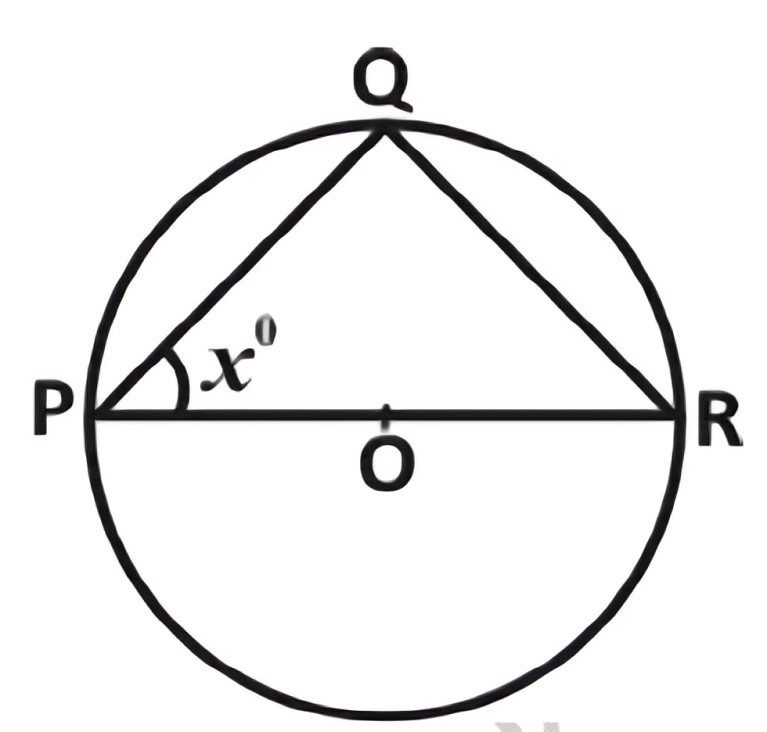
In the diagram above, PQR is a circle centre O. If ∠ QPR is x°, find ∠ QRP.
To find ∠ QRP, we must apply circle geometry theorems. The diagram shows that QR is a diameter of the circle because it passes through the centre O. A fundamental theorem in circle geometry states that the angle subtended by a diameter at the circumference is a right angle (90°).
Therefore, ∠ PQR = 90°. In triangle PQR, the sum of the interior angles must equal 180°:\[\angle QPR + \angle PQR + \angle QRP = 180^\circ\]Substituting the known values (\(\angle QPR = x^\circ\) and \(\angle PQR = 90^\circ\)):\[x^\circ + 90^\circ + \angle QRP = 180^\circ\]To isolate ∠ QRP, we subtract \(x^\circ\) and 90° from both sides:\[\angle QRP = 180^\circ - 90^\circ - x^\circ\]\[\angle QRP = 90^\circ - x^\circ\]\[\angle QRP = (90 - x)^\circ\]The angle at vertex R is the complement of the angle at vertex P.
Therefore, ∠ PQR = 90°. In triangle PQR, the sum of the interior angles must equal 180°:\[\angle QPR + \angle PQR + \angle QRP = 180^\circ\]Substituting the known values (\(\angle QPR = x^\circ\) and \(\angle PQR = 90^\circ\)):\[x^\circ + 90^\circ + \angle QRP = 180^\circ\]To isolate ∠ QRP, we subtract \(x^\circ\) and 90° from both sides:\[\angle QRP = 180^\circ - 90^\circ - x^\circ\]\[\angle QRP = 90^\circ - x^\circ\]\[\angle QRP = (90 - x)^\circ\]The angle at vertex R is the complement of the angle at vertex P.
Not clear enough?
Question 43
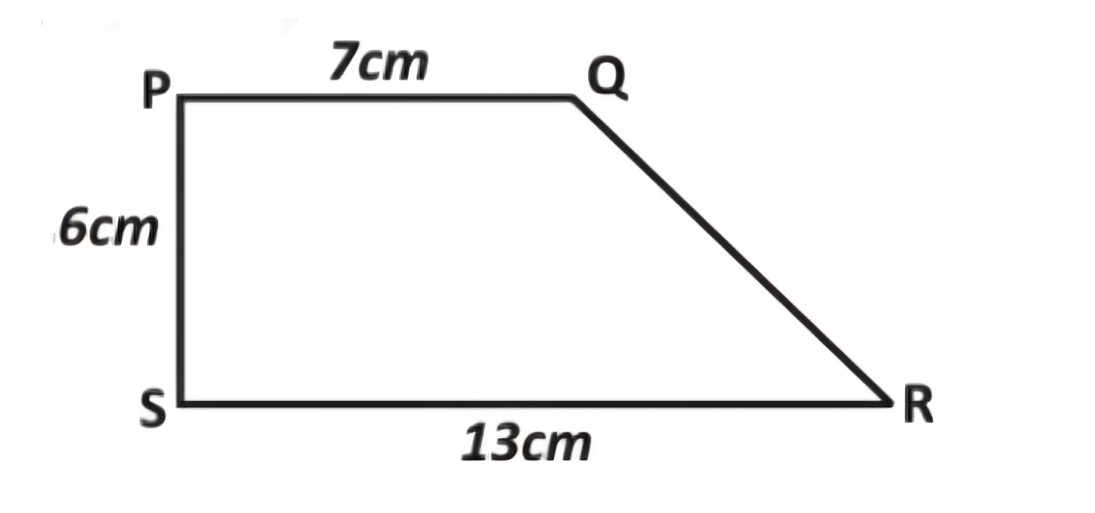
Find the area of the trapezium above.
To calculate the area of a trapezium, we use the formula:\[\text{Area} = \frac{1}{2}(a + b)h\]where \(a\) and \(b\) are the lengths of the parallel sides and \(h\) is the perpendicular height. From the diagram, we have the following values: top parallel side (a) = 7 cm, bottom parallel side (b) = 13 cm, and height (h) = 6 cm.
Substituting these values into the formula:\[\text{Area} = \frac{1}{2}(7 + 13) \times 6\]\[\text{Area} = \frac{1}{2}(20) \times 6\]\[\text{Area} = 10 \times 6\]\[\text{Area} = 60 \; \text{cm}^2\]The total surface area enclosed by the trapezium is 60 square centimetres.
Substituting these values into the formula:\[\text{Area} = \frac{1}{2}(7 + 13) \times 6\]\[\text{Area} = \frac{1}{2}(20) \times 6\]\[\text{Area} = 10 \times 6\]\[\text{Area} = 60 \; \text{cm}^2\]The total surface area enclosed by the trapezium is 60 square centimetres.
Not clear enough?
Question 44
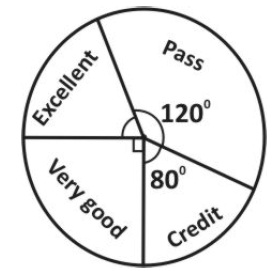
The grades of 36 students in a class test are as shown in the pie chart above. How many students have excellent?
To find the number of students who achieved an 'Excellent' grade, we first need to determine the angle of the 'Excellent' sector in the pie chart. A full circle represents 360°.
The given angles are:
Very Good = 80°
Good = 120°
Credit = 90°
The angle for 'Excellent' is calculated as: \[\text{Angle} = 360^\circ - (80^\circ + 120^\circ + 90^\circ)\]\[\text{Angle} = 360^\circ - 290^\circ = 70^\circ\]Now, we calculate the number of students. Since the total number of students is 36, the number of 'Excellent' students is proportional to its sector angle: \[\text{Number of students} = \frac{\text{Sector Angle}}{360^\circ} \times \text{Total Students}\]\[\text{Number of students} = \frac{70^\circ}{360^\circ} \times 36\]\[\text{Number of students} = \frac{70}{10} = 7\]Therefore, 7 students achieved the 'Excellent' grade.
Not clear enough?
Question 45
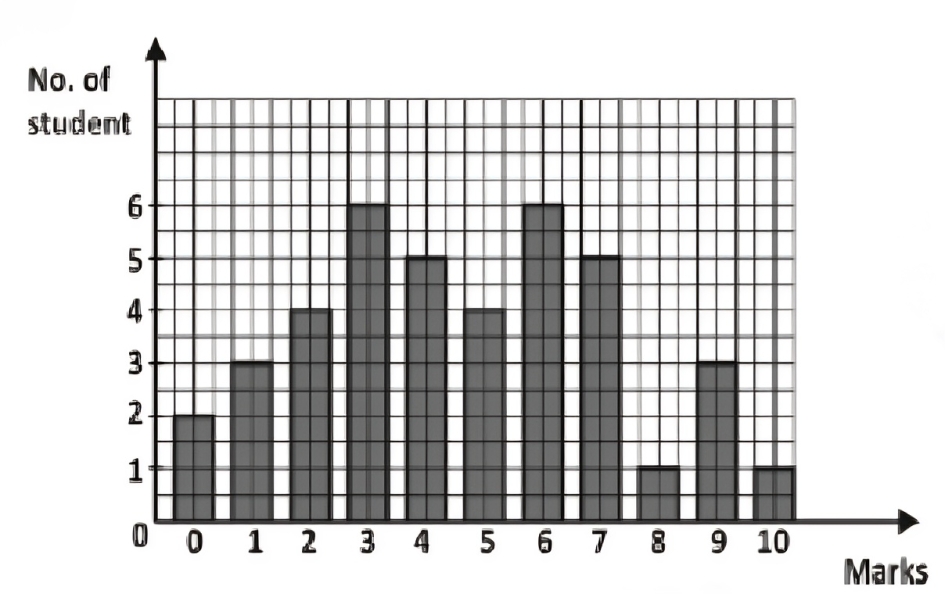
The bar chart above shows the distribution of marks in a class test. If the pass mark is 5, what percentage of students failed the test?
To find the percentage of students who failed, we first determine the total number of students and the number of students who scored below the pass mark (5).
From the bar chart, the frequency for each mark is:
From the bar chart, the frequency for each mark is:
Number that score less than 5: 5 + 6 + 4 + 3 + 2 = 20
Total number of students: 5 + 6 + 4 + 3 + 2 + 4 + 6 + 5 + 1 + 3 + 1 = 40.
%age of students that failed: 2040×100
Not clear enough?
Question 46
A circular arc subtends angle 150° at the centre of a circle of radius 12cm. Calculate the area of the sector of the arc.
To calculate the area of a sector of a circle, we use the formula that represents a fraction of the total area of the circle based on the subtended angle \(\theta\). The formula is:\[\text{Area of sector} = \frac{\theta}{360} \times \pi r^2\]Given that the radius \(r = 12\) cm and the angle \(\theta = 150^\circ\), we substitute these values into the formula: \[\text{Area} = \frac{150}{360} \times \pi \times (12)^2\]First, simplify the fraction \(\frac{150}{360}\) by dividing both numerator and denominator by 30, which gives \(\frac{5}{12}\). Then calculate the square of the radius: \[\text{Area} = \frac{5}{12} \times \pi \times 144\]Now, divide 144 by 12: \[\text{Area} = 5 \times \pi \times 12\]\[\text{Area} = 60\pi \; \text{cm}^2\]The space enclosed by the arc and the two radii is 60π square centimetres.
Not clear enough?
Question 47
A man stands on a tree 150 cm high and sees a boat at an angle of depression of 74°. Find the distance of the boat from the base of the tree.
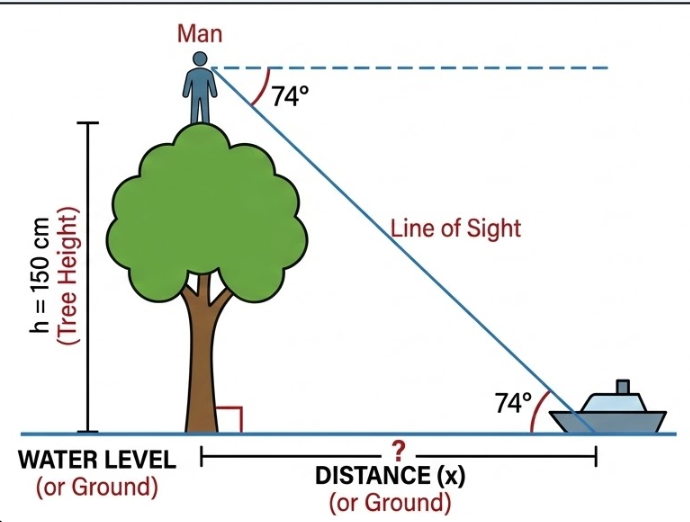
Using the tangent ratio: \[\tan \theta = \frac{\text{Opposite}}{\text{Adjacent}}\]Let \(x\) be the distance from the base of the tree. Substituting the known values: \[\tan 74^\circ = \frac{150}{x}\]To solve for \(x\), we rearrange the equation: \[x = \frac{150}{\tan 74^\circ}\]Using a calculator or mathematical table, \(\tan 74^\circ \approx 3.4874\): \[x = \frac{150}{3.4874}\]\[x \approx 43.01 \; \text{cm}\]Rounding to the nearest whole number, the boat is approximately 43 cm from the base of the tree.
Not clear enough?
Question 48
Find \(\dfrac{dy}{dx}\) if \(y = \cos x\).
The differentiation of the cosine function is a fundamental rule in calculus: \[\frac{d}{dx}(\cos x) = -\sin x\]Conversely, the derivative of \(\sin x\) is \(\cos x\).
Not clear enough?
You might like
The strategy adopted by a flrm that ceases to operate at one or more locations because of inactivity is
Choose the word that is opposite in meaning to the underlined word.
It is inconceivable that the sun shone in the night?
The average of 5 quantities is 10 and the average of 3 of them is 9. What is the average of the remaining 2?
Which of the reproductive system in mammals secretes a part of the seminal fluid which raises the pH of the fluid in the female reproductive system?