
Mathematics 2013 Jamb Examination
Mathematics 2013 Jamb Examination

Question 31
A basket contains 9 apples, 8 bananas and 7 oranges. A fruit is picked from the basket, find the probability that it is neither an apple nor an orange.
To find the probability that a picked fruit is neither an apple nor an orange, we must first determine the total number of fruits in the basket and the number of fruits that satisfy the given condition.
Step 1: Calculate the total number of fruits in the basket:\[\text{Total} = 9 \text{ (apples)} + 8 \text{ (bananas)} + 7 \text{ (oranges)} = 24\]Step 2: Identify the fruits that are neither apples nor oranges. In this basket, if a fruit is not an apple and not an orange, it must be a banana. The number of bananas is 8.
Step 3: Calculate the probability using the formula:\[P(\text{neither apple nor orange}) = \frac{\text{Number of bananas}}{\text{Total number of fruits}}\]\[P = \frac{8}{24}\]Step 4: Simplify the fraction by dividing both the numerator and the denominator by their greatest common divisor, which is 8:\[P = \frac{1}{3}\]Thus, there is a 1 in 3 chance of picking a fruit that is neither an apple nor an orange.
Not clear enough?
Question 32
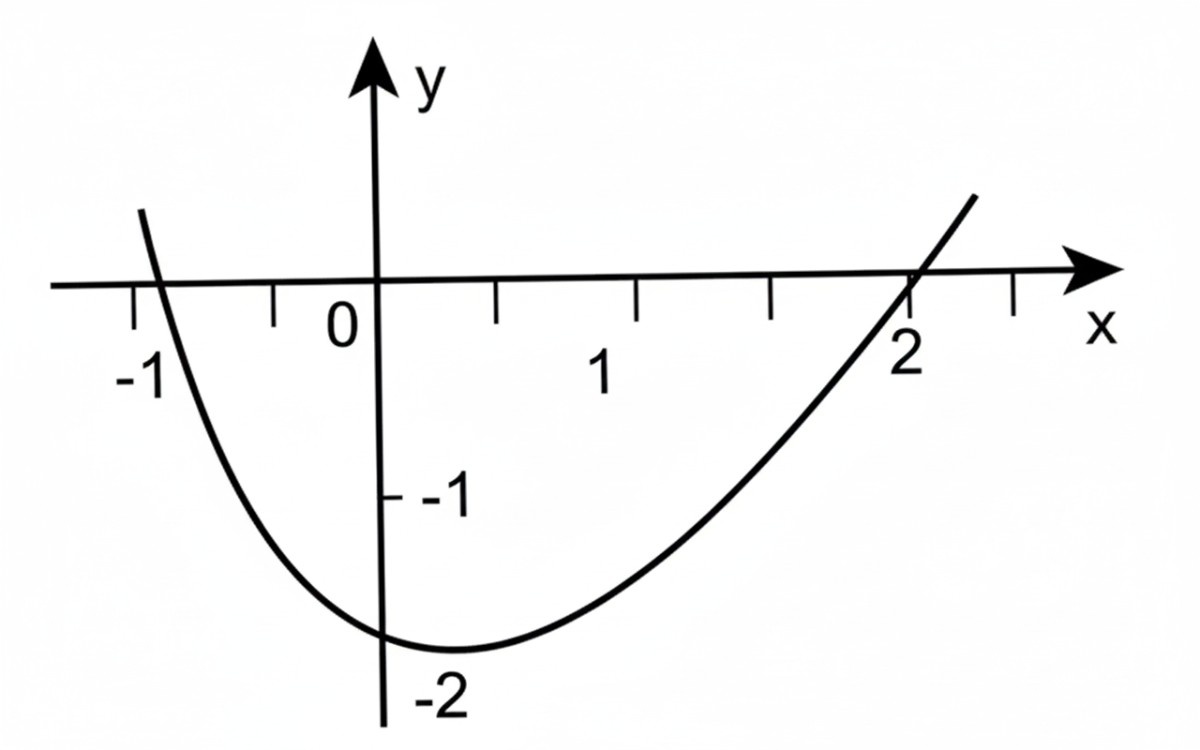
The graph above is correctly represented by
To determine the correct quadratic equation for the graph, we identify the key features: the x-intercepts and the y-intercept. From the graph, the curve crosses the x-axis at \(x = -1\) and \(x = 2\), and the y-axis at \(y = -2\).
If the x-intercepts are \(x_1 = -1\) and \(x_2 = 2\), the quadratic equation can be written in factored form as: \[ y = a(x - x_1)(x - x_2) \] \[ y = a(x - (-1))(x - 2) \] \[ y = a(x + 1)(x - 2) \] To find the value of \(a\), we use the y-intercept \((0, -2)\). Substituting \(x = 0\) and \(y = -2\) into the equation: \[ -2 = a(0 + 1)(0 - 2) \] \[ -2 = a(1)(-2) \] \[ -2 = -2a \implies a = 1 \] Now, substitute \(a = 1\) back into the factored form and expand the expression: \[ y = 1(x + 1)(x - 2) \] \[ y = x^2 - 2x + x - 2 \] \[ y = x^2 - x - 2 \] This matches the standard form of the quadratic function shown in the graph.
If the x-intercepts are \(x_1 = -1\) and \(x_2 = 2\), the quadratic equation can be written in factored form as: \[ y = a(x - x_1)(x - x_2) \] \[ y = a(x - (-1))(x - 2) \] \[ y = a(x + 1)(x - 2) \] To find the value of \(a\), we use the y-intercept \((0, -2)\). Substituting \(x = 0\) and \(y = -2\) into the equation: \[ -2 = a(0 + 1)(0 - 2) \] \[ -2 = a(1)(-2) \] \[ -2 = -2a \implies a = 1 \] Now, substitute \(a = 1\) back into the factored form and expand the expression: \[ y = 1(x + 1)(x - 2) \] \[ y = x^2 - 2x + x - 2 \] \[ y = x^2 - x - 2 \] This matches the standard form of the quadratic function shown in the graph.
Not clear enough?
Question 33
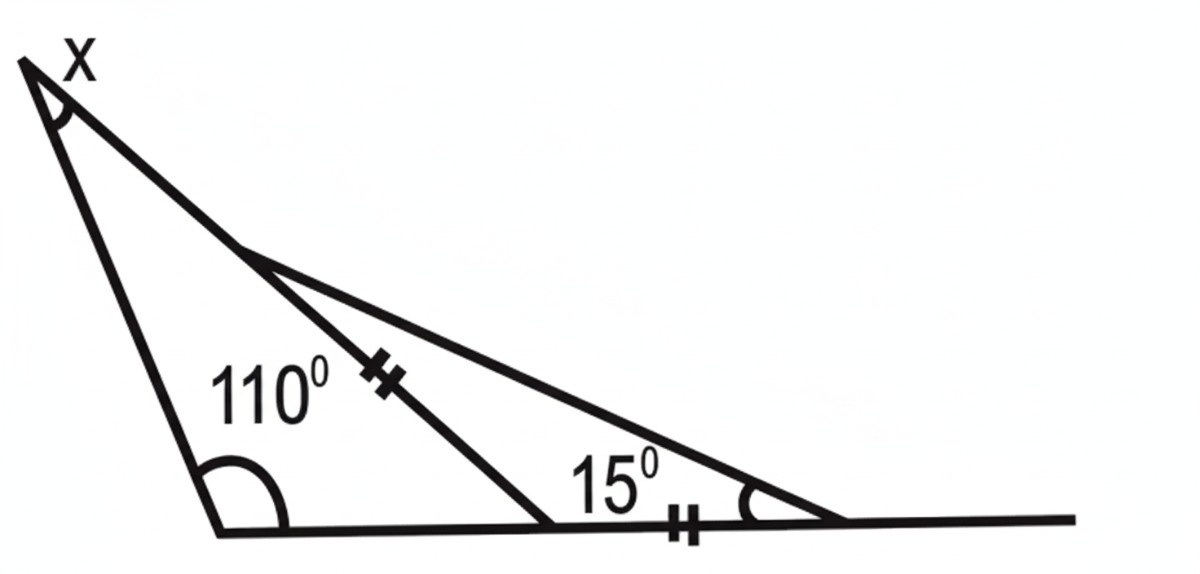
In the diagram given, find the value of x.
In the diagram above, < CDE = < CED = 15o
(base < s of isos. △)
< ECD = 180o - (15 + 15)o
= 180o - 30o = 150o
But x + 110o = 150o
(Sum of opp. interior < s of a△ = opp. exterior < )
x = 150o - 110o = 40o
(base < s of isos. △)
< ECD = 180o - (15 + 15)o
= 180o - 30o = 150o
But x + 110o = 150o
(Sum of opp. interior < s of a△ = opp. exterior < )
x = 150o - 110o = 40o
Not clear enough?
Question 34
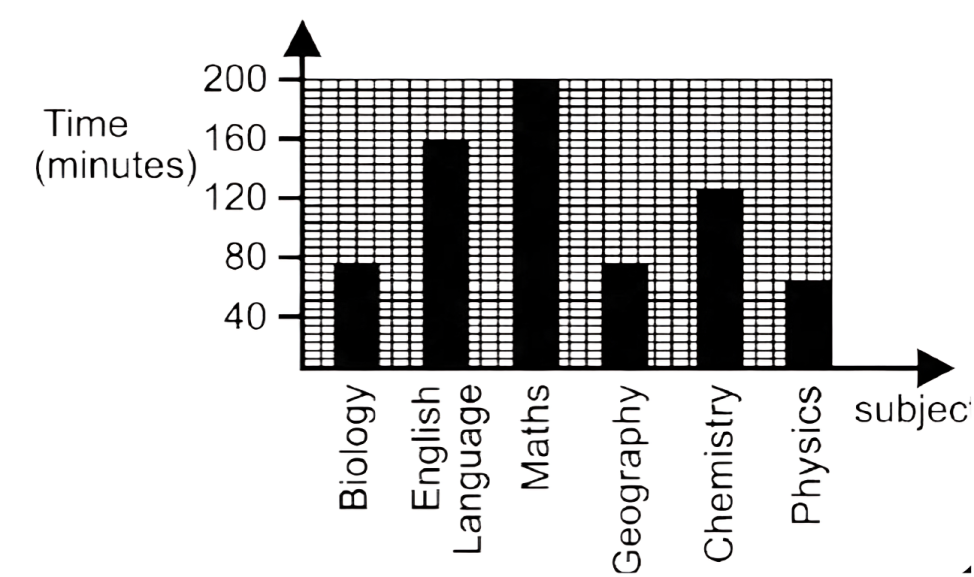
The bar chart above shows the allotment of time(in minutes) per week for selected subjects in a certain school. What is the total time allocated to the six subjects per week?
To find the total time allocated, we sum the minutes for each subject shown on the bar chart:
* Mathematics: 180
* English: 120
* Biology: 80
* Chemistry: 100
* Physics: 120
* Geography: 120
Summing these values: \[ 180 + 120 + 80 + 100 + 120 + 120 = 720 \text{ minutes} \]
* Mathematics: 180
* English: 120
* Biology: 80
* Chemistry: 100
* Physics: 120
* Geography: 120
Summing these values: \[ 180 + 120 + 80 + 100 + 120 + 120 = 720 \text{ minutes} \]
Not clear enough?
Question 35
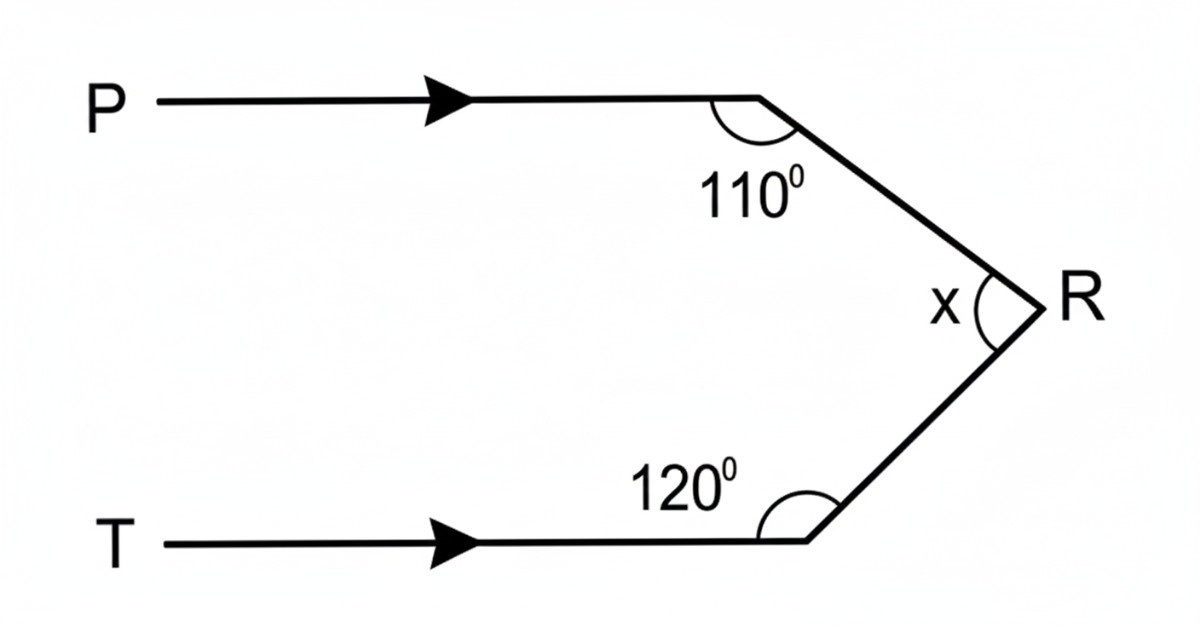
The value x in the figure given is
Sum of the angles in a triangle = 180°
180° - x + 60 + 70 = 180
130° - x = 180° - 180° = 0°
x = 130°
Not clear enough?
Question 36
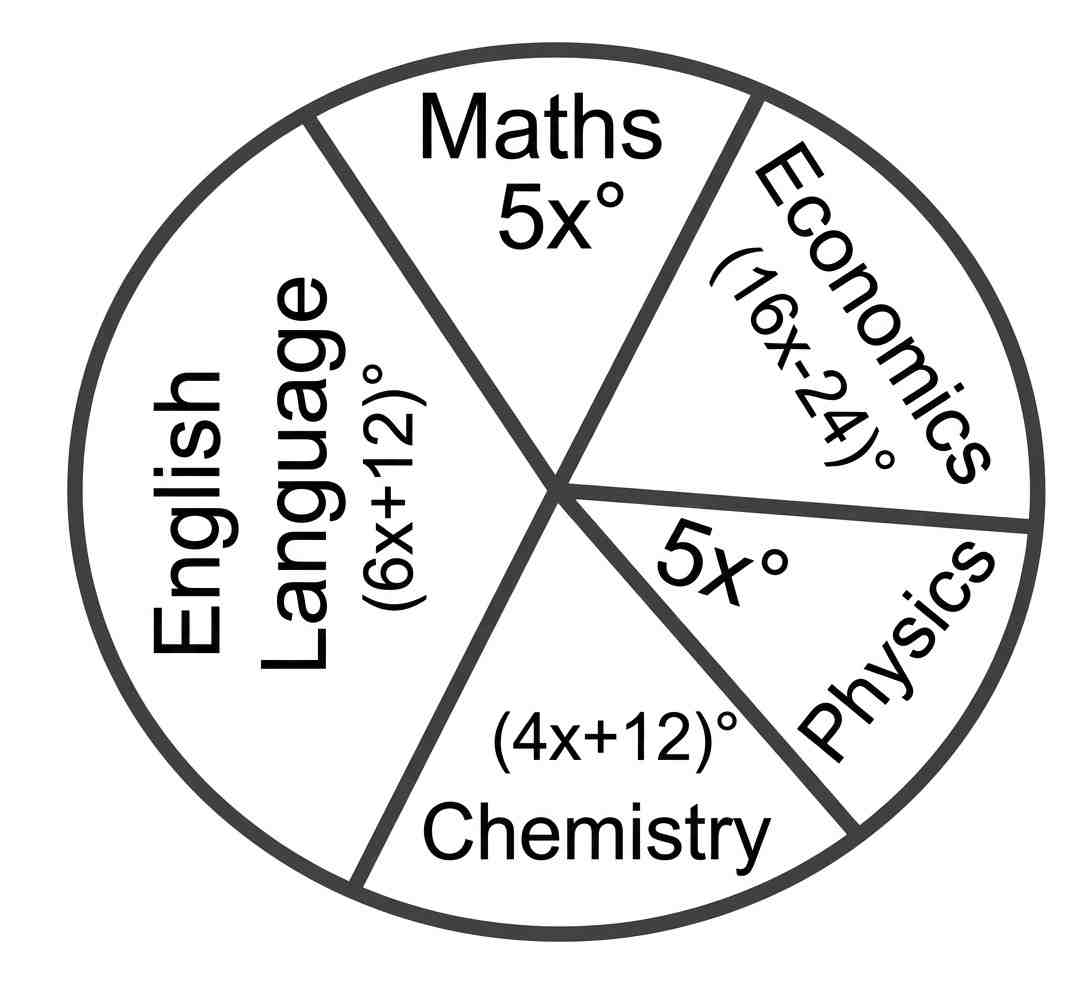
The pie chart above shows the statistical distribution of 80 students in five subjects in an examination. Calculate how many student offer Mathematics.
5x° + (16x - 24)° + 5x° + (4x + 12)° + (6x + 12)° = 360°
36x° - 24 + 12 + 12 = 360°
36x° = 360°
x° = \(\dfrac{360°}{36} = 10°\)
Thus, the angle of sector representing Mathematics is 5 x 10° = 50°. Hence the number of students who offer mathematics is
\[\frac{50}{360}×80≈11\]
Not clear enough?
Question 37
If the angles of a quadrilateral are \((3y + 10)^\circ\), \((2y + 30)^\circ\), \((y + 20)^\circ\) and \(4y^\circ\). Find the value of y.
The sum of the interior angles of any quadrilateral is always 360°. Therefore:\[(3y + 10) + (2y + 30) + (y + 20) + 4y = 360\]Combine like terms:\[10y + 60 = 360\]\[10y = 300\]\[y = 30^\circ\]
Not clear enough?
Question 38
A square tile has side 30 cm. How many of these tiles will cover a rectangular floor of length 7.2m and width 4.2m?
First, convert all measurements to centimeters: Length = 720 cm, Width = 420 cm.
Area of floor = \(720 \times 420 = 302,400 \text{ cm}^2\).
Area of one tile = \(30 \times 30 = 900 \text{ cm}^2\).
Number of tiles = \(\dfrac{302,400}{900} = 336\).
Area of floor = \(720 \times 420 = 302,400 \text{ cm}^2\).
Area of one tile = \(30 \times 30 = 900 \text{ cm}^2\).
Number of tiles = \(\dfrac{302,400}{900} = 336\).
Not clear enough?
Question 39
Find the length of a chord which subtends an angle of 90° at the centre of a circle whose radius is 8 cm.
In a circle, a chord and two radii form an isosceles triangle. Since the angle is 90°, it is a right-angled isosceles triangle. Using Pythagoras theorem where the chord is the hypotenuse:\[c^2 = r^2 + r^2 = 8^2 + 8^2 = 64 + 64 = 128\]\[c = \sqrt{128} = \sqrt{64 \times 2} = 8\sqrt{2} \text{ cm}\]
Not clear enough?
Question 40
A chord of a circle subtends an angle of 120° at the centre of a circle of diameter \(4\sqrt{3}\) cm. Calculate the area of the major sector.
Radius \(\displaystyle r = \frac{\text{diameter}}{2} = 2\sqrt{3}\).
The minor sector angle is 120°, so the major sector angle is \(360^\circ - 120^\circ = 240^\circ\).\[\text{Area} = \frac{240}{360} \times \pi r^2 = \frac{2}{3} \times \pi \times (2\sqrt{3})^2\]\[\text{Area} = \frac{2}{3} \times \pi \times 12 = 8\pi \text{ cm}^2\]
The minor sector angle is 120°, so the major sector angle is \(360^\circ - 120^\circ = 240^\circ\).\[\text{Area} = \frac{240}{360} \times \pi r^2 = \frac{2}{3} \times \pi \times (2\sqrt{3})^2\]\[\text{Area} = \frac{2}{3} \times \pi \times 12 = 8\pi \text{ cm}^2\]
Not clear enough?
You might like
This question is from the novel The Last Days at Forcados High school.
What was the early morning surprise Jimi get while he was still half-asleep?
Choose the most appropriate option for the gap labelled [....14.....] in the passage.
The referee sometimes allows the bout to go on for long so that one of the ...14... is reduced to a human punch bag.
Each of the questions below consists of two words that have a certain relationship to each other.
Select the pair of words.
(Question incomplete but inferred as a verb-action relationship set)
System analysis and design phase of software development life cycle includes which of the following?