
Mathematics 2013 Jamb Examination
Mathematics 2013 Jamb Examination

Question 41
The locus of the points which is equidistant from the line PQ forms a
The locus of points at a constant distance from a straight line consists of two lines, one on either side of the original line, that never meet it. Since every point on these lines maintains the same perpendicular distance from PQ, they are by definition parallel to PQ. Therefore, the resulting shape is a pair of parallel lines.
Not clear enough?
Question 42
If the midpoint of the line PQ is (2, 3) and the point P is (-2, 1), find the coordinate of the point Q.
The midpoint formula is given by: \(\displaystyle M = \left( \frac{x_1 + x_2}{2}, \frac{y_1 + y_2}{2} \right) \).
Given \( M = (2, 3) \) and \( P = (-2, 1) \), let \( Q = (x, y) \).
For the x-coordinate: \(\displaystyle 2 = \frac{-2 + x}{2} \implies 4 = -2 + x \implies x = 6 \).
For the y-coordinate: \( \displaystyle3 = \frac{1 + y}{2} \implies 6 = 1 + y \implies y = 5 \).
Thus, the coordinates of Q are (6, 5).
Not clear enough?
Question 43
Find the equation of the perpendicular bisector of the line joining P(2, -3) to Q(-5, 1)
Step 1: Find the midpoint of PQ: \(\displaystyle \left( \frac{2-5}{2}, \frac{-3+1}{2} \right) = (-1.5, -1) \).
Step 2: Find the gradient of PQ (\( m_1 \)): \(\displaystyle \frac{1 - (-3)}{-5 - 2} = \frac{4}{-7} \).
Step 3: The gradient of the perpendicular bisector (\( m_2 \)) is the negative reciprocal: \( m_2 = \frac{7}{4} \).
Step 4: Use the point-slope form \( y - y_1 = m(x - x_1) \):\[ y - (-1) = \frac{7}{4}(x - (-1.5)) \]\[ y + 1 = \frac{7}{4}(x + 1.5) \]\[ 4(y + 1) = 7(x + 1.5) \implies 4y + 4 = 7x + 10.5 \]Multiply by 2 to clear decimals: \[ 8y + 8 = 14x + 21 \implies 8y - 14x - 13 = 0 \].
Not clear enough?
Question 44
In triangle PQR, q = 8 cm, r = 6 cm and \( \cos P = \frac{1}{12} \). Calculate the value of p.
We use the Cosine Rule: \( p^2 = q^2 + r^2 - 2qr \cos P \).
Substitute the given values:\[ p^2 = 8^2 + 6^2 - 2(8)(6)\left(\frac{1}{12}\right) \]\[ p^2 = 64 + 36 - 96\left(\frac{1}{12}\right) \]\[ p^2 = 100 - 8 = 92 \]There seems to be a discrepancy in the options provided in the source text. Based on the calculation \( p = \sqrt{92} \), option C (\( 9\sqrt{2} \)) is approximately 12.7, while \( \sqrt{92} \) is roughly 9.6. However, if \( \cos P = \frac{1}{12} \) was meant to be a different value or the calculation results in 100, the answer would change. Re-checking: \( 100 - 8 = 92 \). If the question intended \( p^2 = 100 \), then \( p = 10 \).
Substitute the given values:\[ p^2 = 8^2 + 6^2 - 2(8)(6)\left(\frac{1}{12}\right) \]\[ p^2 = 64 + 36 - 96\left(\frac{1}{12}\right) \]\[ p^2 = 100 - 8 = 92 \]There seems to be a discrepancy in the options provided in the source text. Based on the calculation \( p = \sqrt{92} \), option C (\( 9\sqrt{2} \)) is approximately 12.7, while \( \sqrt{92} \) is roughly 9.6. However, if \( \cos P = \frac{1}{12} \) was meant to be a different value or the calculation results in 100, the answer would change. Re-checking: \( 100 - 8 = 92 \). If the question intended \( p^2 = 100 \), then \( p = 10 \).
Not clear enough?
Question 45
If \(\displaystyle \tan \theta = \frac{3}{4} \), find the value of \( \sin \theta + \cos \theta \).
If \( \displaystyle\tan \theta = \frac{\text{Opposite}}{\text{Adjacent}} = \frac{3}{4} \), we can find the hypotenuse using Pythagoras: \[ \text{Hypotenuse} = \sqrt{3^2 + 4^2} = \sqrt{9 + 16} = 5 \]Now find sine and cosine:
\(\displaystyle \sin \theta = \frac{3}{5} \) and \(\displaystyle \cos \theta = \frac{4}{5} \).
Adding them together: \[ \frac{3}{5} + \frac{4}{5} = \frac{7}{5} = 1\frac{2}{5} \].
\(\displaystyle \sin \theta = \frac{3}{5} \) and \(\displaystyle \cos \theta = \frac{4}{5} \).
Adding them together: \[ \frac{3}{5} + \frac{4}{5} = \frac{7}{5} = 1\frac{2}{5} \].
Not clear enough?
Question 46
Integrate \(\displaystyle\int \frac{1+x}{x^3} dx\)
To integrate this expression, we first split the fraction into two separate terms:\[ \int \left( \frac{1}{x^3} + \frac{x}{x^3} \right) dx = \int \left( x^{-3} + x^{-2} \right) dx \]Next, we apply the power rule for integration, \(\int x^n dx = \frac{x^{n+1}}{n+1} + k\):\[ \frac{x^{-3+1}}{-3+1} + \frac{x^{-2+1}}{-2+1} + k \]\[ = \frac{x^{-2}}{-2} + \frac{x^{-1}}{-1} + k \]\[ = -\frac{1}{2x^2} - \frac{1}{x} + k \]This result accounts for both the inverse square and inverse linear components of the function.
Not clear enough?
Question 47
Evaluate \(\displaystyle \int_{0}^{\pi/2} \sin x \, dx\)
To evaluate a definite integral, we first find the antiderivative of the function. The integral of \(\sin x\) is \(-\cos x\).
Now, we apply the Fundamental Theorem of Calculus by evaluating at the upper and lower limits:\[ [-\cos x]_{0}^{\pi/2} = (-\cos(\pi/2)) - (-\cos(0)) \]Knowing that \(\cos(\pi/2) = 0\) and \(\cos(0) = 1\), we substitute these values:\[ (0) - (-1) = 1 \]
Now, we apply the Fundamental Theorem of Calculus by evaluating at the upper and lower limits:\[ [-\cos x]_{0}^{\pi/2} = (-\cos(\pi/2)) - (-\cos(0)) \]Knowing that \(\cos(\pi/2) = 0\) and \(\cos(0) = 1\), we substitute these values:\[ (0) - (-1) = 1 \]
Not clear enough?
Question 48

P, Q, and R are subsets of the universal set U. The Venn diagram showing the relationship \((P \cap Q) \cup R\) is
1
To identify the correct Venn diagram for the expression \((P \cap Q) \cup R\), we can break the operation into two steps:
1. Identify \(P \cap Q\): This represents the intersection (overlap) between set P and set Q.
2. Identify the Union with R (\(\cup R\)): The union operation means we take everything identified in the first step and add everything that belongs to set R.
Looking at the diagrams:
* In Diagram A, the entire circle R is shaded, along with the specific region where P and Q overlap. This perfectly represents the union of the intersection \(P \cap Q\) and the set R.
Not clear enough?
You might like
In a perfectly competitive condition, a firm uses 10 units of labour at N25 and 11 units at N36, what is the marginal cost of labour?
Which Of the following refers to something that can be identified in the users work environment, something that the users want to track?
Which of the following compounds of trioxonitrate (V) will decompose to give dinitrogen (I) oxide and water when heated?
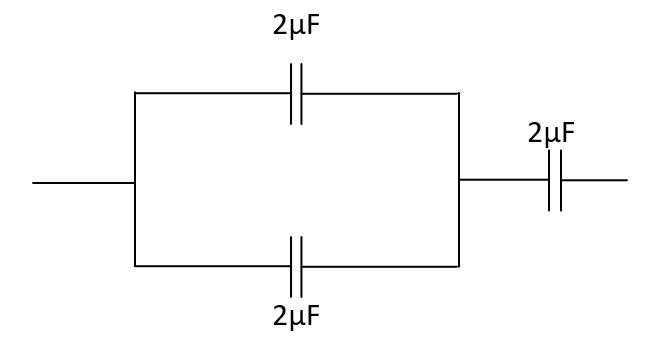 The net capacitance in the circuit above is
Select the option that is related to the third term in the same way as the second term is related to the first term. 6 :18 :: 14 :___ ?