
Mathematics 2014 Jamb Examination
Mathematics 2014 Jamb Examination

Question 41
A number is chosen at random from 10 to 30 both inclusive. What is the probability that the number is divisible by 3?
First, we determine the total number of integers from 10 to 30 inclusive:\[ \text{Total} = (30 - 10) + 1 = 21 \]Next, we list the numbers between 10 and 30 that are divisible by 3:
12, 15, 18, 21, 24, 27, 30.
Counting these successes, we find there are 7 numbers.
The probability (P) is the number of successes divided by the total count:\[ P = \dfrac{7}{21} \]Simplifying the fraction by dividing both the numerator and the denominator by 7:\[ P = \dfrac{1}{3} \]
12, 15, 18, 21, 24, 27, 30.
Counting these successes, we find there are 7 numbers.
The probability (P) is the number of successes divided by the total count:\[ P = \dfrac{7}{21} \]Simplifying the fraction by dividing both the numerator and the denominator by 7:\[ P = \dfrac{1}{3} \]
Not clear enough?
Question 42

In the figure above, what is the equation of the line that passes the y-axis at (0, 5) and passes the x-axis at (5, 0)?
The equation of a straight line is generally expressed in the slope-intercept form:\[ y = mx + c \]where \(m\) is the gradient (slope) and \(c\) is the y-intercept. From the question, the line crosses the y-axis at (0, 5), which directly tells us that the y-intercept \(c = 5\).
Next, we calculate the gradient \(m\) using the two points provided, \((x_1, y_1) = (0, 5)\) and \((x_2, y_2) = (5, 0)\):\[ m = \dfrac{y_2 - y_1}{x_2 - x_1} \]\[ m = \dfrac{0 - 5}{5 - 0} = \dfrac{-5}{5} = -1 \]Substituting \(m = -1\) and \(c = 5\) into the slope-intercept equation:\[ y = -1(x) + 5 \]\[ y = -x + 5 \]Alternatively, we can use the intercept form of a linear equation \(\dfrac{x}{a} + \dfrac{y}{b} = 1\), where \(a\) and \(b\) are the x and y intercepts respectively:\[ \frac{x}{5} + \frac{y}{5} = 1 \]Multiplying through by 5 gives \(x + y = 5\), which simplifies to \(y = -x + 5\).
Not clear enough?
Question 43
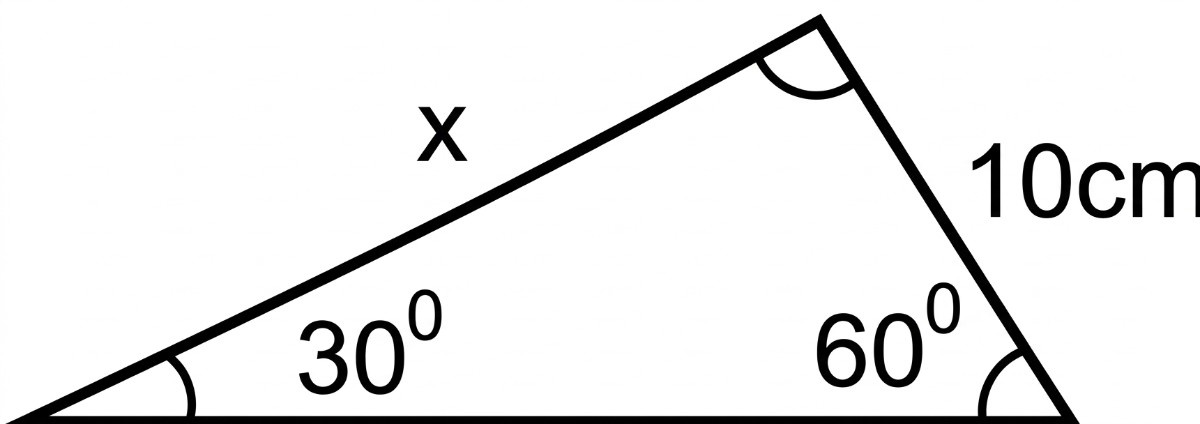
Find the value of x in the figure above
To find the value of x in the right-angled triangle, we use trigonometric ratios. In this triangle, we are given an angle of 60°, the length of the adjacent side (10 cm), and we need to find the length of the opposite side (x).
The trigonometric ratio that relates the opposite side and the adjacent side is the tangent (tan):\[ \tan \theta = \dfrac{\text{Opposite}}{\text{Adjacent}} \] Substituting the known values into the formula:\[ \tan 60^\circ = \frac{x}{10} \] From trigonometric tables or the unit circle, we know that \(\tan 60^\circ = \sqrt{3}\). Substituting this into the equation gives:\[ \sqrt{3} = \frac{x}{10} \] To solve for x, multiply both sides by 10:\[ x = 10\sqrt{3} \] Thus, the length of the side x is exactly \(10\sqrt{3}\) cm, which corresponds to option B.
The trigonometric ratio that relates the opposite side and the adjacent side is the tangent (tan):\[ \tan \theta = \dfrac{\text{Opposite}}{\text{Adjacent}} \] Substituting the known values into the formula:\[ \tan 60^\circ = \frac{x}{10} \] From trigonometric tables or the unit circle, we know that \(\tan 60^\circ = \sqrt{3}\). Substituting this into the equation gives:\[ \sqrt{3} = \frac{x}{10} \] To solve for x, multiply both sides by 10:\[ x = 10\sqrt{3} \] Thus, the length of the side x is exactly \(10\sqrt{3}\) cm, which corresponds to option B.
Not clear enough?
Question 44

From the figure above, what is the value of p?
Opposite angles are equal
q = 30
2(p + 2q) + 2q = 360
p + 2q + q = 180
p + 3q = 180
p + 3(30) = 180
p = 180 - 90
p = 90
q = 30
2(p + 2q) + 2q = 360
p + 2q + q = 180
p + 3q = 180
p + 3(30) = 180
p = 180 - 90
p = 90
Not clear enough?
Question 45
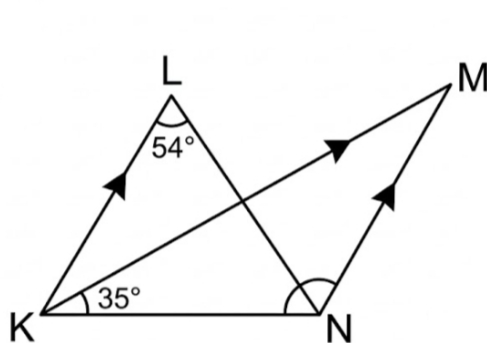
In the figure above, KL//NM, LN bisects ∠KNM. If ∠KLN is 54° and ∠MKN is 35°, calculate the size of ∠KMN.
To solve for ∠KMN, we use the properties of parallel lines and triangles.
Step 1: Identify alternate angles. Since KL is parallel to NM (KL//NM) and LN is a transversal, ∠KLN and ∠LNM are alternate angles. Therefore:\[ \angle LNM = \angle KLN = 54^\circ \] Step 2: Use the bisection property. We are told LN bisects ∠KNM, which means it divides the angle into two equal parts. Thus:\[ \angle KNL = \angle LNM = 54^\circ \] \[ \angle KNM = \angle KNL + \angle LNM = 54^\circ + 54^\circ = 108^\circ \] Step 3: Consider the triangle KNM. The sum of angles in a triangle is 180°. In ΔKNM, we have ∠KNM = 108° and ∠MKN = 35°. Let ∠KMN be x:\[ 108^\circ + 35^\circ + x = 180^\circ \] \[ 143^\circ + x = 180^\circ \] \[ x = 180^\circ - 143^\circ \] \[ x = 37^\circ \] Therefore, the size of ∠KMN is 37°.
Step 1: Identify alternate angles. Since KL is parallel to NM (KL//NM) and LN is a transversal, ∠KLN and ∠LNM are alternate angles. Therefore:\[ \angle LNM = \angle KLN = 54^\circ \] Step 2: Use the bisection property. We are told LN bisects ∠KNM, which means it divides the angle into two equal parts. Thus:\[ \angle KNL = \angle LNM = 54^\circ \] \[ \angle KNM = \angle KNL + \angle LNM = 54^\circ + 54^\circ = 108^\circ \] Step 3: Consider the triangle KNM. The sum of angles in a triangle is 180°. In ΔKNM, we have ∠KNM = 108° and ∠MKN = 35°. Let ∠KMN be x:\[ 108^\circ + 35^\circ + x = 180^\circ \] \[ 143^\circ + x = 180^\circ \] \[ x = 180^\circ - 143^\circ \] \[ x = 37^\circ \] Therefore, the size of ∠KMN is 37°.
Not clear enough?
Question 46

From the Venn diagram above, the shaded parts represent
By observing the shaded regions in the provided Venn diagram, we can identify which set operations describe them. The diagram shows two distinct shaded areas within circle P.
The first shaded area is the region where circle P and circle Q overlap. In set theory, the overlap or common elements between two sets is known as the intersection, denoted by the symbol ∩. Therefore, this region is represented as \(P \cap Q\).
The second shaded area is the region where circle P and circle R overlap. Similarly, this region is represented as the intersection of P and R, denoted as \(P \cap R\).
Since both of these regions are shaded together, we use the union operation (denoted by ∪) to combine them. The union represents the collection of all elements found in either of the specified regions. Combining these two intersection regions gives us the final expression:\[ (P \cap Q) \cup (P \cap R) \]This expression can also be simplified using the distributive law of set theory to \(P \cap (Q \cup R)\), which represents the part of P that overlaps with the combined area of Q and R. However, based on the options provided, the expanded form is the correct match.
Not clear enough?
Question 47
The pie chart below shows the monthly distribution of a man's salary on food items. If he spent ₦8,000 on rice, how much did he spent on yam?
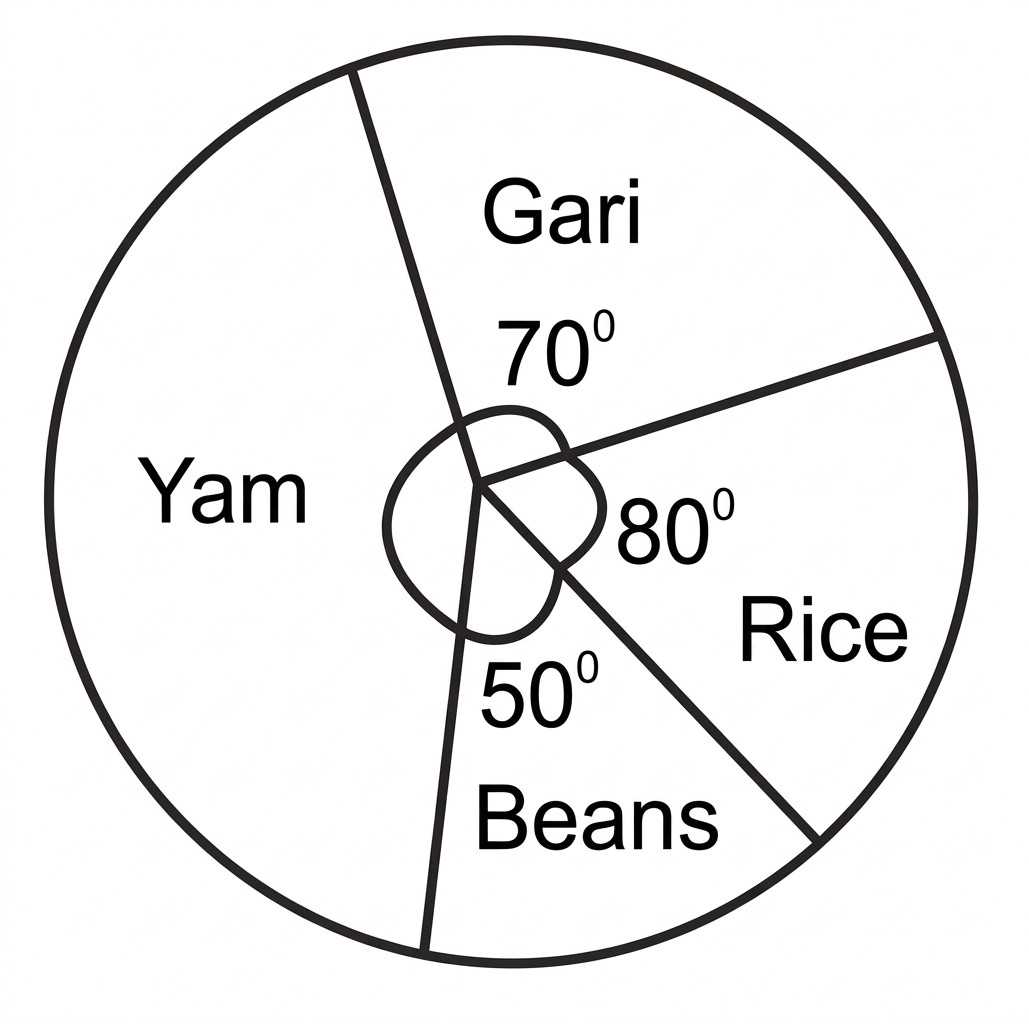
To determine the amount spent on yam, we first need to find the angle of the sector subtended by yam in the pie chart. The total angle in a circle is \(360^\circ\). Based on the distribution provided in the chart, the angles for the other food items (excluding yam) sum up to \(200^\circ\) (specifically \(70^\circ + 80^\circ + 50^\circ = 200^\circ\)).
The angle for yam is calculated as:\[ \text{Angle of Yam} = 360^\circ - 200^\circ = 160^\circ \] Thus twice the what was spent on rice was spent on yam. We are given that the man spent ₦8,000 on rice. So for yam we have 2 x 8,000 = ₦16,000
The angle for yam is calculated as:\[ \text{Angle of Yam} = 360^\circ - 200^\circ = 160^\circ \] Thus twice the what was spent on rice was spent on yam. We are given that the man spent ₦8,000 on rice. So for yam we have 2 x 8,000 = ₦16,000
Not clear enough?
Question 48
If the angle of a sector of a circle with radius 10.5 cm is 120°, find the perimeter of the sector. [Take \(\pi = \dfrac{22}{7}\)]
The perimeter of a sector consists of the lengths of the two radii and the length of the arc. The formula is given by:\[ \text{Perimeter} = 2r + \text{Arc length} \]Where the arc length is calculated as:\[ \text{Arc length} = \frac{\theta}{360} \times 2\pi r \]Given \(r = 10.5\, \text{cm}\), \(\theta = 120^\circ\), and \(\pi = \dfrac{22}{7}\), we first calculate the arc length:\[ \text{Arc length} = \frac{120}{360} \times 2 \times \frac{22}{7} \times 10.5 \]\[ = \frac{1}{3} \times \frac{44}{7} \times 10.5 \]\[ = \frac{1}{3} \times 44 \times 1.5 \]\[ = 44 \times 0.5 = 22\, \text{cm} \]Now, add the lengths of the two radii to the arc length to find the total perimeter:\[ \text{Perimeter} = 2(10.5) + 22 \]\[ = 21 + 22 \]\[ = 43\, \text{cm} \]The sector boundary thus measures 43 cm in total length.
Not clear enough?
You might like
Choose the option nearest in meaning to the underlined word.
The popularity of the military dictator waned after the war?
Which characteristic of a computer refers to its ability to minimize energy, consumption and resource usage?
Choose the option nearest in meaning to the underlined word(s).
Fila has always been described as belligerent.
A basket contains 9 apples, 8 bananas and 7 oranges. A fruit is picked from the basket, find the probability that it is neither an apple nor an orange.
Each of the questions below consists of two words that have a certain relationship to each other.
Select the pair of words.
ANTIMACASSAR : SOFA