
Mathematics 2019 Jamb Examination
Mathematics 2019 Jamb Examination

Question 11
If a fair coin is tossed 3 times, what is the probability of getting at least two heads?
The sample space for 3 tosses is \( \displaystyle 2^3 = 8 \):
{HHH, HHT, HTH, THH, TTH, THT, HTT, TTT}. '
At least two heads' means 2 or 3 heads. The favorable outcomes are {HHH, HHT, HTH, THH}. \[ \displaystyle \text{Probability} = \frac{4}{8} = \frac{1}{2} \]
{HHH, HHT, HTH, THH, TTH, THT, HTT, TTT}. '
At least two heads' means 2 or 3 heads. The favorable outcomes are {HHH, HHT, HTH, THH}. \[ \displaystyle \text{Probability} = \frac{4}{8} = \frac{1}{2} \]
Not clear enough?
Question 12
In how many ways can the word MATHEMATICIAN be arranged?
The word MATHEMATICIAN has 13 letters. We count the repetitions:
- M: 2 times
- A: 3 times
- T: 2 times
- I: 2 times
\[ \displaystyle \text{Arrangements} = \frac{13!}{2! \times 3! \times 2! \times 2!} \]
\[ \displaystyle = \frac{6,227,020,800}{2 \times 6 \times 2 \times 2} = \frac{6,227,020,800}{48} = 129,729,600 \]
Not clear enough?
Question 13
Given matrix \( \displaystyle M = \begin{pmatrix} -2 & 0 & 4 \\ 0 & -1 & 6 \\ 5 & 6 & 3 \end{pmatrix} \), find \( \displaystyle M^{T} + 2M \)
First, find \( \displaystyle M^T \) (rows become columns): \[ \displaystyle M^T = \begin{pmatrix} -2 & 0 & 5 \\ 0 & -1 & 6 \\ 4 & 6 & 3 \end{pmatrix} \] Next, find \( \displaystyle 2M \): \[ \displaystyle 2M = \begin{pmatrix} -4 & 0 & 8 \\ 0 & -2 & 12 \\ 10 & 12 & 6 \end{pmatrix} \] Add them together: \[\displaystyle \begin{pmatrix} -2-4 & 0+0 & 5+8 \\ 0+0 & -1-2 & 6+12 \\ 4+10 & 6+12 & 3+6 \end{pmatrix} = \begin{pmatrix} -6 & 0 & 13 \\ 0 & -3 & 18 \\ 14 & 18 & 9 \end{pmatrix} \]
Not clear enough?
Question 14
The table below shows the scores of a group of students. Find the mean of the data.
\[ \begin{array}{|l|c|c|c|c|c|c|c|} \hline \text{Score (x)} & 0 & 1 & 2 & 3 & 4 & 5 & 6 \\ \hline \text{Freq (f)} & 5 & 7 & 3 & 7 & 11 & 6 & 7 \\ \hline \end{array} \]
First, calculate \( \displaystyle \sum f \) and \( \displaystyle \sum fx \):
\[ \displaystyle \sum f = 5+7+3+7+11+6+7 = 46 \]
\[ \displaystyle \sum fx = (0\times 5) + (1\times 7) + (2\times 3) + (3\times 7) + (4\times 11) + (5\times 6) + (6\times 7) \]
\[ \displaystyle \sum fx = 0 + 7 + 6 + 21 + 44 + 30 + 42 = 150 \]
\[ \displaystyle \text{Mean } (\bar{x}) = \frac{150}{46} \approx 3.26 \]
Not clear enough?
Question 15
The table below shows the scores of a group of students. Find the variance.
\[ \begin{array}{|l|c|c|c|c|c|c|c|} \hline \text{Score (x)} & 0 & 1 & 2 & 3 & 4 & 5 & 6 \\ \hline \text{Freq (f)} & 5 & 7 & 3 & 7 & 11 & 6 & 7 \\ \hline \end{array} \]
Variance \( \displaystyle \sigma^2 = \frac{\sum fx^2}{\sum f} - (\bar{x})^2 \).
\[ \displaystyle \sum fx^2 = (0^2\cdot 5) + (1^2\cdot 7) + (2^2\cdot 3) + (3^2\cdot 7) + (4^2\cdot 11) + (5^2\cdot 6) + (6^2\cdot 7) \]
\[ \displaystyle = 0 + 7 + 12 + 63 + 176 + 150 + 252 = 660 \]
\[ \displaystyle \sigma^2 = \frac{660}{46} - (3.26)^2 = 14.347 - 10.627 = 3.72 \]
Not clear enough?
Question 16
The locus of a point which moves so that it is equidistant from two intersecting straight lines is the
By geometric definition, the set of all points that are at an equal distance from two intersecting lines forms the bisector of the angles formed by those lines. Any point on the angle bisector will have equal perpendicular distances to both lines.
Not clear enough?
Question 17
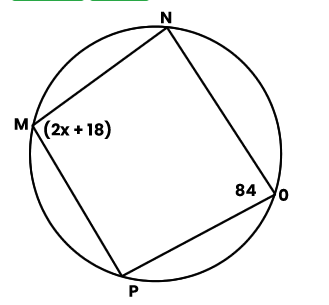
From the cyclic quadrilateral MNOP above, find the value of x.
The sum of two opposite angles of a cyclic quadrilateral = 180°
\(\therefore\) (2x + 18)° + 84° = 180°
2x + 102° = 180° \(\implies\) 2x = 78°
x = 39°
Not clear enough?
Question 18
If \( \displaystyle 4\sin^2 x - 3 = 0 \), find the value of x, when \( \displaystyle 0^\circ \le x \le 90^\circ \)
Solve the equation for \( \displaystyle \sin x \):
\[ \displaystyle 4\sin^2 x = 3 \]
\[ \displaystyle \sin^2 x = \frac{3}{4} \]
\[ \displaystyle \sin x = \sqrt{\frac{3}{4}} = \frac{\sqrt{3}}{2} \]
For the range \( \displaystyle 0^\circ \le x \le 90^\circ \), the angle whose sine is \( \displaystyle \frac{\sqrt{3}}{2} \) is \( \displaystyle 60^\circ \).
Not clear enough?
Question 19

In the figure above, |CD| is the base of the triangle CDE. Find the area of the figure to the nearest whole number.
Area of rectangle ABCD = length x breadth
= 7 x 4
= 28 cm\(^2\)
Area of triangle CDE = \(\frac{1}{2}\) base x height
= \(\frac{1}{2} \times 3 \times 4\)
= 6 cm\(^2\)
Area of the figure = 28 cm\(^2\) + 6 cm\(^2\)
= 34 cm\(^2\)
Not clear enough?
Question 20
The marks scored by 30 students in a Mathematics test are recorded in the table below:
\[ \begin{array}{|l|c|c|c|c|c|c|} \hline \text{Scores (Mark)} & 0 & 1 & 2 & 3 & 4 & 5 \\ \hline \text{No of students} & 4 & 3 & 7 & 8 & 6 & 2 \\ \hline \end{array} \]
What is the total number of marks scored by the children?
To find the total marks, we multiply each score (x) by the number of students (f) who got that score and then sum them up (\( \displaystyle \sum fx \)):
\[ \displaystyle (0 \times 4) + (1 \times 3) + (2 \times 7) + (3 \times 8) + (4 \times 6) + (5 \times 2) \]
\[ \displaystyle = 0 + 3 + 14 + 24 + 24 + 10 = 75 \]
 Prime cost is