
Mathematics 2019 Jamb Examination
Mathematics 2019 Jamb Examination

Question 41
Simplify \( \displaystyle \frac{0.0839 \times 6.381}{5.44} \) to 2 significant figures.
Perform the calculation:
\[ \displaystyle \frac{0.5353659}{5.44} \approx 0.09841 \]
Significant figures start at the first non-zero digit (9). The second is 8. Since the next digit is 4 (less than 5), we do not round up.
\[ \displaystyle 0.098 \]
Not clear enough?
Question 42
Find the value of x and y in the simultaneous equations: \( \displaystyle 3x + y = 21 \) and \( \displaystyle xy = 30 \).
From the first equation, \( \displaystyle y = 21 - 3x \). Substitute this into the second equation:
\[ \displaystyle x(21 - 3x) = 30 \implies 21x - 3x^2 = 30 \]
Rearrange into a quadratic equation: \( \displaystyle 3x^2 - 21x + 30 = 0 \). Divide by 3:
\[ \displaystyle x^2 - 7x + 10 = 0 \implies (x - 2)(x - 5) = 0 \]
If \( \displaystyle x = 2, y = 30/2 = 15 \). If \( \displaystyle x = 5, y = 30/5 = 6 \).
Not clear enough?
Question 43
Points X and Y are 20km North and 9km East of point O, respectively. What is the bearing of Y from X? Correct to the nearest degree.
Point X is at (0, 20) and Y is at (9, 0) relative to origin O. To find the bearing of Y from X, we look at the angle from the North line at X.
In the right triangle at X:
\[ \displaystyle \tan \theta = \frac{\text{Opposite}}{\text{Adjacent}} = \frac{9}{20} = 0.45 \]
\[ \displaystyle \theta = \tan^{-1}(0.45) \approx 24.2^\circ \]
The bearing (clockwise from North) is \( \displaystyle 180^\circ - 24.2^\circ = 155.8^\circ \approx 156^\circ \).
Not clear enough?
Question 44
If \( \displaystyle P = \left(\frac{Q(R - T)}{15}\right)^{\frac{1}{3}} \), make T the subject of the formula.
Cube both sides: \( \displaystyle P^3 = \frac{Q(R - T)}{15} \)
Multiply by 15: \( \displaystyle 15P^3 = Q(R - T) \)
Divide by Q: \( \displaystyle \frac{15P^3}{Q} = R - T \)
Rearrange for T: \( \displaystyle T = R - \frac{15P^3}{Q} \)
Multiply by 15: \( \displaystyle 15P^3 = Q(R - T) \)
Divide by Q: \( \displaystyle \frac{15P^3}{Q} = R - T \)
Rearrange for T: \( \displaystyle T = R - \frac{15P^3}{Q} \)
Not clear enough?
Question 45
Each of the interior angles of a regular polygon is 140°. Calculate the sum of all the interior angles of the polygon.
First, find the number of sides (n). The exterior angle is \( \displaystyle 180^\circ - 140^\circ = 40^\circ \).
\[ \displaystyle n = \frac{360}{40} = 9 \text{ sides} \]
Sum of interior angles = \( \displaystyle (n - 2) \times 180^\circ \):
\[ \displaystyle (9 - 2) \times 180 = 7 \times 180 = 1260^\circ \]
Not clear enough?
Question 46
A man bought a car for ₦1,250,000 and later sold it for ₦1,085,000. What is the percentage gain or loss?
Since the selling price is less than the cost price, it is a loss.
Loss = \( \displaystyle 1,250,000 - 1,085,000 = 165,000 \).
\[ \displaystyle \%\text{Loss} = \frac{165,000}{1,250,000} \times 100 = 13.2\% \]
Not clear enough?
Question 47
If the volume of a frustum is \( \displaystyle V = \frac{\pi h}{3}(R^2 + Rr + r^2) \), find \( \displaystyle \frac{dV}{dR} \).
Differentiate the expression with respect to R, treating \( \displaystyle \pi, h, \) and \( \displaystyle r \) as constants:
\[ \displaystyle \frac{d}{dR}(R^2) = 2R, \quad \frac{d}{dR}(Rr) = r, \quad \frac{d}{dR}(r^2) = 0 \]
\[ \displaystyle \frac{dV}{dR} = \frac{\pi h}{3}(2R + r) \]
Not clear enough?
Question 48
Express \( \displaystyle (0.0439 \div 3.62) \) as a fraction.
Perform the division: \( \displaystyle 0.0439 / 3.62 \approx 0.01212... \)
The closest standard fraction provided in this exam context for this decimal range is \( \displaystyle 12/1000 \), which is \( \displaystyle 0.012 \).
Not clear enough?
Question 49
If \( \displaystyle 25^{1 - x} \times 5^{x + 2} \div \left(\frac{1}{125}\right)^{x} = 625^{-1} \), find the value of x.
Convert everything to base 5:
\[ \displaystyle (5^2)^{1-x} \times 5^{x+2} \div (5^{-3})^x = (5^4)^{-1} \]
\[ \displaystyle 5^{2-2x} \times 5^{x+2} \div 5^{-3x} = 5^{-4} \]
Using index laws: \( \displaystyle 2 - 2x + x + 2 - (-3x) = -4 \)
\[ \displaystyle 2x + 4 = -4 \implies 2x = -8 \implies x = -4 \]
Not clear enough?
Question 50
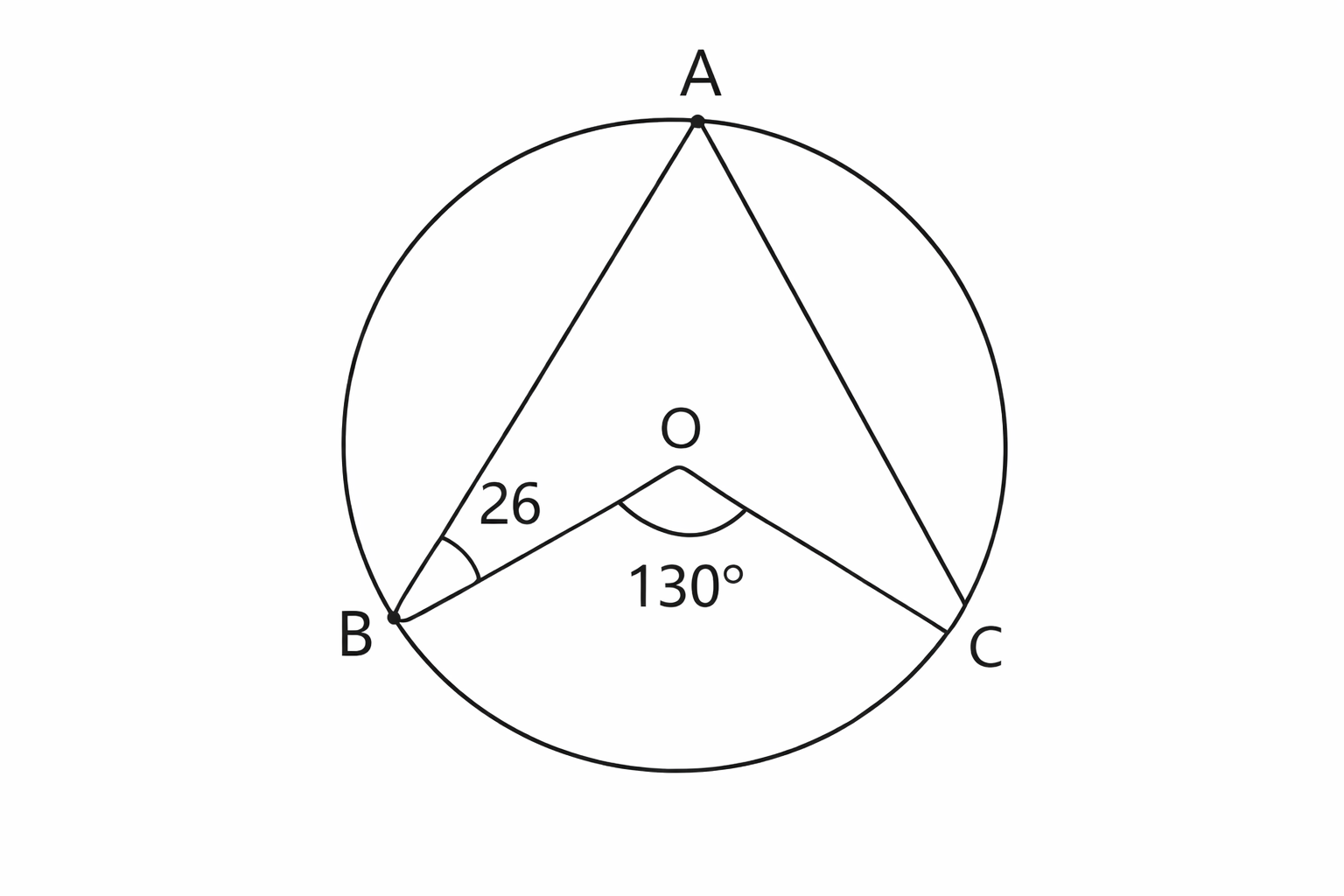
In the diagram above, O is the centre of the circle ABC, \( \angle ABO = 26^\circ \) and \( \angle BOC = 130^\circ \). Calculate \( \angle AOC \).
In triangle ABO, OA = OB (radii). Thus, \( \angle OAB = \angle ABO = 26^\circ \). The interior angle \( \angle AOB = 180 - (26 + 26) = 128^\circ \).
Angles at a point sum to \( 360^\circ \):
\[ \angle AOC = 360 - (\angle AOB + \angle BOC) \]
\[ \angle AOC = 360 - (128 + 130) = 360 - 258 = 102^\circ \]
Not clear enough?
You might like
I. It has a varied composition from one place to another.
II. Its constituents can be separated by physical means.
III. It contains unreactive noble gases.
Which of the above shows that air is a mixture?
"Why should I play the Roman fool, and die
On mine own sword?"
Based on William Shakespeare's Macbeth, playing the Roman fool from the above statement implies
Which of the following soil types becomes less fertile due to the intense leaching caused by tropical rains?
A tuning fork having a frequency of 312 Hz emits a wave which has a wavelength of 1.10 m. Calculate the velocity of sound