
Mathematics 2025 Jamb Examination
Mathematics 2025 Jamb Examination

Question 1
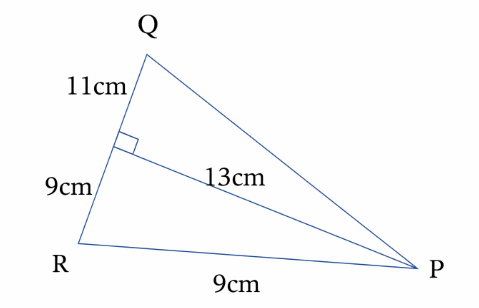
From the diagram above, find the area of the triangle PQR
The area of triangle \(PQR\) is given by the formula
\[ \text{Area of } \triangle PQR = \frac{1}{2} \times \text{base} \times \text{height}\]
Here, \(QR\) is the base and \(P_c\) is the corresponding height. Therefore,
\[ \text{Area of } \triangle PQR = \frac{1}{2} \times 20 \times 13\] \[ = 10 \times 13\] \[ = 130\text{ cm}^2\]
\[ \text{Area of } \triangle PQR = \frac{1}{2} \times \text{base} \times \text{height}\]
Here, \(QR\) is the base and \(P_c\) is the corresponding height. Therefore,
\[ \text{Area of } \triangle PQR = \frac{1}{2} \times 20 \times 13\] \[ = 10 \times 13\] \[ = 130\text{ cm}^2\]
Not clear enough?
Question 2
The set {1, 2, 3, 4, 5} is equivalent to
Two sets are equal if they contain exactly the same elements, regardless of order. They are equivalent if they have the same number of elements (cardinality).
The set {1, 2, 3, 4, 5} has 5 elements.
Option A has 4 elements.
Option B has 5 unique elements (repeated elements in set notation are counted once).
Option C has 4 elements.
Option D {4, 3, 1, 5, 2} has 5 elements and they are identical to the original set.
Since Option D contains the exact same five elements in a different order, it is both equal and equivalent to the original set.
Not clear enough?
Question 3
Solve the simultaneous equation \(\frac{x}{2} - \frac{y}{5} = 1\) and \(y - \frac{x}{3} = 8\)
Equation 1: \(\frac{x}{2} - \frac{y}{5} = 1\). Multiply by 10: \(5x - 2y = 10\).
Equation 2: \(y - \frac{x}{3} = 8\). Multiply by 3: \(3y - x = 24 \implies x = 3y - 24\).
Substitute \(x\) into the modified Equation 1:\[ 5(3y - 24) - 2y = 10 \]\[ 15y - 120 - 2y = 10 \]\[ 13y = 130 \]\[ y = 10 \]Now find \(x\):\[ x = 3(10) - 24 = 30 - 24 = 6 \]The solution is \(x = 6, y = 10\).
Not clear enough?
Question 4
Solve the inequality 2x + 3 > 5x + 8
Collect like terms:\[ 2x - 5x > 8 - 3 \]\[ -3x > 5 \]When dividing by a negative number, the inequality sign must be reversed:\[ x < -\frac{5}{3} \]\[ x < -1\frac{2}{3} \]
Not clear enough?
Question 5
Given that a * b = \(\frac{a + b}{ab}\) + (a - b). Find the value of 3 * 2
Substitute \(a = 3\) and \(b = 2\) into the given operation:\[ 3 * 2 = \frac{3 + 2}{3 \times 2} + (3 - 2) \]\[ 3 * 2 = \frac{5}{6} + 1 \]\[ 3 * 2 = 1\frac{5}{6} \text{ or } \frac{11}{6} \]
Not clear enough?
Question 6
Simplify 125\(^{-\frac{1}{3}}\) × 49\(^{-\frac{1}{2}}\) × 10\(^{0}\)
\(125^{-1/3} = (5^{3})^{-1/3} = 5^{-1} = 1/5\)
\(49^{-1/2} = (7^{2})^{-1/2} = 7^{-1} = 1/7\)
\(10^{0} = 1\)
Multiply the results:\[ \frac{1}{5} \times \frac{1}{7} \times 1 = \frac{1}{35} \]
Not clear enough?
Question 7
Find the coordinates of the midpoint of line PQ given P(-3, 4) and Q(5, 6).
The midpoint formula is \(M = \left( \dfrac{x_{1} + x_{2}}{2}, \dfrac{y_{1} + y_{2}}{2} \right)\).
Substitute the values for P(-3, 4) and Q(5, 6):\[ M = \left( \frac{-3 + 5}{2}, \frac{4 + 6}{2} \right) \]\[ M = \left( \frac{2}{2}, \frac{10}{2} \right) = (1, 5) \]
Substitute the values for P(-3, 4) and Q(5, 6):\[ M = \left( \frac{-3 + 5}{2}, \frac{4 + 6}{2} \right) \]\[ M = \left( \frac{2}{2}, \frac{10}{2} \right) = (1, 5) \]
Not clear enough?
Question 8
Given that Cos A = \(\frac{12}{13}\) for 0 ≤ A ≤ 90º, find Tan A.
Since \(\cos A = 12/13\) (Adjacent/Hypotenuse), let the adjacent side be 12 and the hypotenuse be 13.
Find the opposite side (opp) using Pythagoras:\[ \text{opp} = \sqrt{13^{2} - 12^{2}} = \sqrt{169 - 144} = \sqrt{25} = 5 \]Now, calculate \(\tan A = \text{Opposite}/\text{Adjacent} = 5/12\).
Not clear enough?
Question 9
Which of the following angles cannot be constructed using a protractor, a compass, and a sharpened pencil?
Angles that are multiples of 15° or 7.5° (derived from bisecting 60°, 90°, etc.) can be constructed using only a compass and ruler.
- 60° is constructed using an equilateral triangle.
- 90° is a perpendicular bisector.
- 135° is 90° + 45° (bisected 90).
145° is not a multiple of 7.5° or 15° and cannot be constructed using a compass and straightedge (though the prompt mentions a protractor, in the context of examination theory, it refers to standard Euclidean construction limits).
Not clear enough?
Question 10
Find the number of permutations of the letters of the word SCHOOL.
The word SCHOOL has 6 letters in total (n=6).
The letter 'O' is repeated 2 times.
The formula for permutations with repetitions is:\[ P = \frac{n!}{p!q!...} \]\[ P = \frac{6!}{2!} = \frac{720}{2} = 360 \]
Not clear enough?
You might like
A binary operation defines * on the set of positive integers such that \(x * y = 2x - 3y + 2\) for all positive integers x and y. The binary operation is
A farmer planted 5000 grains of maize and harvested 5000 cobs, each bearing 500 grains.What is the ratio of the number of grains sowed to the number harvested?