
Mathematics 2025 Jamb Examination
Mathematics 2025 Jamb Examination

Question 51
\[ \begin{array}{|l|c|c|c|c|c|} \hline \text{Weight in kg} & 54 & 56 & 58 & 60 & 62 \\ \hline \text{No of students} & x & 1 & 2x & 2 & 3 \\ \hline \end{array} \]
The table above shows the weights of twelve mathematics students. Find the modal weight.
A. 54
B. 58
C. 60
D. 62
To find the modal weight, we first determine the value of \( x \) by summing the frequencies to 12: \[ x + 1 + 2x + 2 + 3 = 12 \] \[ 3x + 6 = 12 \] \[ 3x = 6 \implies x = 2 \] Now, substitute \( x \) back into the table to find the frequencies:
Weight 54: \( x = 2 \)
Weight 58: \( 2x = 4 \)
Since 4 is the highest frequency, the modal weight is \( 58 \text{ kg} \).
Not clear enough?
Question 52
A binary operation \( * \) is defined on the set \( X = \{1, 2, 3, 4, 5, 6\} \) as \( a*b = ab + a + b \). Compute \( 1 * 3 \)
Substitute the values \( a = 1 \) and \( b = 3 \) into the defined rule: \[ 1 * 3 = (1 \times 3) + 1 + 3 \] \[ 1 * 3 = 3 + 1 + 3 = 7 \]
Not clear enough?
Question 53
\[ \begin{array}{|l|c|c|c|c|c|} \hline \text{Weight in kg} & 54 & 56 & 58 & 60 & 62 \\ \hline \text{No of students} & x & 1 & 2x & 2 & 3 \\ \hline \end{array} \]
The table above shows the weights of twelve mathematics students. Find the modal weight.
First, find the value of \( x \) by summing the frequencies to 12: \[ x + 1 + 2x + 2 + 3 = 12 \] \[ 3x + 6 = 12 \] \[ 3x = 6 \implies x = 2 \] Now, substitute \( x \) back into the frequencies to find the highest occurrence:
Weight 54: \( x = 2 \)
Weight 58: \( 2x = 4 \)
Weight 60: 2
Weight 62: 3
Since 4 is the highest frequency, the modal weight is \( 58 \text{ kg} \).
Not clear enough?
Question 54
\[ \begin{array}{|l|c|} \hline \text{Range} & \text{Frequency} \\ \hline 1 - 10 & 2 \\ \hline 11 - 20 & 7 \\ \hline 21 - 30 & 10 \\ \hline 31 - 40 & 3 \\ \hline 41 - 50 & 1 \\ \hline \end{array} \]
From the table above, determine the upper - class boundary of the modal class
The modal class is the range with the highest frequency, which is \( 21 - 30 \) (frequency 10).
The upper-class boundary is the midpoint between the current upper limit (30) and the next lower limit (31): \[ \text{Upper Boundary} = \displaystyle \frac{30 + 31}{2} = 30.5 \]
Not clear enough?
Question 55
A bird flies from a tree P on a bearing of \( N60^{\circ} E \) to a building, Q, a distance of 200 km. It then changes course and flies to another tree R on a bearing of \( S30^{\circ}E \). Tree R is directly east of tree P. Calculate the distance of the building to tree R.

In \( \triangle PQR \), the interior angle at \( Q \) is \( 60^{\circ} + 30^{\circ} = 90^{\circ} \). Since R is due East of P, the angle at \( P \) is \( 90^{\circ} - 60^{\circ} = 30^{\circ} \).
We need the length \( QR \) (the side opposite the \( 30^{\circ} \) angle), and we have \( PQ = 200 \text{ km} \) (the adjacent side): \[ \tan(30^{\circ}) = \displaystyle \frac{QR}{PQ} \] \[ QR = 200 \times \tan(30^{\circ}) = 200 \times \displaystyle \frac{1}{\sqrt{3}} \] If we look at the triangle from the perspective where \( PQ \) is opposite the \( 30^{\circ} \) angle, then \( QR = 200 \times \tan(60^{\circ}) = 200\sqrt{3} \).
Not clear enough?
Question 56
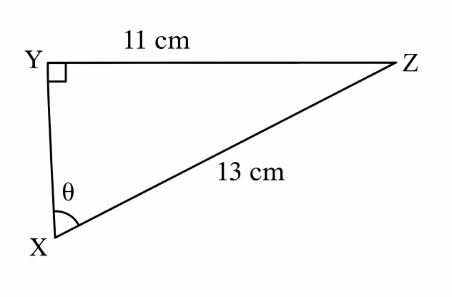
Given the triangle XYZ above, calculate the value of \( \cot \theta \) and the length XY, respectively
First, solve for the length \( XY \) (the side opposite \( \theta \)): \[ XY = \sqrt{13^{2} - 11^{2}} = \sqrt{169 - 121} = \sqrt{48} \] Next, calculate \( \cot \theta \), which is the ratio of the Adjacent side to the Opposite side: \[ \cot \theta = \displaystyle \frac{\text{Adjacent}}{\text{Opposite}} = \frac{11}{\sqrt{48}} \] Therefore, the values are \( \displaystyle \frac{11}{\sqrt{48}} \) and \( \sqrt{48} \).
Not clear enough?
You might like
Raman's age is twice the age of his daughter Shruti. If ten years ago Raman's age was three times to the age of Shruti, then what is the present age of shruti ?
200 cm3 of a gas at 25°C exerts a pressure of 700 mmHg. Calculate its pressure if its volume increases to 350 cm3 at 75°C.
During this period, she would have -laid- more than half a million eggs. In the gap numbered 19, choose the most appropriate option.