
Physics 2007 Jamb Examination
Physics 2007 Jamb Examination

Question 11
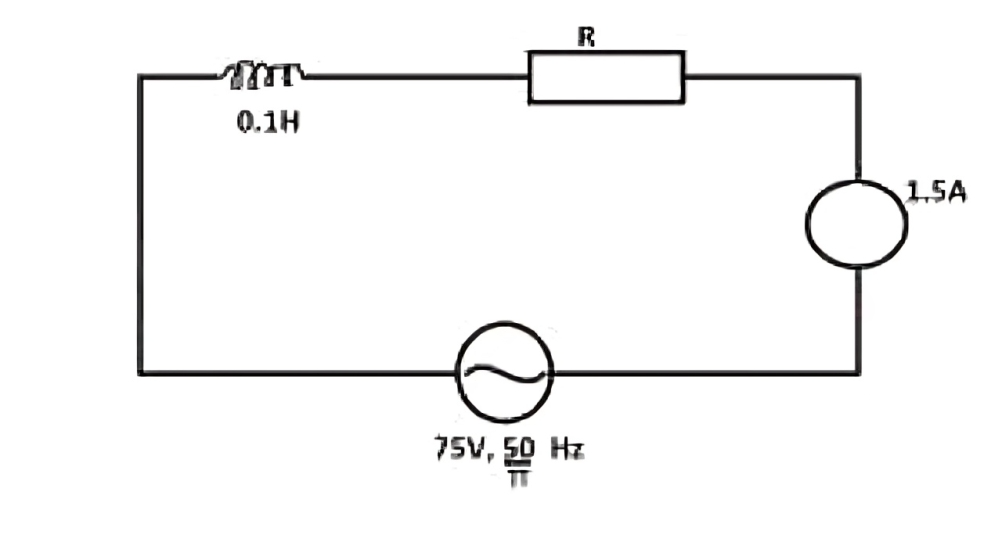
From the diagram above, the inductive reactance and the resistance R are respectively
Inductance:
From the diagram: $L=0.10\ \text{H}$, $f=\dfrac{50}{\pi}\ \text{Hz}$, supply voltage $V_s=75\ \text{V}$ and current $I=1.5\ \text{A}$.1. Inductive reactance: $$X_L = 2\pi f L = 2\pi\left(\dfrac{50}{\pi}\right)(0.10)=2\times50\times0.10=10\ \Omega.$$2. Magnitude of the total impedance:$$Z=\dfrac{V_s}{I}=\dfrac{75}{1.5}=50\ \Omega.$$Resistance $R$ from $Z^2=R^2+X_L^2$:$$R=\sqrt{Z^2-X_L^2}=\sqrt{50^2-10^2}$$ $$=\sqrt{2500-100}=\sqrt{2400}=48.99\ \Omega\approx49\ \Omega.$$
From the diagram: $L=0.10\ \text{H}$, $f=\dfrac{50}{\pi}\ \text{Hz}$, supply voltage $V_s=75\ \text{V}$ and current $I=1.5\ \text{A}$.1. Inductive reactance: $$X_L = 2\pi f L = 2\pi\left(\dfrac{50}{\pi}\right)(0.10)=2\times50\times0.10=10\ \Omega.$$2. Magnitude of the total impedance:$$Z=\dfrac{V_s}{I}=\dfrac{75}{1.5}=50\ \Omega.$$Resistance $R$ from $Z^2=R^2+X_L^2$:$$R=\sqrt{Z^2-X_L^2}=\sqrt{50^2-10^2}$$ $$=\sqrt{2500-100}=\sqrt{2400}=48.99\ \Omega\approx49\ \Omega.$$
Not clear enough?
Question 12
The fundamental frequency of a plucked wire under a tension of 400 N is 250 Hz. When the frequency is changed to 500 Hz at constant length, the tension is
For a stretched string \(f\propto\sqrt{T}\) at fixed length and mass per unit length. Doubling frequency requires quadrupling tension.\[T_2 = T_1\left(\dfrac{f_2}{f_1}\right)^2 = 400\left(\dfrac{500}{250}\right)^2 = 400\times4 = 1600\;\text{N}\]
Not clear enough?
Question 13
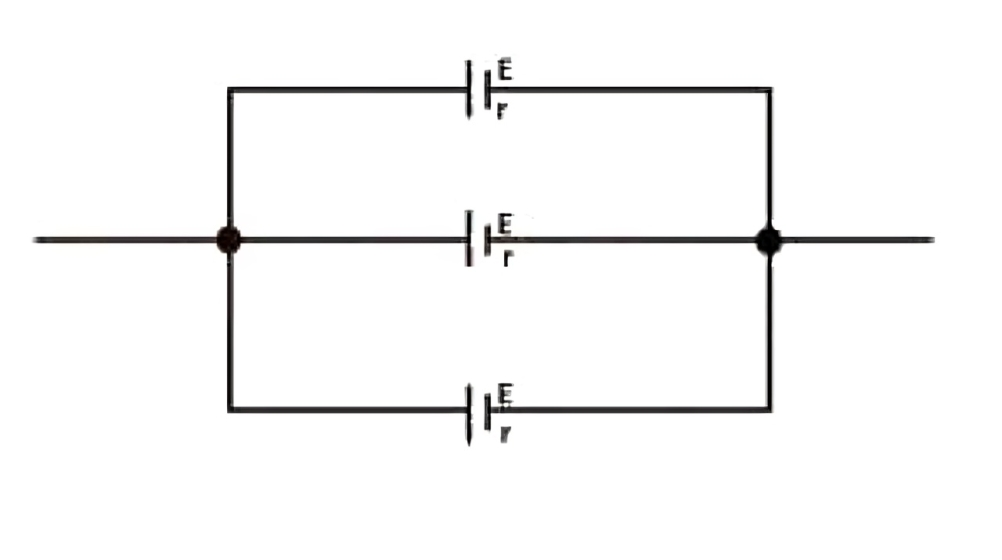
Three cells each of e.m.f 1.5 V and internal resistance 2.5Ω are connected as shown in the diagram above. Find the net e.m.f and the internal resistance
Three identical cells connected in parallel have the same terminal voltage as one cell while their internal resistances combine like resistors in parallel. For internal resistance \(r=2.5\,\Omega\) and three identical parallel branches:\[r_{eq}=\dfrac{r}{3}=\dfrac{2.5}{3}\approx0.83\,\Omega\]The net e.m.f. equals the single cell e.m.f. = 1.5 V.
Not clear enough?
Question 14
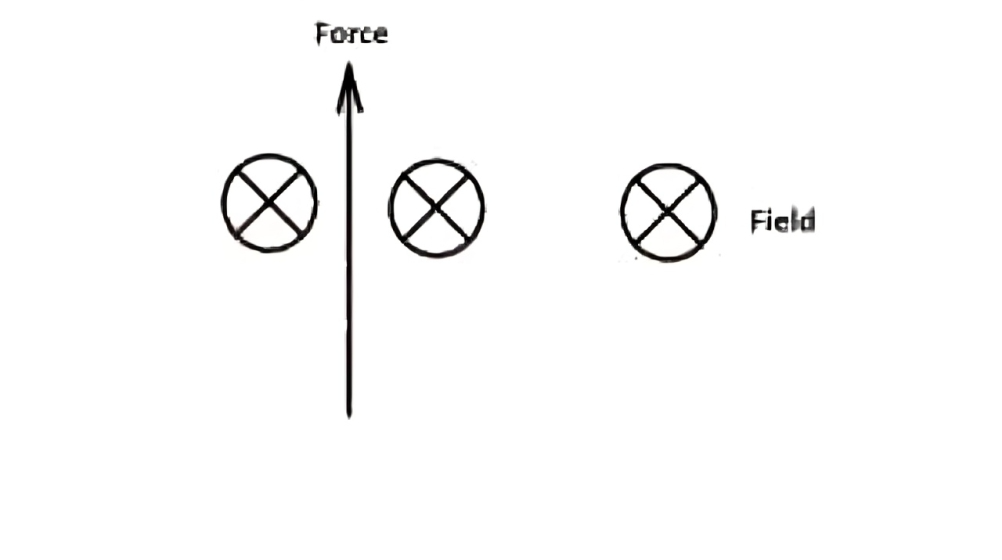
In the diagram above, if the magnetic field points into the paper and the force on a current-carrying conductor points upwards, what is the direction of the current?
Use the vector relation \(\mathbf{F}=I\mathbf{L}\times\mathbf{B}\). With magnetic field into the page and force upwards, the current direction must be towards the left so that \(\mathbf{L}\times\mathbf{B}\) points upward (use right-hand rule for cross product with conventional current).
Not clear enough?
Question 15
The instantaneous value of the induced e.m.f. as a function of time is \(\varepsilon=\varepsilon_0\sin\omega t\). The instantaneous value of the e.m.f. one quarter of the period is
One quarter period corresponds to \(\omega t=\pi/2\). Since \(\sin(\pi/2)=1\):\[\varepsilon=\varepsilon_0\sin\left(\dfrac{\pi}{2}\right)=\varepsilon_0\]
Not clear enough?
Question 16
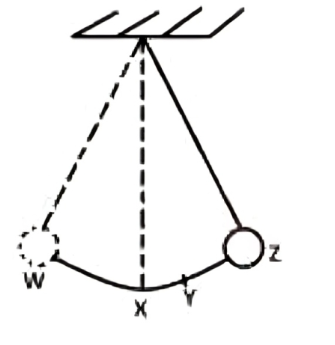
From the diagram above, the bob of the pendulum has the fastest speed at
The bob attains maximum speed at the equilibrium position where potential energy is minimum and kinetic energy is maximum. The labelled point at the centre (equilibrium) is where speed is highest.
Not clear enough?
Question 17
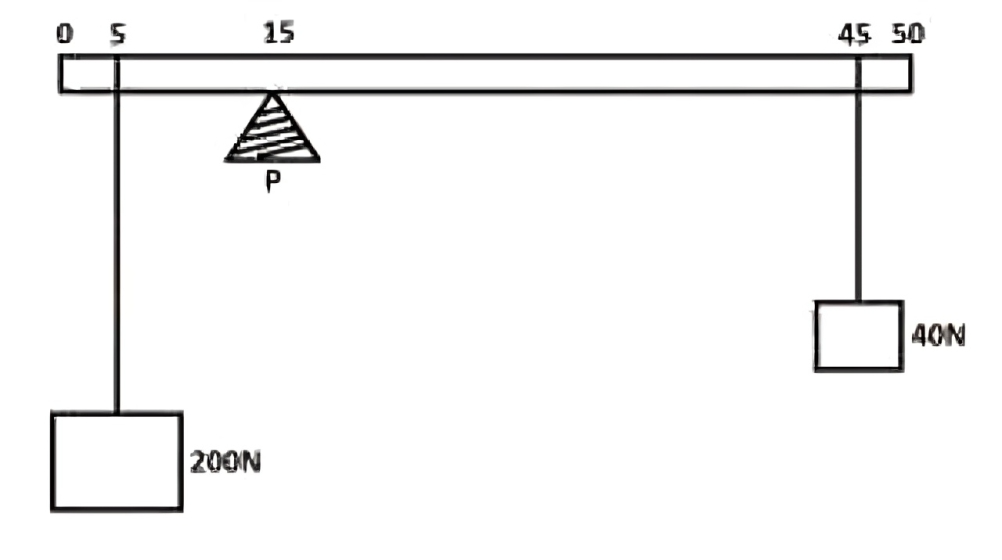
In the diagram above, a rod 50 cm long of uniform cross-section is suspended horizontally on a fulcrum, F, by the action of two forces. What is the weight of the rod?
We solve it using the principle of moments.
The rod is uniform, so its weight acts at its midpoint (25 cm from either end).
From the diagram (given in your question set), the forces balance the rod on the fulcrum. One force acts at 20 cm from F, the other at 30 cm from F.
Taking moments about F:
W × 25= (40 × 20) + (40 × 30)= 800 + 1200 = 2000$$W = \dfrac{2000}{25} = 80 \,\text{N}$$Not clear enough?
Question 18
A boy drags a bag of rice along a smooth horizontal floor with a force of 2 N applied at the angle of 60° to the floor. The work done after a distance of 3 m is
Only the horizontal component of the force does work along the floor.
Horizontal component = \(2\cos60^\circ=2\times0.5=1\,\text{N}\). Work = force × distance = \(1\times3=3\,\text{J}\).
Horizontal component = \(2\cos60^\circ=2\times0.5=1\,\text{N}\). Work = force × distance = \(1\times3=3\,\text{J}\).
Not clear enough?
Question 19
A metal has cubic expansivity \(\beta=6.3\times10^{-6}\;\text{K}^{-1}\). The areal expansivity is
For isotropic solids \(\beta\approx3\alpha\) where \(\alpha\) is linear expansivity. So \(\alpha=\beta/3=6.3\times10^{-6}/3=2.1\times10^{-6}\).
Areal expansivity ≈ \(2\alpha=2\times2.1\times10^{-6}=4.2\times10^{-6}\).
Areal expansivity ≈ \(2\alpha=2\times2.1\times10^{-6}=4.2\times10^{-6}\).
Not clear enough?
Question 20
The ratio of the coefficient of linear expansion of two metals \(\alpha_1/\alpha_2\) is 3:4. If, when heated through the same temperature change, the ratio of the increase in length \(e_1/e_2\) is 1:2, the ratio of the original lengths \(l_1/l_2\) is
For small temperature change \(\Delta T\), length increase \(e=\alpha l\Delta T\).
Hence \(\dfrac{e_1}{e_2}=\dfrac{\alpha_1 l_1}{\alpha_2 l_2}\).
Rearranging for the length ratio: \[\dfrac{l_1}{l_2}=\dfrac{e_1}{e_2}\cdot\dfrac{\alpha_2}{\alpha_1}=\dfrac{1}{2}\cdot\dfrac{4}{3}=\dfrac{2}{3}.\]
Hence \(\dfrac{e_1}{e_2}=\dfrac{\alpha_1 l_1}{\alpha_2 l_2}\).
Rearranging for the length ratio: \[\dfrac{l_1}{l_2}=\dfrac{e_1}{e_2}\cdot\dfrac{\alpha_2}{\alpha_1}=\dfrac{1}{2}\cdot\dfrac{4}{3}=\dfrac{2}{3}.\]
Not clear enough?
You might like
'I wonder how long, you awful parasites, Shall
Share with me this little bed, And awake me, from
My sweet dreams be lost, By sucking blood from
My poor head...' Mbure: To a Bed-Bug
The lines above are an example of a
Three taps A, B, C can fill an overhead tank in 4, 6 and 12 hours respectively. How long would the three taps take to fill the tank if all of them are opened together ?