
Physics 2007 Jamb Examination
Physics 2007 Jamb Examination

Question 21
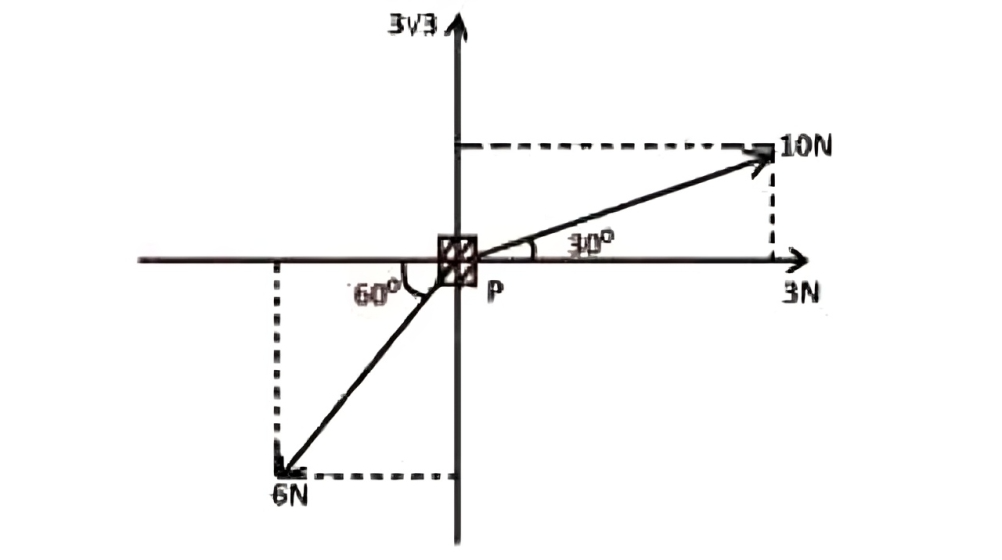
The figure above shows 4 forces 3N, 10N, 3√3N and 6N acting on a particle P. The resultant of the four forces is
Resolve each force into its rectangular components (as indicated by the diagram), sum horizontal components to get \(R_x\) and sum vertical components to get \(R_y\). The magnitude of the resultant is then given by the Pythagorean relation:\[ R=\sqrt{R_x^2+R_y^2} \]Carrying out the component addition from the diagram yields \(R_x=10\) N and \(R_y=0\) N, therefore\[ R=\sqrt{10^2+0^2}=10\;\text{N}. \]
Not clear enough?
Question 22
A 120 V, 60 W lamp is to be operated on 220 V a.c. the supply mains. Calculate the value of non-inductive resistance that would be required to ensure that the lamp is run on correct current value.
First find the lamp current at its rated conditions:\[ I=\dfrac{P}{V_{lamp}}=\dfrac{60}{120}=0.5\;\text{A}. \]The resistor must drop the difference between supply and lamp voltages: \(V_R=220-120=100\) V. Using Ohm's law for the required series resistance:\[ R=\dfrac{V_R}{I}=\dfrac{100}{0.5}=200\;\Omega.\]
Not clear enough?
Question 23
A radioactive substance has a half-life of 20 days. What fraction of the original radioactive nuclei will remain after 80 days?
Number of half-lives in 80 days:\[ n=\dfrac{80}{20}=4. \]Fraction remaining after \(n\) half-lives is \(\left(\tfrac{1}{2}\right)^n\). Therefore:\[ \left(\tfrac{1}{2}\right)^4=\tfrac{1}{16}. \]
Not clear enough?
Question 24
The energy \(E\) of a photon and its wavelength \(\lambda\) are related by \(E\lambda=X\). The numerical value of \(X\) is?
[\(h=6.63\times10^{-34}\) J·s, \(c=3\times10^8\) m·s-1]
[\(h=6.63\times10^{-34}\) J·s, \(c=3\times10^8\) m·s-1]
Photon energy relation: \(E=\dfrac{hc}{\lambda}\) so \(E\lambda=hc\). Compute numerically:\[ X=hc=(6.63\times10^{-34})(3.00\times10^{8})=19.89\times10^{-26}\;\text{J·m}=1.989\times10^{-25}. \]Rounded to two significant figures gives \(1.99\times10^{-25}\).
Not clear enough?
Question 25
The bond that forms a semiconductor is?
Semiconductors such as silicon and germanium consist of a crystal lattice in which atoms share electrons with neighbours forming directional bonds. These materials are held together predominantly by covalent bonding, which gives the characteristic band structure enabling semiconducting behaviour.
Not clear enough?
Question 26
Silicon doped with aluminium and germanium doped with arsenic become?
Aluminium has one fewer valence electron than silicon, so it creates acceptor levels leading to a p-type material. Arsenic has one more valence electron than germanium (or silicon), creating donor levels and producing n-type material.
Not clear enough?
Question 27
A charge 50 \(\mu\)C produces electric field strength 360 N·C-1 at a point. The electric field strength due to another charge 120 \(\mu\)C at the same distance in the same medium is?
Electric field from a point charge is proportional to charge: \(E\propto q\) at fixed distance. So scale the given field by the charge ratio:\[ E_2=E_1\times\dfrac{q_2}{q_1}=360\times\dfrac{120}{50}=360\times2.4=864\;\text{N·C}^{-1}. \]
Not clear enough?
Question 28
If two charged plates are maintained at a potential difference of 3 kV, the work done in taking a charge of 600 \(\mu\)C across the field is?
Work done in moving charge across a potential difference: \(W=QV\). Convert units: \(Q=600\times10^{-6}\) C, \(V=3000\) V.\[ W=(600\times10^{-6})(3000)=1.8\;\text{J}. \]
Not clear enough?
Question 29
A conductor has diameter 1.00 mm and length 2.00 m. If the resistance is 0.1 \(\Omega\), its resistivity is?
Resistivity relation: \(\rho=R\dfrac{A}{L}\). Area of circular cross-section: \(A=\pi r^2\) with \(r=0.5\times10^{-3}\) m.\[ A=\pi(0.5\times10^{-3})^2=\pi\times0.25\times10^{-6}=7.85398\times10^{-7}\;\text{m}^2. \]Compute \(\rho\):\[ \rho=0.1\times\dfrac{7.85398\times10^{-7}}{2.0}=3.92699\times10^{-8}\;\Omega\,\text{m}\approx3.93\times10^{-8}. \]
Not clear enough?
Question 30
A 40 kW electric cable is used to transmit electricity through a resistor of resistance 2.0 \(\Omega\) at 800 V. The power loss as internal energy is?
Find transmission current: \(I=\dfrac{P}{V}=\dfrac{40000}{800}=50\) A. Power loss in resistor: \(P_{loss}=I^2R=50^2\times2=2500\times2=5000\) W = \(5.0\times10^3\) W.
Not clear enough?
You might like
Choose the option nearest in meaning to the underlined word.
I cannot stand Simon. I find his attitude offensive?
What is the technical term used to describe any data that is stored or transmitted without being encrypted?
Using the 'Rule of Nines' for burn assessment, what is the total body surface area (TBSA) percentage for a third-degree burn covering the entire left arm and the entire back?