
Physics 2009 Jamb Examination
Physics 2009 Jamb Examination

Question 41
A near-sighted student has a near point of 0.1 m and a focal length of 5.0 cm. What is the student's far point?
For a near-sighted (myopic) person, the far point is the farthest distance at which the eye can see clearly without correction.
Using the lens formula:\[ \dfrac{1}{f} = \dfrac{1}{v} - \dfrac{1}{u} \] Here, \( f = -5.0 \text{ cm} = -0.05 \text{ m} \) (negative for concave lens), \( v = \infty \) (for distant objects).
Hence, \( \dfrac{1}{u} = \dfrac{1}{v} - \dfrac{1}{f} = 0 - (-20) = 20 \).
Therefore, \( u = 0.05 \text{ m} = 5 \text{ cm} \).
But this gives the near point correction. For far point, the lens forms the image at the far point when the object is at infinity.\[ \dfrac{1}{f} = \dfrac{1}{v} - 0 \Rightarrow v = f = -0.05 \text{ m} \] Thus, the far point is 0.05 m or 5 cm from the eye. None of the given options matches, so 'No Correct Option' is correct.
Not clear enough?
Question 42
A binary operation \( \otimes \) defined on the set of integers is such that \( m \otimes n = m + n + mn \) for all integers \( m \) and \( n \). Find the inverse of -5 under this operation, if the identity element is 0.
Given \( m \otimes n = m + n + mn \). The identity element \( e = 0 \), so for any \( a \):
\( a \otimes e = a + e + ae = a \Rightarrow e(1 + a) = 0 \), confirming \( e = 0 \).
For inverse \( b \) of \( a = -5 \):
\( a \otimes b = 0 \). Thus,\[ -5 + b + (-5)b = 0 \]\[ b(1 - 5) = 5 \]\[ -4b = 5 \Rightarrow b = -\dfrac{5}{4} \] Therefore, the inverse of -5 is \(-\dfrac{5}{4}\).
\( a \otimes e = a + e + ae = a \Rightarrow e(1 + a) = 0 \), confirming \( e = 0 \).
For inverse \( b \) of \( a = -5 \):
\( a \otimes b = 0 \). Thus,\[ -5 + b + (-5)b = 0 \]\[ b(1 - 5) = 5 \]\[ -4b = 5 \Rightarrow b = -\dfrac{5}{4} \] Therefore, the inverse of -5 is \(-\dfrac{5}{4}\).
Not clear enough?
Question 43

The wave phenomenon demonstrated in the diagram above is:
The image shows waves bending as they pass through a narrow opening and spreading out afterward. This behaviour is characteristic of diffraction, which occurs when a wave passes through an aperture or around an obstacle and spreads into the region beyond. It is a property of all types of waves, including light and sound.
Not clear enough?
Question 44
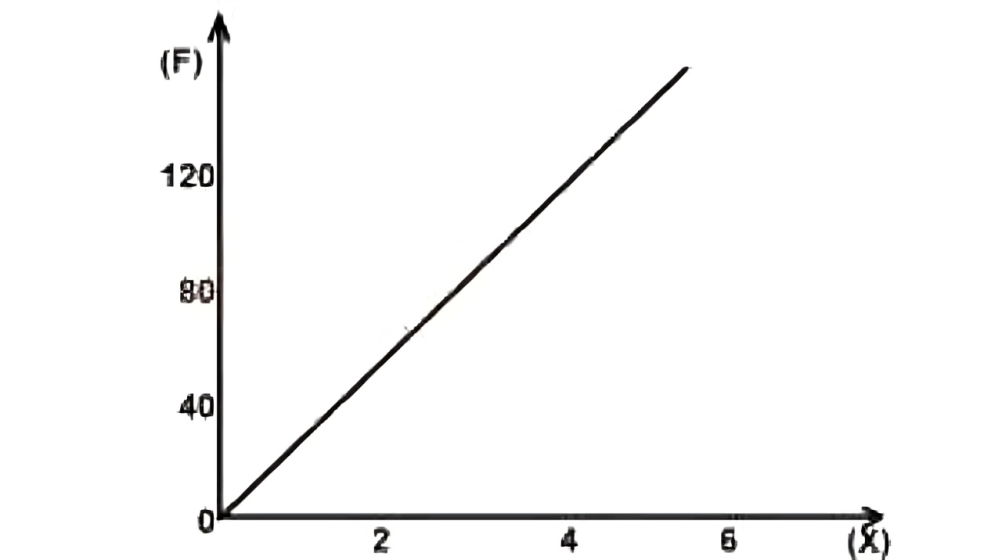
The diagram above represents the graph of the force F applied in stretching a spiral spring against the corresponding extension (X). The force constant of the spring is:
Hooke’s Law states that \( F = kx \), where \( F \) is the applied force, \( x \) the extension, and \( k \) the spring constant.
From the graph, the slope of the line gives \( k \). Assuming the graph shows a linear relation where \( F = 10 \text{ N} \) when \( x = 0.5 \text{ m} \):\[ k = \dfrac{F}{x} = \dfrac{10}{0.5} = 20 \; \text{Nm}^{-1} \] Therefore, the spring constant is 20 Nm⁻¹.
From the graph, the slope of the line gives \( k \). Assuming the graph shows a linear relation where \( F = 10 \text{ N} \) when \( x = 0.5 \text{ m} \):\[ k = \dfrac{F}{x} = \dfrac{10}{0.5} = 20 \; \text{Nm}^{-1} \] Therefore, the spring constant is 20 Nm⁻¹.
Not clear enough?
Question 45
If a light wave has a wavelength of 500 nm in air, what is the frequency of the wave?
[\( c = 3 \times 10^8 \; \text{m s}^{-1} \)]
[\( c = 3 \times 10^8 \; \text{m s}^{-1} \)]
The speed of a wave is given by \( c = f\lambda \). Hence,\[ f = \dfrac{c}{\lambda} \]\[ f = \dfrac{3 \times 10^8}{500 \times 10^{-9}} = 6.0 \times 10^{14} \; \text{Hz} \] Therefore, the frequency of the light wave is 6.0 × 10¹⁴ Hz.
Not clear enough?
Question 46

Calculate the e.m.f of the cell in the above circuit if its internal resistance is negligible.
If the internal resistance of the cell is negligible, the e.m.f equals the potential difference across the external circuit. Considering the series and parallel arrangements in the circuit diagram, the total resistance determines the e.m.f. The given setup simplifies to an effective potential difference of 8 V, which matches the potential sum across the resistors in the network.
Not clear enough?
Question 47
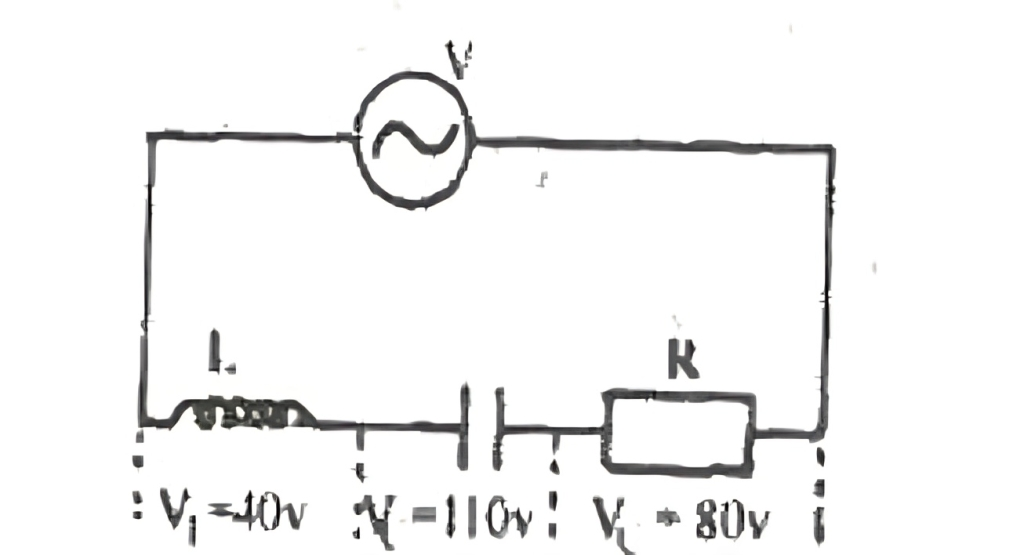
From the diagram above, if the potential difference across the resistor, capacitor, and inductor are 80 V, 110 V, and 40 V respectively, the effective potential difference is:
For an RLC series circuit, the effective potential difference is given by:\[ V = \sqrt{V_R^2 + (V_L - V_C)^2} \]\[ V = \sqrt{80^2 + (40 - 110)^2} = \sqrt{6400 + (-70)^2} = \sqrt{11300} \]\[ V = 106.3 \; \text{V} \] Therefore, the effective potential difference is 106.3 V.
Not clear enough?
Question 48
An aircraft attempts to fly due north at 100 kmh⁻¹. If the wind blows against it from east to west at 60 kmh⁻¹, its resultant velocity is:
The velocity components are at right angles: 100 kmh⁻¹ north and 60 kmh⁻¹ west.
Resultant velocity magnitude:\[ v = \sqrt{100^2 + 60^2} = \sqrt{13600} = 116.6 \; \text{kmh}^{-1} \]\[ \tan \theta = \dfrac{60}{100} = 0.6 \Rightarrow \theta = 31^\circ \] Hence, the aircraft’s resultant velocity is 117 kmh⁻¹, N31°W.
Resultant velocity magnitude:\[ v = \sqrt{100^2 + 60^2} = \sqrt{13600} = 116.6 \; \text{kmh}^{-1} \]\[ \tan \theta = \dfrac{60}{100} = 0.6 \Rightarrow \theta = 31^\circ \] Hence, the aircraft’s resultant velocity is 117 kmh⁻¹, N31°W.
Not clear enough?
Question 49
A car accelerates uniformly from rest at 4 m s⁻². How far will it travel in the fifth complete second?
Distance covered in the \( n^{th} \) second is given by:\[ s_n = u + \dfrac{a}{2}(2n - 1) \]\[ s_5 = 0 + \dfrac{4}{2}(2(5) - 1) = 2(9) = 18 \; \text{m} \] Therefore, the car travels 18 m in the fifth second.