Physics 2011 Jamb Examination

Physics 2011 Jamb Examination

Available Sections
2. Career
4. Job
12345

Question 1

If the volume of a gas increases steadily as the temperature decreases at constant pressure, the gas obeys
Show explanation Expand Question
According to Boyle’s Law, at constant temperature, the volume of a gas is inversely proportional to its pressure. However, in this question, the pressure is constant while the volume changes with temperature. Charles’ Law states that at constant pressure, the volume of a fixed mass of gas is directly proportional to its absolute temperature. Hence, when temperature decreases, the volume decreases as well. Since the question mentions that volume increases as temperature decreases, this is contrary to Charles’ Law and inconsistent with any of the stated gas laws. Therefore, no given option accurately describes such behaviour, as it violates the normal gas laws.
Not clear enough?

Question 2

In homes, electrical appliances and lamps are connected in parallel because
Show explanation Expand Question
In household circuits, appliances are connected in parallel so that each device receives the full supply voltage and can operate independently. If connected in series, switching off one device would interrupt current flow to others. Parallel connections also allow each appliance to draw the current it needs without affecting others. Hence, the main reason for using parallel connection is that each appliance gets the same voltage as the supply, not less.
Not clear enough?

Question 3

In an A.C circuit, the ratio of r.m.s value to peak value of current is
Show explanation Expand Question
For a sinusoidal alternating current, the r.m.s (root mean square) value is related to the peak value by the expression \( I_{rms} = \dfrac{I_{0}}{\sqrt{2}} \). Hence, the ratio of the r.m.s value to the peak value is \( \dfrac{1}{\sqrt{2}} \), which is approximately 0.707. This ratio is standard for all sinusoidal AC quantities such as current and voltage.
Not clear enough?

Question 4

Two resistors 5Ω and 10Ω are arranged first in series and later in parallel to a 24V source, the ratio of total power dissipated in the series and parallel arrangements respectively is
Show explanation Expand Question
For the series connection:\[R_s = 5 + 10 = 15\;\Omega\]Power dissipated, \(P_s = \dfrac{V^2}{R_s} = \dfrac{24^2}{15} = 38.4\;W\)

For the parallel connection:\[\dfrac{1}{R_p} = \dfrac{1}{5} + \dfrac{1}{10} = \dfrac{3}{10} \Rightarrow R_p = 3.33\;\Omega\]Power dissipated, \(P_p = \dfrac{V^2}{R_p} = \dfrac{24^2}{3.33} = 172.8\;W\)

Therefore, the ratio of power in series to parallel arrangement is:\[P_s : P_p = 38.4 : 172.8 = 1 : 4.5\]None of the provided options correctly matches this ratio.
Not clear enough?

Question 5

The bond between silicon and germanium is
Show explanation Expand Question
Silicon and germanium are both group IV elements with similar electronegativities. They share electrons equally to form a covalent bond, typical of elements with four valence electrons. The bond is neither ionic nor dative because there is no transfer of electrons or lone pair donation; instead, they share electrons to achieve a stable configuration.
Not clear enough?

Question 6

An image in a convex lens is upright and magnified 3 times. If the focal length of the lens is 15 cm, what is the object distance?
Show explanation Expand Question
For an upright and magnified image formed by a convex lens, the image is virtual and the object lies within the focal length. Using the magnification formula:\[m = \dfrac{v}{u}\] and the lens formula:\[\dfrac{1}{f} = \dfrac{1}{v} - \dfrac{1}{u}\]Given \(m = 3\) and \(f = 15\;cm\), so \(v = 3u\). Substituting:\[\dfrac{1}{15} = \dfrac{1}{3u} - \dfrac{1}{u}\]\[\dfrac{1}{15} = \dfrac{1 - 3}{3u} = -\dfrac{2}{3u}\]\[u = -10\;cm\]Hence, the object distance is 10 cm (the negative sign indicates the object is on the same side as the incident light).
Not clear enough?

Question 7

A length of wire has a frequency of 255Hz when stretched by a force of 225N. If the force is increased to 324N, what is the new frequency of vibration?
Show explanation Expand Question
The frequency of a vibrating string is given by:\[f \propto \sqrt{T}\]Therefore:\[\dfrac{f_2}{f_1} = \sqrt{\dfrac{T_2}{T_1}}\]\[f_2 = 255 \times \sqrt{\dfrac{324}{225}} = 255 \times \sqrt{1.44} = 255 \times 1.2 = 306\;Hz\]Hence, the new frequency is 306 Hz.
Not clear enough?

Question 8

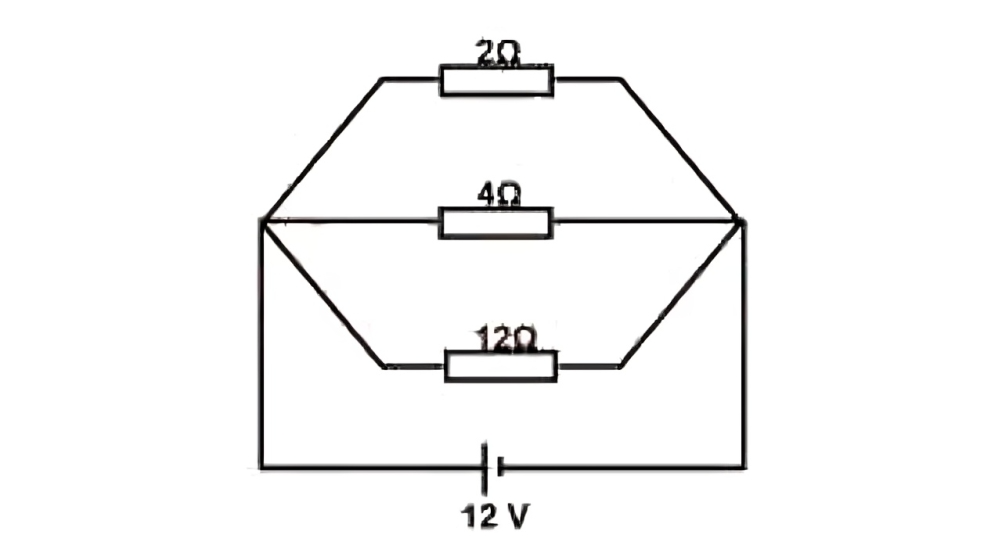
three resistors, 2Ω, 4Ω and 12Ω are connected in parallel and a 12V battery is connected across the combination
In the circuit above, three resistors, 2Ω, 4Ω and 12Ω are connected in parallel and a 12V battery is connected across the combination. The current flowing through the 12Ω resistor is
Show explanation Expand Question
In a parallel connection, the voltage across each resistor is the same as the source voltage. Using Ohm’s law:\[I = \dfrac{V}{R}\]For the 12Ω resistor:\[I = \dfrac{12}{12} = 1.0\;A\]Hence, the current through the 12Ω resistor is 1.0 A.
Not clear enough?

Question 9

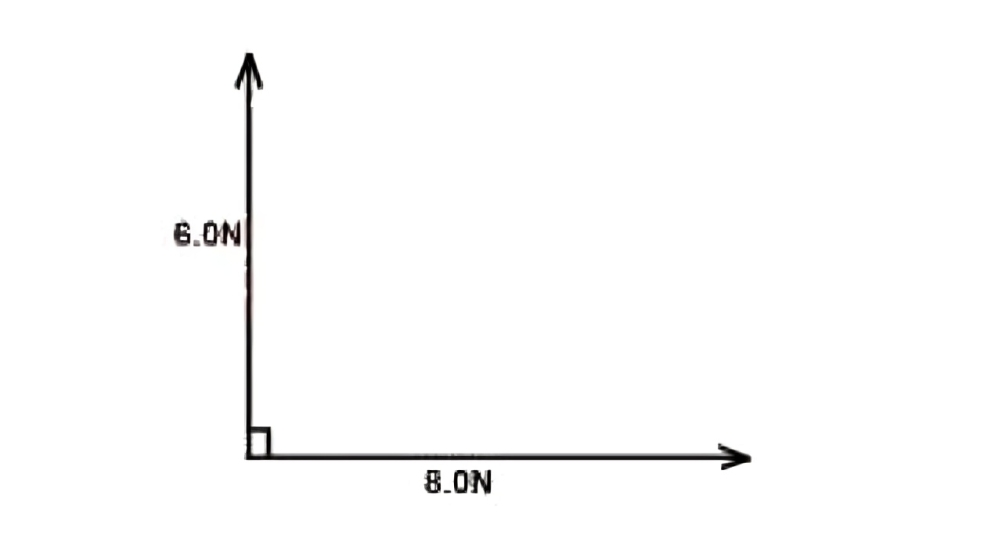
The diagram above shows two vectors at right angles to each other. The value of the resultant vector is
Show explanation Expand Question
When two vectors act at right angles, their resultant is given by Pythagoras’ theorem:\[R = \sqrt{P^2 + Q^2}\] If the perpendicular components are 6 N and 8 N (as is standard for such vector diagrams), then:\[R = \sqrt{6^2 + 8^2} = \sqrt{100} = 10\;N\] Therefore, the resultant vector is 10.0 N.
Not clear enough?

Question 10

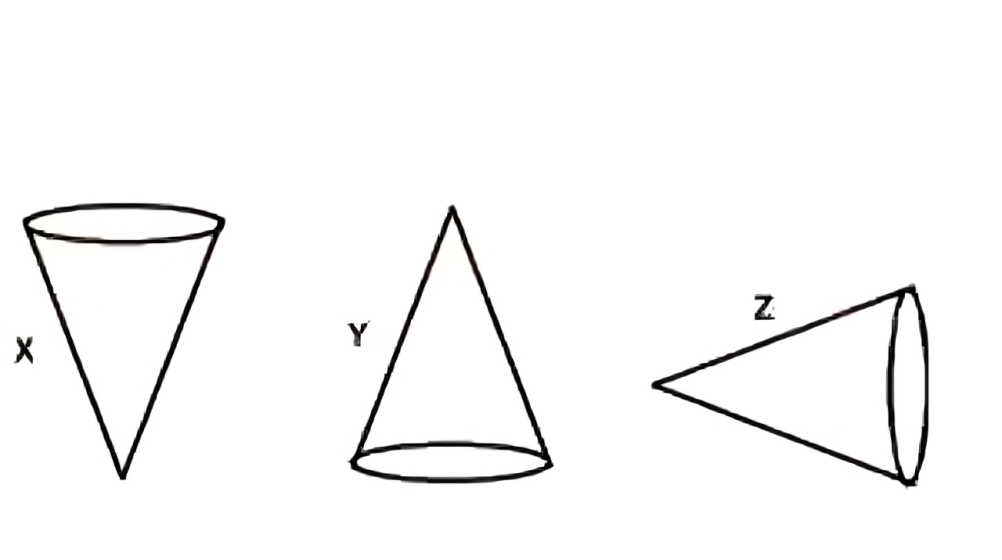
The diagram above show the positions of a cone. The position which can be described as neutral equilibrium is represented as
The diagram above shows the positions of a cone. The position which can be described as neutral equilibrium is represented as
Show explanation Expand Question
A body is in neutral equilibrium when its centre of gravity remains at the same height after slight displacement. For a cone lying on its side (position Z), any small movement does not change the height of its centre of gravity, so it neither tends to return nor move further away from its original position. Hence, Z represents neutral equilibrium.
Not clear enough?

12345
In this page
Physics 2011 Jamb Examination
Open Model!