
Physics 2013 Jamb Examination
Physics 2013 Jamb Examination

Question 11
What volume of alcohol will have same mass as 4.2m\(^{3}\) of petrol?
Density of alcohol = 8.4 x 10\(^{2}\) kgm\(^{-3}\), density of petrol = 7.2 x 10\(^{2}\) kgm\(^{-3}\)
Density of alcohol = 8.4 x 10\(^{2}\) kgm\(^{-3}\), density of petrol = 7.2 x 10\(^{2}\) kgm\(^{-3}\)
To find the volume of alcohol that has the same mass as a given volume of petrol, we first recall the relationship between mass, density, and volume: \[ m = \rho V \] Since the masses are equal: \[ m_{\text{alcohol}} = m_{\text{petrol}} \] \[ \rho_{\text{alcohol}} \times V_{\text{alcohol}} = \rho_{\text{petrol}} \times V_{\text{petrol}} \] Given: \[ \rho_{\text{alcohol}} = 8.4 \times 10^{2} \; \text{kgm}^{-3} \] \[ \rho_{\text{petrol}} = 7.2 \times 10^{2} \; \text{kgm}^{-3} \] \[ V_{\text{petrol}} = 4.2 \; \text{m}^{3} \] Substituting the values: \[ 840 \times V_{\text{alcohol}} = 720 \times 4.2 \] \[ 840 \times V_{\text{alcohol}} = 3024 \] \[ V_{\text{alcohol}} = \frac{3024}{840} \] \[ V_{\text{alcohol}} = 3.6 \; \text{m}^{3} \] Thus, a volume of 3.6m\(^{3}\) of alcohol is required to match the mass of 4.2m\(^{3}\) of petrol.
Not clear enough?
Question 12
Calculate the length which corresponds to a temperature of 20°C if the ice and steam points of an ungraduated thermometer are 400 mm apart
Temperature on a linear scale can be calculated by comparing the ratio of the length at a specific temperature to the total length between the fixed points. The formula for a mercury-in-glass thermometer is: \[ \frac{\theta - \theta_0}{\theta_{100} - \theta_0} = \frac{L_{\theta} - L_0}{L_{100} - L_0} \] Given that the ice point (\(0^{\circ}\)C) and steam point (\(100^{\circ}\)C) are 400 mm apart, this distance represents the fundamental interval \(L_{100} - L_0\). We want to find the length \(L_{\theta} - L_0\) above the ice point for \(\theta = 20^{\circ}\)C. \[ \frac{20 - 0}{100 - 0} = \frac{L_{20} - L_0}{400} \] \[ \frac{20}{100} = \frac{L_{20} - L_0}{400} \] \[ 0.2 = \frac{L_{20} - L_0}{400} \] \[ L_{20} - L_0 = 0.2 \times 400 \] \[ L_{20} - L_0 = 80 \; \text{mm} \] This means the mercury level at 20°C is 80 mm above the ice point.
Not clear enough?
Question 13
A wire of length 100.0m at 30°C has linear expansivity of 2x10\(^{-5}\)K\(^{-1}\). Calculate the length of the wire at a temperature of -10°C
Linear expansion (or contraction) is determined by the formula: \[ L_2 = L_1 [1 + \alpha(\theta_2 - \theta_1)] \] Given: \[ L_1 = 100.0 \; \text{m} \] \[ \theta_1 = 30^{\circ}\text{C} \] \[ \theta_2 = -10^{\circ}\text{C} \] \[ \alpha = 2 \times 10^{-5} \; \text{K}^{-1} \] First, find the change in temperature: \[ \Delta\theta = \theta_2 - \theta_1 = -10 - 30 = -40^{\circ}\text{C} \] Now calculate the new length: \[ L_2 = 100.0 [1 + (2 \times 10^{-5} \times -40)] \] \[ L_2 = 100.0 [1 - 0.0008] \] \[ L_2 = 100.0 \times 0.9992 \] \[ L_2 = 99.92 \; \text{m} \] Since the temperature decreased, the wire contracted, resulting in a length of 99.92m.
Not clear enough?
Question 14
A gas at a pressure of 10\(^{5}\)Nm\(^{-2}\) expands from 0.6m\(^{3}\) to 1.2m\(^{3}\) at constant temperature, the work done is
For a gas expanding against a constant external pressure, the work done \(W\) is given by the formula: \[ W = P \Delta V \] where \(P\) is the pressure and \(\Delta V\) is the change in volume (\(V_2 - V_1\)). Given: \[ P = 10^{5} \; \text{Nm}^{-2} \] \[ V_1 = 0.6 \; \text{m}^{3} \] \[ V_2 = 1.2 \; \text{m}^{3} \] \[ \Delta V = 1.2 - 0.6 = 0.6 \; \text{m}^{3} \] Substituting into the formula: \[ W = 10^{5} \times 0.6 \] \[ W = 6.0 \times 10^{4} \; \text{J} \] Although real isothermal expansion work involves a natural logarithm, in introductory physics contexts like this where a single pressure is provided, the isobaric work formula is the expected approach.
Not clear enough?
Question 15
Two liquids X and Y having the same mass are supplied with the same quantity of heat. If the temperature rise in X is twice that of Y, the ratio of specific heat capacity of X to that of Y is
The quantity of heat \(Q\) required to raise the temperature of a substance is given by: \[ Q = mc\Delta\theta \] For liquid X: \[ Q_X = m_X c_X \Delta\theta_X \] For liquid Y: \[ Q_Y = m_Y c_Y \Delta\theta_Y \] Since the mass (\(m\)) and the quantity of heat (\(Q\)) are the same for both: \[ m c_X \Delta\theta_X = m c_Y \Delta\theta_Y \] \[ c_X \Delta\theta_X = c_Y \Delta\theta_Y \] We are told that the temperature rise in X is twice that of Y (\(\Delta\theta_X = 2\Delta\theta_Y\)): \[ c_X (2\Delta\theta_Y) = c_Y \Delta\theta_Y \] Dividing both sides by \(\Delta\theta_Y\): \[ 2c_X = c_Y \] \[ \frac{c_X}{c_Y} = \frac{1}{2} \] Therefore, the ratio of the specific heat capacity of X to that of Y is 1:2.
Not clear enough?
Question 16
Steam from boiling water causes more damage on the skin than does boiling water because
Both boiling water and steam exist at 100°C under standard atmospheric pressure. However, steam possesses a significantly higher total energy content due to the latent heat of vaporisation.
When steam comes into contact with the skin, it first undergoes a phase change, condensing into liquid water at 100°C. During this condensation process, it releases a large amount of latent heat (approximately 2260 kJ/kg). Only after this phase change does the resulting 100°C water continue to cool down and transfer more heat to the skin. Boiling water only transfers sensible heat as its temperature drops. This extra burst of energy from condensation makes steam burns much more severe.
When steam comes into contact with the skin, it first undergoes a phase change, condensing into liquid water at 100°C. During this condensation process, it releases a large amount of latent heat (approximately 2260 kJ/kg). Only after this phase change does the resulting 100°C water continue to cool down and transfer more heat to the skin. Boiling water only transfers sensible heat as its temperature drops. This extra burst of energy from condensation makes steam burns much more severe.
Not clear enough?
Question 17
What will happen to the boiling point of pure water when it is heated in a place 30m below sea level?
The boiling point of a liquid is the temperature at which its vapour pressure equals the external atmospheric pressure. Atmospheric pressure increases as you go deeper below sea level (due to the increased weight of the air column above).
When the external pressure increases, the water molecules require more kinetic energy (and thus a higher temperature) to escape the surface of the liquid and form bubbles of vapour. Since standard boiling point (100°C) is measured at sea level, heating water in a location below sea level (where pressure is higher) will cause the boiling point to rise above 100°C.
When the external pressure increases, the water molecules require more kinetic energy (and thus a higher temperature) to escape the surface of the liquid and form bubbles of vapour. Since standard boiling point (100°C) is measured at sea level, heating water in a location below sea level (where pressure is higher) will cause the boiling point to rise above 100°C.
Not clear enough?
Question 18
The rise or fall of a liquid in a narrow tube is because of the
The phenomenon of a liquid rising or falling in a narrow tube is known as capillarity. It is a direct result of the interplay between the surface tension of the liquid and the relative strengths of adhesive forces (between the liquid and the tube wall) and cohesive forces (between liquid molecules).
Surface tension acts to minimise the surface area of the liquid, creating a curved meniscus. In narrow tubes, this force is sufficient to pull the liquid up against gravity (if adhesion > cohesion, like water in glass) or push it down (if cohesion > adhesion, like mercury in glass).
Surface tension acts to minimise the surface area of the liquid, creating a curved meniscus. In narrow tubes, this force is sufficient to pull the liquid up against gravity (if adhesion > cohesion, like water in glass) or push it down (if cohesion > adhesion, like mercury in glass).
Not clear enough?
Question 19
The mechanism of heat transfer from one point to another through the vibration of the molecules of the medium is
Conduction is the primary method of heat transfer in solids. It occurs when thermal energy is passed from one molecule to another through direct contact and vibration. When a part of a solid is heated, the molecules gain kinetic energy and vibrate more vigorously. These vibrations are then transferred to neighbouring molecules through collisions. In metals, this process is significantly enhanced by the movement of free (delocalised) electrons, but the fundamental mechanism involving molecular vibration is conduction.
Not clear enough?
Question 20
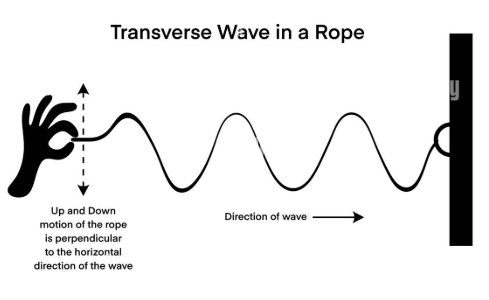
A wave that travels through stretched strings is known as
Mechanical waves are waves that require a material medium (solid, liquid, or gas) to propagate. They transfer energy through the oscillation of the particles in that medium. Stretched strings serve as a physical medium for transverse waves, where the displacement of the string is perpendicular to the direction of wave travel. Unlike electromagnetic waves, which can travel through a vacuum, the waves on a string cannot exist without the string itself, categorising them firmly as mechanical waves.
Not clear enough?
You might like
A public company with an authorized capital of N60,000, issued N36,000 shares at 1.50k each. What is its capital?
Farm management pulls together facts and findings from various sciences (like agronomy, animal science, and economics) to solve individual farmers' problems. Therefore, it is best described as an __________.