Physics 2014 Jamb Examination
Physics 2014 Jamb Examination

Question 31
A circuit has a resistance of 200Ω. The resistance of the circuit can be reduced to 120Ω when
To reduce the total resistance of a circuit, a resistor must be added in parallel. The formula for total resistance \( R_T \) in parallel is: \[ \frac{1}{R_T} = \frac{1}{R_1} + \frac{1}{R_2} \] Given \( R_1 = 200\Omega \) and the desired \( R_T = 120\Omega \): \[ \frac{1}{120} = \frac{1}{200} + \frac{1}{R_2} \] \[ \frac{1}{R_2} = \frac{1}{120} - \frac{1}{200} \] The LCM of 120 and 200 is 600: \[ \frac{1}{R_2} = \frac{5 - 3}{600} = \frac{2}{600} \] \[ R_2 = \frac{600}{2} = 300\Omega \] Thus, a 300Ω resistor must be connected in parallel.
Not clear enough?
Question 32
PHCN measures its electrical energy in
PHCN (now DisCos in Nigeria) and other utility companies measure electrical energy consumption in kilowatt-hours (kWh). While the Joule (J) is the SI unit for energy, it is too small for commercial billing. One kilowatt-hour represents the energy consumed by a 1000-watt appliance running for one hour.
Not clear enough?
Question 33
What is the best method of demagnetizing a steel bar magnet?
While hammering and heating can demagnetize a magnet, the most complete and efficient 'best' method is the electrical (solenoid) method. The magnet is placed inside a solenoid connected to an alternating current (AC) source. As the magnet is slowly withdrawn to a distance while the current is still flowing, the rapidly reversing magnetic field gradually reduces the alignment of the magnetic domains to zero.
Not clear enough?
Question 34
The magnitude of the angle of dip at the equator is
The angle of dip (magnetic inclination) is the angle that the Earth's magnetic field lines make with the horizontal plane. At the magnetic equator, the magnetic field lines are perfectly horizontal, so the angle of dip is 0°. At the magnetic poles, the lines are vertical, resulting in an angle of dip of 90°.
Not clear enough?
Question 35
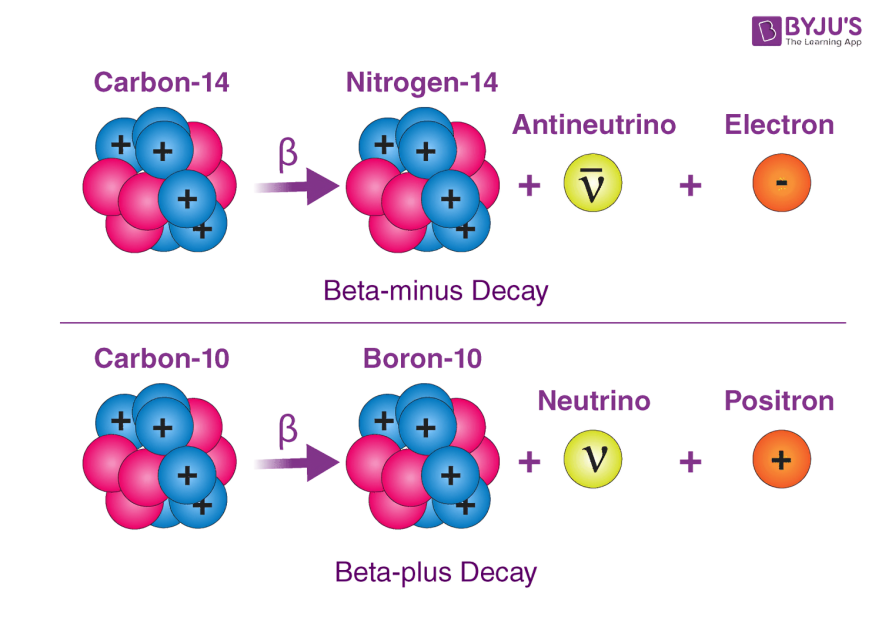
When an atom undergoes a beta decay, the atomic number of the nucleus
In standard beta decay (\(\beta^-\)), a neutron in the nucleus transforms into a proton and an electron (the beta particle).
Not clear enough?
Question 36
Calculate the mass of the copper deposited during electrolysis when a current of 4A passes through a copper salt for 2 hours. [Ece of Copper z=3.3x10\(^{-7}\)kgC\(^{-1}\)]
Using Faraday's first law of electrolysis: \( m = zIt \)
Given:
\( z = 3.3 \times 10^{-7} \; \text{kgC}^{-1} \)
\( I = 4 \; \text{A} \)
\( t = 2 \; \text{hours} = 2 \times 3600 = 7200 \; \text{s} \)\[ m = (3.3 \times 10^{-7}) \times 4 \times 7200 \] \[ m = (3.3 \times 10^{-7}) \times 28800 \] \[ m = 0.009504 \; \text{kg} \] In scientific notation: \( 9.5 \times 10^{-3} \; \text{kg} \).
Not clear enough?
Question 37
Which gas produces a red coloured light in a discharge tube?
Neon is well known for its distinct reddish-orange glow when used in gas discharge tubes (neon signs). Other gases produce different colors: Mercury vapor typically produces blue/violet light, and Argon produces a pale lavender or blue glow.
Not clear enough?
Question 38
Which of the following is NOT a Fundamental S.I unit?
The seven fundamental SI units are the metre (length), kilogram (mass), second (time), ampere (electric current), kelvin (temperature), mole (amount of substance), and candela (luminous intensity). The Newton (N) is a derived unit used for force, defined as \[ 1 \; \text{N} = 1 \; \text{kg} \cdot \text{m/s}^2 \]
Not clear enough?
Question 39
When \( ^{210}_{82}Pb \) decays to \( ^{206}_{80}Pb \), it emits
Compare the changes in mass number (A) and atomic number (Z):
Change in A: \( 210 - 206 = 4\)
Change in Z: \( 82 - 80 = 2 \)
An alpha particle (\( ^{4}_{2}He \)) has a mass of 4 and an atomic number of 2. Since the reduction in both numbers perfectly matches the composition of one alpha particle, the decay involves the emission of exactly one alpha particle.
Change in A: \( 210 - 206 = 4\)
Change in Z: \( 82 - 80 = 2 \)
An alpha particle (\( ^{4}_{2}He \)) has a mass of 4 and an atomic number of 2. Since the reduction in both numbers perfectly matches the composition of one alpha particle, the decay involves the emission of exactly one alpha particle.
Not clear enough?
Question 40
What type of reaction is represented by the equation \( ^{2}_{1}X + ^{2}_{1}X \rightarrow ^{3}_{2}Y + ^{1}_{0}n + \text{Energy} \)
The equation shows two light nuclei (isotopes of Hydrogen, likely Deuterium) combining to form a heavier nucleus (an isotope of Helium) and a neutron, accompanied by the release of energy. The process of combining light nuclei to form a heavier one is called nuclear fusion.