Physics 2015 Jamb Examination
Physics 2015 Jamb Examination

Question 41
A radioactive source emits X–rays of very short wavelength (10\(^{-13}\)m). What is the frequency of these rays?
X-rays are electromagnetic waves and therefore travel at the speed of light in a vacuum. To find the frequency, we use the wave equation that relates speed, frequency, and wavelength:\[ v = f\lambda \]Given:
Velocity of light \( c = 3 \times 10^{8} \; \text{ms}^{-1} \)
Wavelength \( \lambda = 10^{-13} \; \text{m} \)
Rearranging the formula to solve for frequency (f):\[ f = \frac{c}{\lambda} \]\[ f = \frac{3 \times 10^{8}}{10^{-13}} \]\[ f = 3 \times 10^{(8 - (-13))} \]\[ f = 3 \times 10^{21} \; \text{Hz} \]The frequency of the X-rays is 3 × 10\(^{21}\)Hz.
Not clear enough?
Question 42
The strength of an electromagnet increases with
An electromagnet is a type of magnet in which the magnetic field is produced by an electric current. The magnetic flux density (strength) of a solenoid or electromagnet is directly proportional to both the current flowing through the wire and the number of turns in the coil. By increasing the number of turns, the magnetic fields produced by each individual loop of wire add together, creating a much stronger overall field. Increasing the current would also increase the strength, but decreasing it or increasing the distance between poles would weaken the effect.
Not clear enough?
Question 43
Which of the following will increase the boiling point of water?
I. Taking it to a high altitude
II. Dissolving a salt into it
III. Heating it in a sealed flask
IV. Increasing the rate of heat supply
I. Taking it to a high altitude
II. Dissolving a salt into it
III. Heating it in a sealed flask
IV. Increasing the rate of heat supply
The boiling point of a liquid is the temperature at which its vapour pressure equals the external atmospheric pressure. There are two primary ways to increase this temperature:
1. Adding Impurities: Dissolving a non-volatile solute like salt into water lowers its vapour pressure, meaning a higher temperature is required to make the water boil (Elevation of Boiling Point).
2. Increasing External Pressure: In a sealed flask, the pressure increases as the water is heated, which forces the boiling point to rise. This is the principle behind a pressure cooker.
Taking water to high altitudes actually lowers the boiling point because atmospheric pressure is lower there. Increasing the rate of heat supply makes water boil faster, but it does not change the temperature at which it boils.
Not clear enough?
Question 44
Transformers are designed so that energy losses are reduced to a minimum. This is achieved through which of these process?
I. Using a soft iron ore
II. Laminating the iron core to reduce energy loses due to eddy current
III. Designing an efficient iron core
I. Using a soft iron ore
II. Laminating the iron core to reduce energy loses due to eddy current
III. Designing an efficient iron core
To maximize the efficiency of a transformer, several design strategies are employed to combat different types of energy loss:
1. Soft Iron Core: A 'soft' magnetic material like silicon steel is used because it is easily magnetized and demagnetized, which minimizes hysteresis loss.
2. Lamination: The core is not a solid block but is made of thin sheets (laminae) insulated from each other.
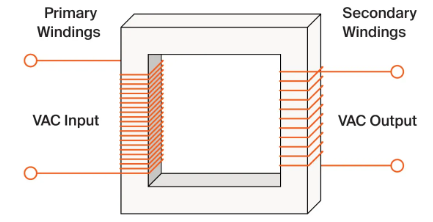
This breaks up the paths for eddy currents, significantly reducing heat loss.
3. Efficient Core Design: The arrangement of the primary and secondary windings on the core is designed to ensure maximum magnetic flux linkage and minimum flux leakage.
Since all three points contribute to reducing energy loss, they are all correct.
1. Soft Iron Core: A 'soft' magnetic material like silicon steel is used because it is easily magnetized and demagnetized, which minimizes hysteresis loss.
2. Lamination: The core is not a solid block but is made of thin sheets (laminae) insulated from each other.
This breaks up the paths for eddy currents, significantly reducing heat loss.
3. Efficient Core Design: The arrangement of the primary and secondary windings on the core is designed to ensure maximum magnetic flux linkage and minimum flux leakage.
Since all three points contribute to reducing energy loss, they are all correct.
Not clear enough?
Question 45
The two liquids which are often used in thermometer on experiment basic is known as
In liquid-in-glass thermometers, mercury and alcohol are the two most commonly used liquids. Mercury is preferred for its high boiling point, uniform expansion, and the fact that it does not wet the glass. Alcohol (usually ethanol) is used because it has a very low freezing point, making it suitable for measuring temperatures in extremely cold environments where mercury would freeze. Water is unsuitable because it wets glass, has a non-uniform expansion near its freezing point, and has a relatively narrow liquid range.
Not clear enough?
Question 46
Neutron were discovered by
The neutron, a subatomic particle with no electrical charge, was discovered in 1932 by the British physicist James Chadwick. By bombarding beryllium atoms with alpha particles, he observed an unknown radiation that was composed of particles with a mass approximately equal to that of a proton but with no charge. For this discovery, he was awarded the Nobel Prize in Physics in 1935. J.J. Thomson is credited with the discovery of the electron, and Dalton proposed the early atomic theory.
Not clear enough?
Question 47
If a projectile has maximum range of 36m, find the speed of projection (Take g = 9.8m/s\(^{2}\))
The maximum horizontal range (\( R_{max} \)) of a projectile occurs when the angle of projection is 45°. The formula for maximum range is:\[ R_{max} = \frac{u^2}{g} \]Given:
\( R_{max} = 36 \; \text{m} \)
\( g = 9.8 \; \text{ms}^{-2} \)
Solving for the initial speed (u):\[ 36 = \frac{u^2}{9.8} \]\[ u^2 = 36 \times 9.8 \]\[ u^2 = 352.8 \]\[ u = \sqrt{352.8} \approx 18.78 \; \text{ms}^{-1} \]Rounding to the nearest whole number gives 19m/s.
\( R_{max} = 36 \; \text{m} \)
\( g = 9.8 \; \text{ms}^{-2} \)
Solving for the initial speed (u):\[ 36 = \frac{u^2}{9.8} \]\[ u^2 = 36 \times 9.8 \]\[ u^2 = 352.8 \]\[ u = \sqrt{352.8} \approx 18.78 \; \text{ms}^{-1} \]Rounding to the nearest whole number gives 19m/s.
Not clear enough?
Question 48
What is the S.I unit of relative density?
Relative density (also known as specific gravity) is defined as the ratio of the density of a substance to the density of a reference substance (usually water for liquids and solids). Mathematically:\[ \text{Relative Density} = \frac{\text{Density of substance}}{\text{Density of water}} \]Since it is a ratio of two identical physical quantities (density divided by density), the units cancel each other out entirely. Therefore, relative density is a dimensionless quantity and has no S.I. unit.
Not clear enough?
Question 49
The dimension of universal gravitational constant is……….?
We can derive the dimensions of the universal gravitational constant (G) from Newton's Law of Gravitation:\[ F = \frac{Gm_1m_2}{r^2} \implies G = \frac{Fr^2}{m_1m_2} \]Breaking down the units into dimensions:\[ \text{Force (F)} = \text{Mass} \times \text{Acceleration} = [M][LT^{-2}] = [MLT^{-2}] \]\[ \text{Distance (r)} = [L] \]\[ \text{Mass (m)} = [M] \]Substituting into the expression for G:\[ [G] = \frac{[MLT^{-2}] \cdot [L]^2}{[M] \cdot [M]} \]\[ [G] = \frac{[ML^3T^{-2}]}{[M^2]} \]\[ [G] = [M^{-1}L^3T^{-2}] \]Therefore, the dimensions of G are M\(^{-1}\) L\(^{3}\) T\(^{-2}\).
Not clear enough?
Question 50
A good electric cell should have the following except
A good electric cell is designed to be efficient, durable, and safe. Minimising the polarisation effect (which reduces the electromotive force by forming hydrogen bubbles on the electrode) ensures consistent power delivery. A long shelf and operational life, as well as the use of inexpensive and non-hazardous electrolytes, are desirable qualities for any commercial or industrial battery. Conversely, high cost and dangerous characteristics are negative attributes that manufacturers work to eliminate. Therefore, option D represents the 'except' condition as it is not a property of a 'good' cell.
Not clear enough?
You might like
The process of loading the operating system software into the computer's memory to start up the system is known as:
Before Nigeria became a republic, the highest body charged with the administration of justice was the
Direction: Three of the following four number pairs are alike in a certain way and one is different. Find the odd one out ?