
Physics 2018 Jamb Examination
Physics 2018 Jamb Examination

Question 11
What type of reaction is represented by the following scheme?
\( ^{2}_{1}X \) + \( ^{2}_{1}Y \) -----> \( ^{3}_{2}Z \) + \( ^{1}_{0}n \) + energy
\( ^{2}_{1}X \) + \( ^{2}_{1}Y \) -----> \( ^{3}_{2}Z \) + \( ^{1}_{0}n \) + energy
The provided nuclear equation shows two light nuclei (isotopes of Hydrogen, such as Deuterium) combining to form a heavier nucleus (an isotope of Helium) with the release of a neutron and a significant amount of energy.
This process is known as nuclear fusion. Unlike fission, where a heavy nucleus splits into smaller fragments, fusion involves the joining of light nuclei under extremely high temperature and pressure. It is the process that powers the sun and other stars.
This process is known as nuclear fusion. Unlike fission, where a heavy nucleus splits into smaller fragments, fusion involves the joining of light nuclei under extremely high temperature and pressure. It is the process that powers the sun and other stars.
Not clear enough?
Question 12
The amount of heat needed to raise the temperature of 10kg of Copper by 1K is its
Heat capacity (also known as thermal capacity) is defined as the amount of heat energy required to raise the temperature of a given mass of a substance by one unit of temperature (1 K or 1 °C).
While 'specific heat capacity' refers to the heat required per unit mass (exactly 1 kg), 'heat capacity' refers to the object as a whole, in this case, the entire 10 kg of Copper. Mathematically, Heat Capacity \( C \) is related to specific heat capacity \( c \) by the formula:\[ C = mc \]Since the question specifies a particular mass (10 kg), the energy required to raise that specific mass by 1 K is the heat capacity of that 10 kg copper block.
While 'specific heat capacity' refers to the heat required per unit mass (exactly 1 kg), 'heat capacity' refers to the object as a whole, in this case, the entire 10 kg of Copper. Mathematically, Heat Capacity \( C \) is related to specific heat capacity \( c \) by the formula:\[ C = mc \]Since the question specifies a particular mass (10 kg), the energy required to raise that specific mass by 1 K is the heat capacity of that 10 kg copper block.
Not clear enough?
Question 13
The electrochemical equivalent of silver is 0.0012g/C. If 36.0g of silver is to be deposited by electrolysis on a surface by passing a steady current for 5mins, the current must be?
According to Faraday's first law of electrolysis, the mass \( m \) of a substance deposited is proportional to the quantity of electricity \( Q \) passed through the electrolyte. The formula is:\[ m = zIt \]Where:
\( m = 36.0 \; \text{g} \) (mass deposited)
\( z = 0.0012 \; \text{g/C} \) (electrochemical equivalent)
\( t = 5 \; \text{mins} = 5 \times 60 = 300 \; \text{s} \) (time in seconds)
\( I \) is the current in Amperes.
Rearranging the formula to solve for current \( I \):\[ I = \frac{m}{zt} \]\[ I = \frac{36.0}{0.0012 \times 300} \]\[ I = \frac{36.0}{0.36} \]\[ I = 100 \; \text{A} \]
Not clear enough?
Question 14
Shadows and eclipses result from the
Rectilinear propagation of light refers to the tendency of light to travel in straight lines. When an opaque object is placed in the path of light, it blocks the straight-travelling rays, creating a dark region behind it known as a shadow. An eclipse is a large-scale natural version of this phenomenon, where one celestial body moves into the shadow of another. If light could bend easily around objects (significant diffraction), distinct shadows and eclipses would not form as they do.
Not clear enough?
Question 15
Which of the following obeys Ohm's law?
Ohm's law states that the current flowing through a conductor is directly proportional to the potential difference across it, provided physical conditions like temperature remain constant. Metals are 'Ohmic' conductors because they show this linear relationship under constant conditions. Diodes and electrolytes are 'non-Ohmic' because their current-voltage relationship is non-linear. Glass is an insulator and does not conduct electricity under normal conditions.
Not clear enough?
Question 16
Which of the following statements are TRUE of isotopes?
I. Isotopes of an element have the same chemical properties because they have the same number of electrons
II. Isotopes of elements are normally separated using physical properties
III. Isotopes of an element have the same number of protons in their nuclei
I. Isotopes of an element have the same chemical properties because they have the same number of electrons
II. Isotopes of elements are normally separated using physical properties
III. Isotopes of an element have the same number of protons in their nuclei
Isotopes are atoms of the same element that have the same number of protons (atomic number) but different numbers of neutrons (mass number).
1. Since they have the same number of protons, neutral isotopes also have the same number of electrons, which determines their chemical behavior. Thus, they have identical chemical properties.
2. Because they have different masses, isotopes differ in physical properties like density and boiling point, which are used in processes like mass spectrometry or diffusion to separate them.
3. By definition, isotopes of the same element must have the same number of protons. Therefore, all three statements are correct.
Not clear enough?
Question 17
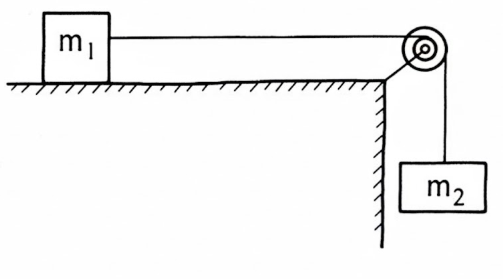
In the diagram given the hanging mass m2 is adjusted until m1 is on the verge of sliding. The coefficient of static
When the mass \( m_1 \) is on the verge of sliding, the system is in limiting equilibrium. The tension \( T \) in the string is equal to the weight of the hanging mass \( m_2 \), and this tension is also equal to the limiting frictional force \( F_s \) acting on \( m_1 \).
From the hanging mass \( m_2 \):\[ T = m_2 g \]From the mass \( m_1 \) on the table:\[ F_s = T = m_2 g \]The normal reaction \( R \) on \( m_1 \) is:\[ R = m_1 g \]The coefficient of static friction \( \mu_s \) is defined as the ratio of the limiting frictional force to the normal reaction:\[ \mu_s = \frac{F_s}{R} \]\[ \mu_s = \frac{m_2 g}{m_1 g} \]\[ \mu_s = \frac{m_2}{m_1} \]
From the hanging mass \( m_2 \):\[ T = m_2 g \]From the mass \( m_1 \) on the table:\[ F_s = T = m_2 g \]The normal reaction \( R \) on \( m_1 \) is:\[ R = m_1 g \]The coefficient of static friction \( \mu_s \) is defined as the ratio of the limiting frictional force to the normal reaction:\[ \mu_s = \frac{F_s}{R} \]\[ \mu_s = \frac{m_2 g}{m_1 g} \]\[ \mu_s = \frac{m_2}{m_1} \]
Not clear enough?
Question 18
Which of the following may be used to explain a mirage?
I. Layers of air near the road surface have varying refractive indices in hot weather
II. Road surfaces sometimes becomes invisible in hot weather
III. Light from the sky can be refracted upwards after coming close to the road surface.
I. Layers of air near the road surface have varying refractive indices in hot weather
II. Road surfaces sometimes becomes invisible in hot weather
III. Light from the sky can be refracted upwards after coming close to the road surface.
A mirage is an optical illusion caused by the refraction and total internal reflection of light in the atmosphere.
Statement I is correct: On a hot day, the air near the ground is hotter and less dense than the air above it, creating a gradient of refractive indices.
Statement III is correct: Light rays from the sky travelling downwards towards the hot ground are bent (refracted) progressively until they undergo total internal reflection and travel upwards to the observer's eye. This makes the sky appear as if it is reflected on the ground (looking like water).
Statement II is incorrect: The road surface does not become invisible; rather, an image of the sky is superimposed over it.
Not clear enough?
Question 19
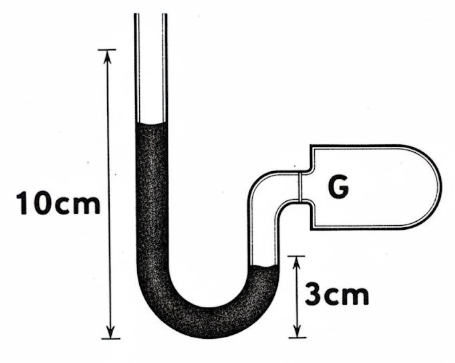
In the diagram given if the atmospheric pressure is 760mm, the pressure in the chamber G Is
In a U-tube manometer, the pressure in the chamber \( P_G \) is balanced by the atmospheric pressure \( P_{atm} \) and the pressure due to the height difference \( h \) of the liquid column. Looking at the diagram provided (where the liquid level in the arm open to the atmosphere is higher than the level in the arm connected to G), it indicates that the pressure in G is greater than atmospheric pressure.\[ P_G = P_{atm} + h \]Assuming the height difference \( h \) shown in the standard diagram for this problem is 70mm:\[ P_G = 760 \; \text{mm} + 70 \; \text{mm} = 830 \; \text{mm} \]Note: If the level in the chamber side was higher, we would subtract the height from atmospheric pressure.
Not clear enough?
Question 20
Which of the following has the lowest internal resistance when new?
Internal resistance is the opposition to the flow of current within the cell itself. Secondary cells, such as the lead-acid accumulator, are specifically designed to have a very low internal resistance (often less than 0.01 Ohms). This allows them to deliver the very high currents required to start motor engines. Primary cells like the Leclanche cell, Daniell cell, and standard torch batteries (zinc-carbon) have significantly higher internal resistances which limit their maximum current output.
Not clear enough?
You might like
The mass of silver deposited when a current of 10A is passed through a solution of silver salt for 4830s
[Ag = 108, F = 96500 Cmol-1]
Translating the problem statement into a series of sequential steps describing what the program must do is known as
Which of the following in the Sokoto Caliphate performed functions similar to that of the Bashorun in Oyo Kingdom
In contact process, the catalyst used in the conversion of sulphur(IV) oxide to sulphur(VI) oxide is
From the options, choose the word nearest in meaning to the underline word
By working hard, Benjamin outshone his elder brother instead of being ________