
Physics 2018 Jamb Examination
Physics 2018 Jamb Examination

Question 21
The pitch of an acoustic device can be increased by
Pitch is the perception of a sound's highness or lowness by the human ear. It is primarily determined by the frequency of the sound waves produced by the source.
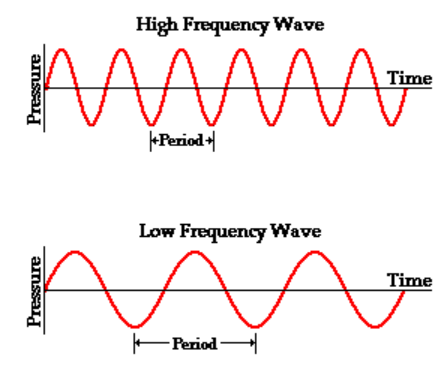
When the frequency (the number of cycles per second) increases, the ear perceives a higher pitch. Loudness and intensity, on the other hand, are related to the amplitude of the wave, not its frequency.
When the frequency (the number of cycles per second) increases, the ear perceives a higher pitch. Loudness and intensity, on the other hand, are related to the amplitude of the wave, not its frequency.
Not clear enough?
Question 22
One of the features of the fission process is that
Nuclear fission is the process where a heavy nucleus, such as Uranium-236, captures a neutron and splits into two smaller nuclei.
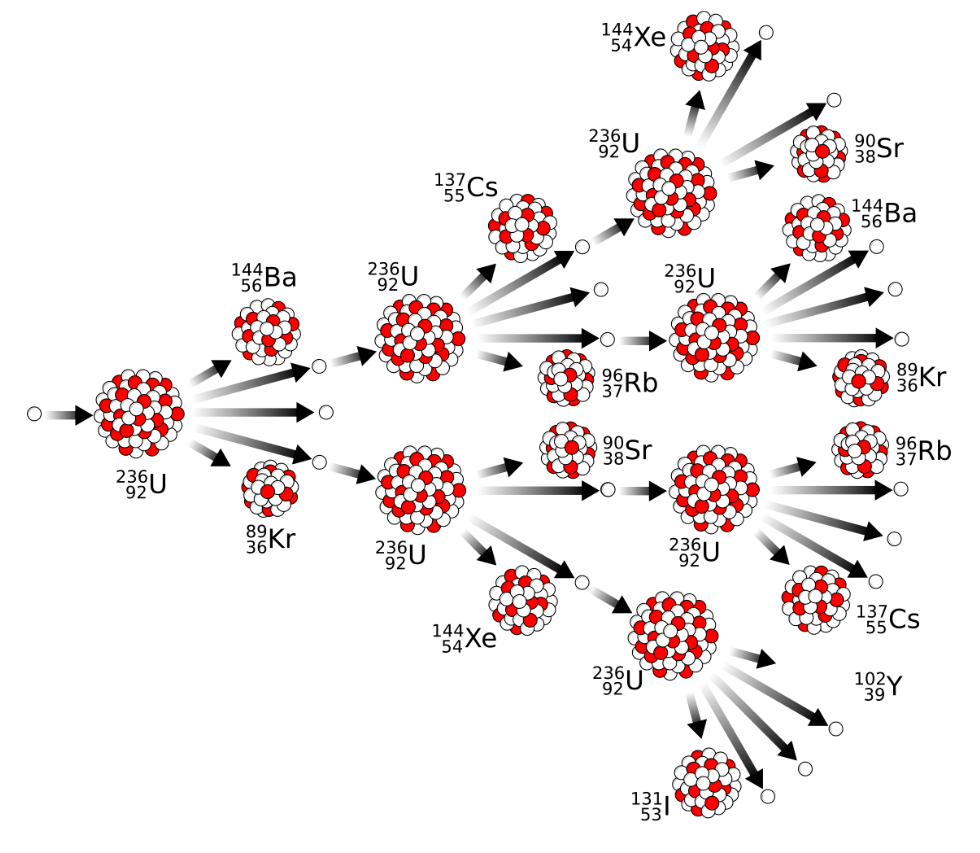
A critical feature of this process is that it releases additional neutrons (usually 2 or 3). These neutrons can then trigger fission in other nearby nuclei, leading to a self-sustaining sequence called a chain reaction. Note that in fission, the sum of the product masses is slightly less than the reactant masses; this 'missing mass' is converted into energy according to \( E = mc^{2} \).
A critical feature of this process is that it releases additional neutrons (usually 2 or 3). These neutrons can then trigger fission in other nearby nuclei, leading to a self-sustaining sequence called a chain reaction. Note that in fission, the sum of the product masses is slightly less than the reactant masses; this 'missing mass' is converted into energy according to \( E = mc^{2} \).
Not clear enough?
Question 23
The linear expansivity of brass is 2 x 10\(^{-5}\) C\(^{-1}\). If the volume of a piece of brass is 15.00cm at 0°C, what is the volume at 100°C
To calculate the final volume, we use the formula for volume expansivity (\( \gamma \)). First, we must find \( \gamma \) from the linear expansivity (\( \alpha \)):\[ \gamma = 3\alpha \]\[ \gamma = 3 \times (2 \times 10^{-5}) = 6 \times 10^{-5} \; ^\circ\text{C}^{-1} \]Now, we use the formula for volume expansion:\[ V_2 = V_1(1 + \gamma \Delta \theta) \]\[ V_2 = 15.00(1 + (6 \times 10^{-5} \times 100)) \]\[ V_2 = 15.00(1 + 0.006) \]\[ V_2 = 15.00 \times 1.006 \]\[ V_2 = 15.09 \; \text{cm}^3 \]
Not clear enough?
Question 24
A lead bullet of mass 0.05 kg is fired with a velocity of 200 m/s into a lead block of mass 0.95 kg. Given that the lead block can move freely, the final kinetic energy after impact is
This is a perfectly inelastic collision where the bullet embeds itself in the block. First, we find the common final velocity (\( v \)) using the conservation of momentum:\[ m_1 u_1 + m_2 u_2 = (m_1 + m_2)v \]\[ (0.05 \times 200) + (0.95 \times 0) = (0.05 + 0.95)v \]\[ 10 = 1.0v \implies v = 10 \; \text{m/s} \]Now, calculate the final kinetic energy (\( K.E._f \)) of the combined mass:\[ K.E._f = \frac{1}{2}(m_1 + m_2)v^{2} \]\[ K.E._f = \frac{1}{2}(1.0) \times 10^{2} \]\[ K.E._f = \frac{1}{2} \times 100 = 50 \; \text{J} \]
Not clear enough?
Question 25
In a series R-L-C circuit at resonance, the voltages across the resistor and the inductor are 30V and 40V respectively. What is the voltage across the capacitor?
Resonance in a series R-L-C circuit occurs when the inductive reactance (\( X_L \)) is equal to the capacitive reactance (\( X_C \)). Since the same current (\( I \)) flows through all components in a series circuit, the voltage across the inductor (\( V_L = I X_L \)) must be equal to the magnitude of the voltage across the capacitor (\( V_C = I X_C \)). Given that the voltage across the inductor is 40V, the voltage across the capacitor must also be 40V at resonance.
Not clear enough?
Question 26
If the fraction of the atoms of a radioactive material left after 120years is 1/64, what is the half-life of the material?
The fraction of atoms remaining after \( n \) half-lives is given by \( (1/2)^{n} \).
We set the fraction equal to the given value:\[ (1/2)^n = 1/64 \]\[ (1/2)^n = (1/2)^6 \implies n = 6 \text{ half-lives} \]The total time \( T \) is related to the half-life \( t_{1/2} \) by:\[ T = n \times t_{1/2} \]\[ 120 = 6 \times t_{1/2} \]\[ t_{1/2} = \frac{120}{6} = 20 \; \text{years} \]
We set the fraction equal to the given value:\[ (1/2)^n = 1/64 \]\[ (1/2)^n = (1/2)^6 \implies n = 6 \text{ half-lives} \]The total time \( T \) is related to the half-life \( t_{1/2} \) by:\[ T = n \times t_{1/2} \]\[ 120 = 6 \times t_{1/2} \]\[ t_{1/2} = \frac{120}{6} = 20 \; \text{years} \]
Not clear enough?
Question 27

In the diagram shown, which of the simple pendulum will resonate with P when set into oscillation?
Resonance occurs when the frequency of a driving force matches the natural frequency of the system. For a simple pendulum, the period (and thus frequency) depends only on the length of the string and gravity (\( T = 2\pi \sqrt{l/g} \)). In the provided diagram, pendulum T has the same length as pendulum P. Because their lengths are identical, they share the same natural frequency. When P oscillates, it will cause T to vibrate with the maximum amplitude due to resonance.
Not clear enough?
Question 28
The time rate of loss of heat by a body is proportional to the
This is a statement of Newton's Law of Cooling. It states that the rate of change of the temperature of an object is proportional to the difference between its own temperature and the ambient temperature (surroundings). Mathematically:\[ \frac{dQ}{dt} \propto (T_{\text{body}} - T_{\text{surroundings}}) \]This law is most accurate when the temperature difference is relatively small and heat loss occurs primarily through convection.
Not clear enough?
Question 29
A positively charged rod X is brought near an uncharged metal sphere Y and is then touched by a finger with X still in place. When the finger is removed, the result is that Y has
This is a process called charging by induction.
1. When the positive rod X is brought near, it attracts electrons to the side of the sphere closest to it (leaving the far side positive).
2. When the sphere is touched (earthed), electrons from the earth flow into the sphere to neutralise the positive charge on the far side.
3. After the finger is removed, the sphere has an excess of electrons (negative charge).
4. Since the sphere is now negatively charged, its electric potential is negative relative to the earth (zero potential).
Not clear enough?
Question 30
Electrical appliances in homes are normally earthed so that
Earthing is a safety measure used to protect people from electric shocks.
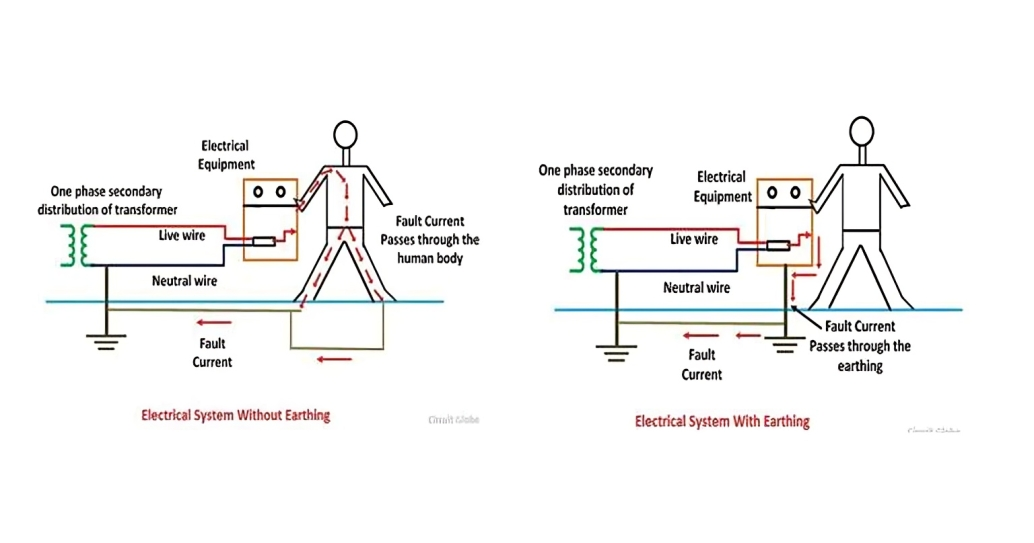
If a fault occurs and a live wire touches the metal casing of an appliance, the earth wire provides a low-resistance path for the current to flow directly to the ground. This prevents the metal casing from reaching a high potential, so if a person touches the appliance, the current flows through the earth wire rather than through the person's body.
If a fault occurs and a live wire touches the metal casing of an appliance, the earth wire provides a low-resistance path for the current to flow directly to the ground. This prevents the metal casing from reaching a high potential, so if a person touches the appliance, the current flows through the earth wire rather than through the person's body.
Not clear enough?
You might like
Find the hydrogen ion, \(H^+\) concentration and hydroxide ion, \(OH^-\) concentration in 0.06 moldm-3 solution of \(H_2SO_4\).
Choose the option that best completes the gap(s).
Ali goes to the stadium regularly, but he.. to the church for months.
A government budget proposing to spend more than its expected revenue in a year will create _______?