
Physics 2018 Jamb Examination
Physics 2018 Jamb Examination

Question 41
A pulley system has three pulleys in the fixed block and two in the movable block and if the pulley has an efficiency of 72%, the mechanical advantage of the system is?
In a block-and-tackle pulley system, the Velocity Ratio (V.R.) is equal to the total number of pulleys in both the fixed and movable blocks.
Total pulleys = 3 (fixed) + 2 (movable) = 5. Therefore, \( V.R. = 5 \).
Efficiency (\( \eta \)) is 72% or 0.72. We use the formula:\[ \eta = \frac{M.A.}{V.R.} \]\[ 0.72 = \frac{M.A.}{5} \]\[ M.A. = 0.72 \times 5 = 3.6 \]
Total pulleys = 3 (fixed) + 2 (movable) = 5. Therefore, \( V.R. = 5 \).
Efficiency (\( \eta \)) is 72% or 0.72. We use the formula:\[ \eta = \frac{M.A.}{V.R.} \]\[ 0.72 = \frac{M.A.}{5} \]\[ M.A. = 0.72 \times 5 = 3.6 \]
Not clear enough?
Question 42
When an atom loses or gain a charge it becomes
An atom is electrically neutral when the number of protons equals the number of electrons. If an atom gains electrons, it becomes a negatively charged particle called an anion. If it loses electrons, it becomes a positively charged particle called a cation. Both of these charged species are broadly termed 'ions'.
Not clear enough?
Question 43
A ball of mass 800g moving horizontally with a speed of 5m/s hits a vertical wall and rebounds with the same speed. The impulse experienced by the ball is?
Impulse is equal to the change in momentum. Since momentum is a vector, we must account for the change in direction.
Given:
Mass \( m = 800\text{g} = 0.8\text{kg} \)
Initial velocity \( u = 5\text{ms}^{-1} \)
Final velocity \( v = -5\text{ms}^{-1} \) (negative because it is in the opposite direction)
Calculation:\[ \text{Impulse} = m(v - u) \]\[ \text{Impulse} = 0.8(-5 - 5) \]\[ \text{Impulse} = 0.8(-10) = -8\text{kgms}^{-1} \]The magnitude of the impulse is 8\(\text{kgms}^{-1}\).
Not clear enough?
Question 44
The force between the molecules of a liquid in contact with that of a solid is?
Forces of attraction between molecules are classified based on the types of molecules involved. Cohesive forces are the attractive forces between molecules of the same kind (e.g., water molecule to water molecule). Adhesive forces are the attractive forces between molecules of different kinds (e.g., water molecules to the molecules of a glass container).
Not clear enough?
Question 45
A body of mass 100g moving with a velocity of 10ms\(^{-1}\) collides with a wall. If after collision it moves with a velocity of 2.0ms\(^{-1}\) in the opposite direction, calculate the change in momentum.
Change in momentum (\( \Delta p \)) is calculated by considering the initial and final velocities as vectors.
Mass \( m = 100\text{g} = 0.1\text{kg} \)
Initial velocity \( u = 10\text{ms}^{-1} \)
Final velocity \( v = -2.0\text{ms}^{-1} \) (opposite direction)
\[ \Delta p = m(v - u) \]\[ \Delta p = 0.1(-2 - 10) \]\[ \Delta p = 0.1(-12) = -1.2\text{Ns} \]The magnitude of the change in momentum is 1.2Ns.
Mass \( m = 100\text{g} = 0.1\text{kg} \)
Initial velocity \( u = 10\text{ms}^{-1} \)
Final velocity \( v = -2.0\text{ms}^{-1} \) (opposite direction)
\[ \Delta p = m(v - u) \]\[ \Delta p = 0.1(-2 - 10) \]\[ \Delta p = 0.1(-12) = -1.2\text{Ns} \]The magnitude of the change in momentum is 1.2Ns.
Not clear enough?
Question 46
A 20kg mass is to be pulled up a slope inclined at 30° to the horizontal. If efficiency of the plane is 75%. The force required to pull the load up the plane is J [g=10ms\(^{-2}\)]
First, find the Velocity Ratio (V.R.) of the inclined plane:\[ V.R. = \frac{1}{\sin \theta} = \frac{1}{\sin 30^{\circ}} = \frac{1}{0.5} = 2 \]Next, find the Mechanical Advantage (M.A.) using the efficiency (\( \eta = 0.75 \)):\[ M.A. = \eta \times V.R. = 0.75 \times 2 = 1.5 \]Finally, find the effort (Force \( E \)) needed to pull the load (\( L = mg = 20 \times 10 = 200\text{N} \)):\[ M.A. = \frac{L}{E} \implies 1.5 = \frac{200}{E} \]\[ E = \frac{200}{1.5} = 133.3\text{N} \]
Not clear enough?
Question 47
The tendency of a body to remain at rest when a force is applied to it is called.
Inertia is the inherent property of a body that resists any change in its state of rest or uniform motion in a straight line. According to Newton's First Law of Motion, an object at rest will remain at rest unless acted upon by an external force; this 'laziness' or resistance to change is inertia.
Not clear enough?
Question 48
An object is placed 20cm from a concave mirror of focal length 10cm. The linear magnification of the image produced is?
First, we find the image distance (\( v \)) using the mirror formula:\[ \frac{1}{f} = \frac{1}{u} + \frac{1}{v} \]\[ \frac{1}{10} = \frac{1}{20} + \frac{1}{v} \implies \frac{1}{v} = \frac{1}{10} - \frac{1}{20} = \frac{2 - 1}{20} = \frac{1}{20} \]\[ v = 20\text{cm} \]Now, calculate linear magnification (\( M \)):\[ M = \frac{v}{u} = \frac{20}{20} = 1 \]When the object is placed at the center of curvature (\( u = 2f \)), the image is also formed at the center of curvature and is the same size as the object.
Not clear enough?
Question 49
The energy needed to move a unit positive charge around a complete electric circuit is called the
The electromotive force (e.m.f.) is the total work done by a source (like a battery) in moving a unit positive charge once around a complete circuit, including the internal parts of the source itself. Potential difference, on the other hand, is the work done moving a charge between two specific points in the circuit.
Not clear enough?
Question 50
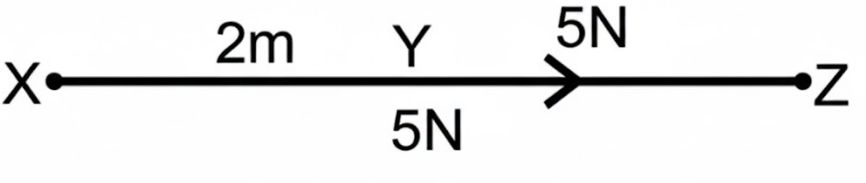
A force of 5N acts at a point Y on a rod XYZ as shown in this diagram. If XYZ is 2m, what is the moment of the force about point X?
The moment of a force is defined as the product of the force and the perpendicular distance from the pivot to the line of action of the force. \[ \text{Moment} = \text{Force} \times \text{Perpendicular Distance} \]\[ \text{Moment} = 5\text{N} \times 0\text{m} = 0\text{Nm} \]
Not clear enough?
You might like
Two trains start from a certain place on two parallel tracks in the same direction. The speed of the trains are 45 km/hr. and 40 km/hr respectively. The distance between the two trains after 45 minutes will be ?

A solid metal cube of side 3 cm is placed in a rectangular tank of dimension 3, 4 and 5 cm. What volume of water can the tank now hold?
The male urethra is considerably longer than the female urethra and is divided into several distinct segments. Which of the following is NOT considered a part of the male urethra?