
Physics 2023 Jamb Examination
Physics 2023 Jamb Examination

Question 1
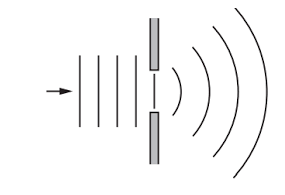
The property of wave shown in the diagram above is?
Diffraction is the bending or spreading out of waves as they pass through an aperture (opening) or around the edge of an obstacle. The extent of the spreading depends on the relationship between the wavelength and the size of the opening. Since the diagram illustrates waves expanding into the 'shadow' region after passing through a gap, it depicts diffraction.
Not clear enough?
Question 2
Which of the following statements regarding the application of electrical conduction via gases is/are correct?
Electrical conduction in gas is applied in:
(i) The identification of gases
(ii) Lighting/fluorescent tubes
(iii) Photocells
(iv) Cathode ray oscilloscope/T.V. tubes
Electrical conduction in gas is applied in:
(i) The identification of gases
(ii) Lighting/fluorescent tubes
(iii) Photocells
(iv) Cathode ray oscilloscope/T.V. tubes
Electrical conduction in gases involves ionizing gas molecules to allow current flow.
1. Identification of gases: Each gas emits a unique spectrum when conducting electricity (discharge tubes).
2. Fluorescent tubes: These rely on mercury vapor conduction to produce UV light.
3. CRO/TV tubes: These use electron beams (cathode rays) in a vacuum or low-pressure gas environment.
Photocells, however, typically rely on the photoelectric effect in solids or vacuums rather than gas conduction. Therefore, i, ii, and iv are correct applications.
Not clear enough?
Question 3
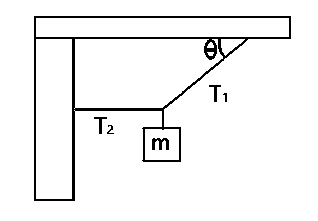
Find the tension in the two cords shown in the figure above. Neglect the mass of the cords, and assume that the angle is 38° and the mass m is 220 kg.
[Take g = 9.8 ms\(^{-2}\)]
Based on a standard static equilibrium setup where \( T_2 \) is the diagonal cord at 38° to the horizontal and \( T_1 \) is horizontal:
1. Vertical balance: \( T_2 \sin(38^\circ) = mg \)\[ T_2 = \frac{220 \times 9.8}{\sin(38^\circ)} = \frac{2156}{0.6157} \approx 3502 \, \text{N} \]2. Horizontal balance: \( T_1 = T_2 \cos(38^\circ) \)\[ T_1 = 3502 \times \cos(38^\circ) = 3502 \times 0.7880 \approx 2760 \, \text{N} \]Thus, \( T_1 = 2760 \, \text{N} \) and \( T_2 = 3502 \, \text{N} \).
1. Vertical balance: \( T_2 \sin(38^\circ) = mg \)\[ T_2 = \frac{220 \times 9.8}{\sin(38^\circ)} = \frac{2156}{0.6157} \approx 3502 \, \text{N} \]2. Horizontal balance: \( T_1 = T_2 \cos(38^\circ) \)\[ T_1 = 3502 \times \cos(38^\circ) = 3502 \times 0.7880 \approx 2760 \, \text{N} \]Thus, \( T_1 = 2760 \, \text{N} \) and \( T_2 = 3502 \, \text{N} \).
Not clear enough?
Question 4
A missile is launched with a speed of 75 ms\(^{-1}\) at an angle of 22° above the surface of a warship. Find the horizontal range achieved by the missile. Ignore the effects of air resistance.
[Take g = 10 ms\(^{-2}\)]
[Take g = 10 ms\(^{-2}\)]
The horizontal range (\( R \)) of a projectile is given by:\[ R = \frac{u^2 \sin(2\theta)}{g} \]Given:
\( u = 75 \, \text{ms}^{-1} \)
\( \theta = 22^\circ \Rightarrow 2\theta = 44^\circ \)
\( g = 10 \, \text{ms}^{-2} \)
Calculation:\[ R = \frac{75^2 \times \sin(44^\circ)}{10} \] \[ R = \frac{5625 \times 0.6947}{10} = 390.7 \approx 391 \, \text{m} \]
\( u = 75 \, \text{ms}^{-1} \)
\( \theta = 22^\circ \Rightarrow 2\theta = 44^\circ \)
\( g = 10 \, \text{ms}^{-2} \)
Calculation:\[ R = \frac{75^2 \times \sin(44^\circ)}{10} \] \[ R = \frac{5625 \times 0.6947}{10} = 390.7 \approx 391 \, \text{m} \]
Not clear enough?
Question 5
On a particular hot day, the temperature is 40°C and the partial pressure of water vapor in the air is 38.8 mmHg. Using the provided table (SVP at 40°C = 55.3 mmHg), what is the relative humidity?
Relative Humidity (R.H.) is the ratio of the actual partial pressure of water vapor to the saturated vapor pressure (SVP) at that same temperature, expressed as a percentage.\[ \text{R.H.} = \frac{\text{Partial Pressure}}{\text{SVP}} \times 100 \]
\[ \text{R.H.} = \frac{38.8}{55.3} \times 100 \approx 70.16\% \]
The closest value is 70%.
Not clear enough?
Question 6
Calculate the absolute pressure at the bottom of a lake at a depth of 32.8 m. Assume the density of the water is 1 x 10\(^3\) kgm\(^{-3}\) and the air above is at a pressure of 101.3 kPa.
[Take g = 9.8 ms\(^{-2}\)]
[Take g = 9.8 ms\(^{-2}\)]
Absolute pressure is the sum of atmospheric pressure and the hydrostatic pressure (gauge pressure) exerted by the liquid column. \[ P_{\text{abs}} = P_{\text{atm}} + h\rho g \]1. Hydrostatic pressure: \( 32.8 \times 1000 \times 9.8 = 321440 \, \text{Pa} = 321.44 \, \text{kPa} \)
2. Total pressure: \( 101.3 \, \text{kPa} + 321.44 \, \text{kPa} = 422.74 \, \text{kPa} \).
2. Total pressure: \( 101.3 \, \text{kPa} + 321.44 \, \text{kPa} = 422.74 \, \text{kPa} \).
Not clear enough?
Question 7
The terminals of a battery of emf 24.0 V and internal resistance of 1.0 Ω is connected to an external resistor 5.0 Ω. Find the terminal p.d.
The terminal potential difference (\( V \)) is the voltage available to the external circuit.
First, find the total current (\( I \)) using Ohm's law for the whole circuit:\[ I = \frac{E}{R + r} = \frac{24.0}{5.0 + 1.0} = \frac{24}{6} = 4 \, \text{A} \]Now, find the terminal p.d.:\[ V = IR = 4 \times 5.0 = 20.0 \, \text{V} \](Alternatively: \( V = E - Ir = 24 - (4 \times 1) = 20 \, \text{V} \)).
First, find the total current (\( I \)) using Ohm's law for the whole circuit:\[ I = \frac{E}{R + r} = \frac{24.0}{5.0 + 1.0} = \frac{24}{6} = 4 \, \text{A} \]Now, find the terminal p.d.:\[ V = IR = 4 \times 5.0 = 20.0 \, \text{V} \](Alternatively: \( V = E - Ir = 24 - (4 \times 1) = 20 \, \text{V} \)).
Not clear enough?
Question 8
A lorry accelerates uniformly in a straight line with acceleration of 4ms\(^{-2}\) and covers a distance of 250 m in a time interval of 10 s. How far will it travel in the next 10 s?
1. Find initial velocity (\( u \)) for the first interval:\[ s = ut + 0.5at^2 \Rightarrow 250 = u(10) + 0.5(4)(100) \]
\[ 250 = 10u + 200 \Rightarrow 10u = 50 \Rightarrow u = 5 \, \text{ms}^{-1} \]2. Find total distance (\( S_{20} \)) covered in 20 seconds:\[ S_{20} = (5 \times 20) + 0.5(4)(20^2) = 100 + 800 = 900 \, \text{m} \]3. Distance in the next 10s = Total distance - First 10s distance:\[ 900 - 250 = 650 \, \text{m} \].
Not clear enough?
Question 9
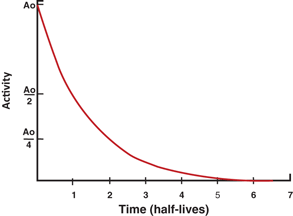
The half life of a radioactive material is 12 days. Calculate the decay constant.
The relationship between the decay constant (\( \lambda \)) and the half-life (\( T_{1/2} \)) is given by:
n\[ \lambda = \frac{\ln(2)}{T_{1/2}} \approx \frac{0.693}{T_{1/2}} \] \[ \lambda = \frac{0.6931}{12} \approx 0.05775 \, \text{day}^{-1} \].
n\[ \lambda = \frac{\ln(2)}{T_{1/2}} \approx \frac{0.693}{T_{1/2}} \] \[ \lambda = \frac{0.6931}{12} \approx 0.05775 \, \text{day}^{-1} \].
Not clear enough?
Question 10
The number of holes in an intrinsic semiconductor
An intrinsic semiconductor is a pure semiconductor without any significant dopant species present. In these materials, the only charge carriers are those generated by thermal excitation. When an electron gains enough energy to jump from the valence band to the conduction band, it leaves behind a 'hole' in the valence band. Therefore, for every free electron generated, exactly one hole is created, making their numbers equal.
Not clear enough?
You might like
The surface temperature of a swimming pool is 25ºC and the bottom is 15ºC. Area = 620 m\(^{2}\), depth = 1.5m. Find the rate of heat transfer. [k = 0.6071 Wm\(^{-1}\)K\(^{-1}\)]
An arc subtends an angle of 50º at the center of circle of radius 6cm. Calculate the area of the sector formed
If the income of Mohan is 150% higher than that of Mahesh, then by what percent the income of Mahesh is less than that of Mohan ?
A biotic factor which affects the distribution and abundance of organisms in a terrestrial habitat is