Physics 2023 Jamb Examination
Physics 2023 Jamb Examination

Question 21
What is the amount of heat required to raise the temperature of a 0.02 kg of ice cube from −10 °C to 10 °C?
[specific latent heat of fusion of ice = 3.34 x 10⁵ Jkg−1, Specific heat capacity of water = 4200 Jkg−1 k−1, Specific heat capacity of ice = 2100 Jkg−1 k−1]
[specific latent heat of fusion of ice = 3.34 x 10⁵ Jkg−1, Specific heat capacity of water = 4200 Jkg−1 k−1, Specific heat capacity of ice = 2100 Jkg−1 k−1]
This problem involves three distinct stages of heat absorption: heating the ice, melting the ice, and heating the resulting water.
1. Heat required to raise the temperature of ice from \(-10\,^{\circ}\text{C}\) to \(0\,^{\circ}\text{C}\):\[Q_1 = m \cdot c_{ice} \cdot \Delta\theta_1\]\[Q_1 = 0.02 \cdot 2100 \cdot (0 - (-10)) = 0.02 \cdot 2100 \cdot 10 = 420\,\text{J}\]2. Heat required to melt the ice at \(0\,^{\circ}\text{C}\) (latent heat of fusion):\[Q_2 = m \cdot L_f\]\[Q_2 = 0.02 \cdot 3.34 \times 10^5 = 6680\,\text{J}\]3. Heat required to raise the temperature of the resulting water from \(0\,^{\circ}\text{C}\) to \(10\,^{\circ}\text{C}\):\[Q_3 = m \cdot c_{water} \cdot \Delta\theta_2\]\[Q_3 = 0.02 \cdot 4200 \cdot (10 - 0) = 0.02 \cdot 4200 \cdot 10 = 840\,\text{J}\]The total heat required is the sum of these three values:\[Q_{total} = Q_1 + Q_2 + Q_3\]\[Q_{total} = 420 + 6680 + 840 = 7940\,\text{J}\]
1. Heat required to raise the temperature of ice from \(-10\,^{\circ}\text{C}\) to \(0\,^{\circ}\text{C}\):\[Q_1 = m \cdot c_{ice} \cdot \Delta\theta_1\]\[Q_1 = 0.02 \cdot 2100 \cdot (0 - (-10)) = 0.02 \cdot 2100 \cdot 10 = 420\,\text{J}\]2. Heat required to melt the ice at \(0\,^{\circ}\text{C}\) (latent heat of fusion):\[Q_2 = m \cdot L_f\]\[Q_2 = 0.02 \cdot 3.34 \times 10^5 = 6680\,\text{J}\]3. Heat required to raise the temperature of the resulting water from \(0\,^{\circ}\text{C}\) to \(10\,^{\circ}\text{C}\):\[Q_3 = m \cdot c_{water} \cdot \Delta\theta_2\]\[Q_3 = 0.02 \cdot 4200 \cdot (10 - 0) = 0.02 \cdot 4200 \cdot 10 = 840\,\text{J}\]The total heat required is the sum of these three values:\[Q_{total} = Q_1 + Q_2 + Q_3\]\[Q_{total} = 420 + 6680 + 840 = 7940\,\text{J}\]
Not clear enough?
Question 22
Which of the following thermometers measures temperature from the thermal radiation emitted by objects?
A pyrometer is a type of remote-sensing thermometer used to measure the temperature of distant surfaces. It works by detecting the intensity of thermal radiation (infrared or visible light) emitted by the object. Unlike other thermometers listed, such as the platinum resistance thermometer (which uses electrical resistance) or the thermocouple (which uses the Seebeck effect at a junction of two metals), the pyrometer does not need to be in thermal contact with the object, making it ideal for measuring extremely high temperatures or moving parts.
Not clear enough?
Question 23

A 400 N box is being pushed across a level floor at a constant speed by a force P of 100 N at an angle of 30.0° to the horizontal, as shown in the the diagram below. What is the coefficient of kinetic friction between the box and the floor?
To find the coefficient of kinetic friction (\(\mu_k\)), we analyze the forces acting on the box. Since the box moves at a constant speed, it is in dynamic equilibrium, meaning the net force in both the horizontal and vertical directions is zero.
First, resolve the applied force \(P\) into components:
Horizontal component: \(P_x = P \cos 30^{\circ} = 100 \cdot 0.866 = 86.6\,\text{N}\)
Vertical component (acting downward): \(P_y = P \sin 30^{\circ} = 100 \cdot 0.5 = 50\,\text{N}\)
Next, find the Normal force (\(N\)):\[N = \text{Weight} + P_y\]\[N = 400 + 50 = 450\,\text{N}\]The frictional force (\(f_k\)) must equal the horizontal pushing force for constant speed:\[f_k = P_x = 86.6\,\text{N}\]Finally, use the friction formula:\[\mu_k = \frac{f_k}{N}\]\[\mu_k = \frac{86.6}{450} \approx 0.192\]
Not clear enough?
Question 24
Light of wavelength 589 nm in vacuum passes through a piece of fused quartz of index of refraction n = 1.458. What is the frequency of the light in fused quartz?
[Speed of light c = 3.00×10⁸ ms−1]
[Speed of light c = 3.00×10⁸ ms−1]
A fundamental property of light is that its frequency remains constant when it moves from one medium to another. While the speed and wavelength change depending on the refractive index of the medium, the frequency depends only on the source. [Image showing light refraction and constant frequency across media]
We can calculate the frequency using the properties of light in a vacuum:\[c = f \cdot \lambda\]\[f = \frac{c}{\lambda}\]\[f = \frac{3.00 \times 10^8}{589 \times 10^{-9}}\]\[f \approx 5.09 \times 10^{14}\,\text{Hz}\]This frequency will be the same inside the fused quartz.
We can calculate the frequency using the properties of light in a vacuum:\[c = f \cdot \lambda\]\[f = \frac{c}{\lambda}\]\[f = \frac{3.00 \times 10^8}{589 \times 10^{-9}}\]\[f \approx 5.09 \times 10^{14}\,\text{Hz}\]This frequency will be the same inside the fused quartz.
Not clear enough?
Question 25
A simple pendulum, has a period of 5.77 seconds. When the pendulum is shortened by 3 m, the period is 4.60 seconds. Calculate the new length of the pendulum
The period \(T\) of a simple pendulum is given by \(T = 2\pi \sqrt{\frac{L}{g}}\), which implies that \(T^2 \propto L\).
Let the initial length be \(L_1\) and the final length be \(L_2\). We are told \(L_2 = L_1 - 3\).\[\frac{T_1^2}{L_1} = \frac{T_2^2}{L_2}\]\[\frac{5.77^2}{L_1} = \frac{4.60^2}{L_1 - 3}\]\[\frac{33.2929}{L_1} = \frac{21.16}{L_1 - 3}\]\[33.2929(L_1 - 3) = 21.16L_1\]\[33.2929L_1 - 99.8787 = 21.16L_1\]\[12.1329L_1 = 99.8787\]\[L_1 = \frac{99.8787}{12.1329} \approx 8.23\,\text{m}\]Since the new length \(L_2 = L_1 - 3\):\[L_2 = 8.23 - 3 = 5.23\,\text{m}\]
Let the initial length be \(L_1\) and the final length be \(L_2\). We are told \(L_2 = L_1 - 3\).\[\frac{T_1^2}{L_1} = \frac{T_2^2}{L_2}\]\[\frac{5.77^2}{L_1} = \frac{4.60^2}{L_1 - 3}\]\[\frac{33.2929}{L_1} = \frac{21.16}{L_1 - 3}\]\[33.2929(L_1 - 3) = 21.16L_1\]\[33.2929L_1 - 99.8787 = 21.16L_1\]\[12.1329L_1 = 99.8787\]\[L_1 = \frac{99.8787}{12.1329} \approx 8.23\,\text{m}\]Since the new length \(L_2 = L_1 - 3\):\[L_2 = 8.23 - 3 = 5.23\,\text{m}\]
Not clear enough?
Question 26
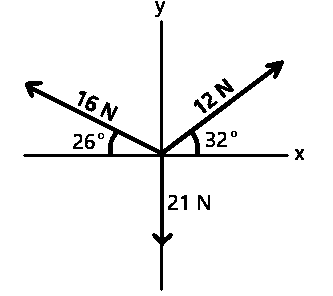
Three forces with magnitudes 16 N, 12 N and 21 N are shown in the diagram below. Determine the magnitude of their resultant force and angle with the x-axis
To find the resultant of the three forces, we resolve each force into its horizontal ($x$) and vertical ($y$) components.
Sum of x-components ($\Sigma F_x$)\[ \Sigma F_x = 12\cos(32^{\circ}) - 16\cos(26^{\circ}) \]\[ \Sigma F_x = 10.18 - 14.38 = -4.20\,\text{N} \]
\textbf{Sum of y-components ($\Sigma F_y$):}\[ \Sigma F_y = 12\sin(32^{\circ}) + 16\sin(26^{\circ}) - 21 \]\[ \Sigma F_y = 6.36 + 7.01 - 21 = -7.63\,\text{N} \]
Resultant magnitude $R$:\[ R = \sqrt{(\Sigma F_x)^2 + (\Sigma F_y)^2} \]\[ R = \sqrt{(-4.20)^2 + (-7.63)^2} = \sqrt{17.64 + 58.22} = \sqrt{75.86} \approx 8.71\,\text{N} \]
The angle $\theta$ with the x-axis:\[ \tan \theta = \frac{|\Sigma F_y|}{|\Sigma F_x|} = \frac{7.63}{4.20} \approx 1.817 \]\[ \theta = \tan^{-1}(1.817) \approx 61^{\circ} \]
Not clear enough?
Question 27
A travelling wave of amplitude 0.80 m has a frequency of 16 Hz and a wave speed of 20 ms−1
Calculate the wave number of the wave.
Calculate the wave number of the wave.
The wave number (\(k\)) is defined as the number of radians per unit distance and is mathematically expressed as:\[k = \frac{2\pi}{\lambda}\]First, we need to find the wavelength (\(\lambda\)) using the wave speed (\(v\)) and frequency (\(f\)):\[v = f \cdot \lambda\]\[\lambda = \frac{v}{f} = \frac{20}{16} = 1.25\,\text{m}\]Now, substitute the wavelength into the formula for the wave number:\[k = \frac{2\pi}{1.25} = \frac{2 \cdot 3.14159}{1.25} \approx 5.02\]Rounding to the nearest whole number, we get 5.
Not clear enough?
Question 28
The near point of a patient's eye is 50.0 cm. What power (in diopters) must a corrective lens have to enable the eye to see clearly an object 25.0 cm away?
The patient suffers from hypermetropia (long-sightedness) because their near point is further away than the standard 25 cm. To correct this, we need a lens that takes an object at 25 cm (the desired near point) and forms a virtual image at 50 cm (the patient's actual near point).
Using the lens formula:\[\frac{1}{f} = \frac{1}{u} + \frac{1}{v}\]Where:
\(u = 25\,\text{cm}\) (object distance)
\(v = -50\,\text{cm}\) (image distance is negative because it is virtual)
\[\frac{1}{f} = \frac{1}{25} + \frac{1}{-50}\]\[\frac{1}{f} = \frac{2 - 1}{50} = \frac{1}{50}\]\[f = 50\,\text{cm} = 0.5\,\text{m}\]The power \(P\) in diopters is the reciprocal of the focal length in metres:\[P = \frac{1}{f} = \frac{1}{0.5} = 2\,\text{diopters}\]
Not clear enough?
Question 29
Which of the following is/are not true about the heat capacity of a substance?
(i) It is an intensive property
(ii) Its S.I unit is jK−1
(iii) It is an extensive property
(iv) Its S.I unit is jkg−1
(i) It is an intensive property
(ii) Its S.I unit is jK−1
(iii) It is an extensive property
(iv) Its S.I unit is jkg−1
Heat capacity (\(C\)) is the amount of heat required to raise the temperature of the entire mass of a substance by one Kelvin. Because it depends on the amount of matter present (mass), it is an extensive property. Therefore, statement (i) is false. The S.I. unit for heat capacity is \(\text{JK}^{-1}\). Statement (iv) is false because \(\text{JKg}^{-1}\) (or more correctly \(\text{JKg}^{-1}\text{K}^{-1}\)) is the unit for *specific* heat capacity, which is an intensive property. Thus, the incorrect statements are (i) and (iv).
Not clear enough?
Question 30
The pinhole camera works on
A pinhole camera is a simple camera without a lens and with a single small aperture. It forms an inverted image of an object on the opposite side of the box. This occurs because light travels in straight lines, a phenomenon known as the rectilinear propagation of light. Since light from the top of an object can only travel in a straight line through the pinhole to reach the bottom of the screen, and light from the bottom travels to the top, the resulting image is inverted.