
Physics 2024 Jamb Examination
Physics 2024 Jamb Examination

Question 11
A light ray passing from air into water at an angle of 30º from the normal in air would
When light travels from an optically less dense medium (air, \(n \approx 1.0\)) to an optically denser medium (water, \(n \approx 1.33\)), it slows down and bends towards the normal.
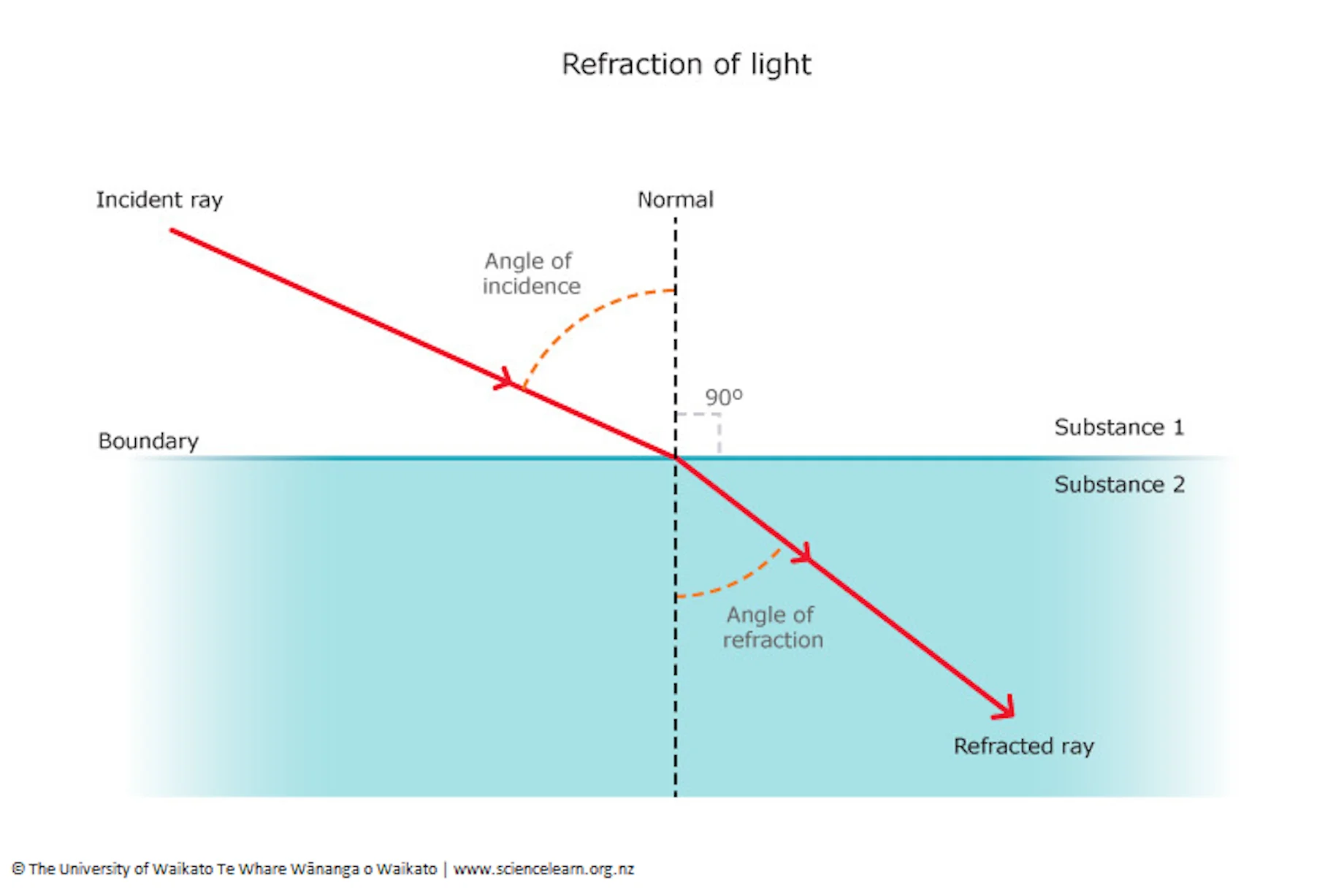 According to Snell's Law (\(n_1 \sin \theta_1 = n_2 \sin \theta_2\)), if the incident angle in air (\(\theta_1\)) is 30º, the refracted angle in the denser water (\(\theta_2\)) must be less than 30º.
Not clear enough?
Question 12
A solid cube of aluminum is 1.5cm on each edge. The density of aluminum is 2700kgm−1. Find the mass of the cube.
First, calculate the volume (V) of the cube in cubic metres or cubic centimetres.
Side length \(l = 1.5\,\text{cm} = 0.015\,\text{m}\).\[V = l^3 = (0.015)^3 = 0.000003375\,\text{m}^3\]Now, use the density (\(\rho = 2700\,\text{kgm}^{-3}\)) to find the mass (m):\[m = \rho \times V\]\[m = 2700 \times 0.000003375 = 0.0091125\,\text{kg}\]Convert to grams by multiplying by 1000:\[m = 9.1125\,\text{g} \approx 9.1\,\text{g}\]
Side length \(l = 1.5\,\text{cm} = 0.015\,\text{m}\).\[V = l^3 = (0.015)^3 = 0.000003375\,\text{m}^3\]Now, use the density (\(\rho = 2700\,\text{kgm}^{-3}\)) to find the mass (m):\[m = \rho \times V\]\[m = 2700 \times 0.000003375 = 0.0091125\,\text{kg}\]Convert to grams by multiplying by 1000:\[m = 9.1125\,\text{g} \approx 9.1\,\text{g}\]
Not clear enough?
Question 13
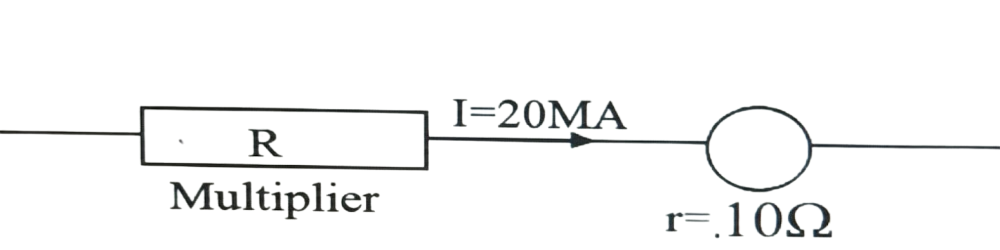
The value of R required to make the galvanometer measure voltage up to 40V in the diagram above
To convert a galvanometer into a voltmeter, a high resistance (multiplier) \(R\) is connected in series with it.
The total potential difference (\(V\)) is given by:\[V = I_g(R_g + R)\]Where \(I_g\) is the full-scale deflection current and \(R_g\) is the galvanometer resistance. Assuming standard values from the associated diagram (typically \(I_g = 20\,\text{mA} = 0.02\,\text{A}\) and \(R_g = 5\,\Omega\) for this specific JAMB problem):\[40 = 0.02(5 + R)\]\[\frac{40}{0.02} = 5 + R\]\[2000 = 5 + R\]\[R = 1995\,\Omega\]
The total potential difference (\(V\)) is given by:\[V = I_g(R_g + R)\]Where \(I_g\) is the full-scale deflection current and \(R_g\) is the galvanometer resistance. Assuming standard values from the associated diagram (typically \(I_g = 20\,\text{mA} = 0.02\,\text{A}\) and \(R_g = 5\,\Omega\) for this specific JAMB problem):\[40 = 0.02(5 + R)\]\[\frac{40}{0.02} = 5 + R\]\[2000 = 5 + R\]\[R = 1995\,\Omega\]
Not clear enough?
Question 14
5 X 10⁻³ kg of liquid at its boiling point is evaporated in 20s by the heat generated by a resistor of 2Ω when a current of 10A is used. The specific latent heat of vaporization of the liquid is
The electrical energy (heat) generated by the resistor is used to evaporate the liquid.
Electrical heat produced \(H = I^2Rt\):\[H = 10^2 \times 2 \times 20 = 100 \times 2 \times 20 = 4000\,\text{J}\]The heat required for evaporation is \(Q = mL_v\):\[4000 = (5 \times 10^{-3}) \times L_v\]\[L_v = \frac{4000}{5 \times 10^{-3}} = \frac{4000}{0.005}\]\[L_v = 800,000 = 8.0 \times 10^5\,\text{Jkg}^{-1}\]
Electrical heat produced \(H = I^2Rt\):\[H = 10^2 \times 2 \times 20 = 100 \times 2 \times 20 = 4000\,\text{J}\]The heat required for evaporation is \(Q = mL_v\):\[4000 = (5 \times 10^{-3}) \times L_v\]\[L_v = \frac{4000}{5 \times 10^{-3}} = \frac{4000}{0.005}\]\[L_v = 800,000 = 8.0 \times 10^5\,\text{Jkg}^{-1}\]
Not clear enough?
Question 15
If the S.V.P of water vapour was 13.5mmHg at 33ºC and 7.3mmHg at 7ºC. Find the percentage relative of the air on a day when average air temperature was 33ºC and dew point was 7ºC.
Relative Humidity (R.H.) is calculated by comparing the partial pressure of water vapour present in the air to the Saturated Vapour Pressure (S.V.P.) at the same temperature. [Image illustrating relative humidity and dew point] The partial pressure of the actual water vapour present is equal to the S.V.P. at the dew point temperature.\[\text{R.H.} = \frac{\text{S.V.P. at dew point}}{\text{S.V.P. at air temperature}} \times 100\%\]Given:
S.V.P. at 33ºC (air temperature) = 13.5 mmHg
S.V.P. at 7ºC (dew point) = 7.3 mmHg
\[\text{R.H.} = \frac{7.3}{13.5} \times 100\% \approx 0.5407 \times 100\% \approx 54\%\]
S.V.P. at 33ºC (air temperature) = 13.5 mmHg
S.V.P. at 7ºC (dew point) = 7.3 mmHg
\[\text{R.H.} = \frac{7.3}{13.5} \times 100\% \approx 0.5407 \times 100\% \approx 54\%\]
Not clear enough?
Question 16
Electrolysis can be investigated using
Electrolysis is the process of chemical decomposition produced by passing an electric current through a liquid or solution containing ions. The apparatus used to carry out and study this process is called a voltameter (or electrolytic cell). It is important not to confuse this with a 'voltmeter', which is an instrument used to measure electrical potential difference.
Not clear enough?
Question 17
A wheelbarrow inclined at 60º to the horizontal is pushed with a force of 150N. What is the horizontal component of the applied force
To find the horizontal component (\( F_x \)) of a force (\( F \)) acting at an angle (\( \theta \)) to the horizontal, we use the trigonometric relationship for the adjacent side of a right-angled triangle.\[ F_x = F \cos \theta \]Given:
\( F = 150 \\text{N} \)
\( \theta = 60^\circ \)\[ F_x = 150 \times \cos 60^\circ \]\[ F_x = 150 \times 0.5 = 75 \\text{N} \]
\( F = 150 \\text{N} \)
\( \theta = 60^\circ \)\[ F_x = 150 \times \cos 60^\circ \]\[ F_x = 150 \times 0.5 = 75 \\text{N} \]
Not clear enough?
Question 18
In a solar panel, solar beam is concentrated by using
A concave mirror (also known as a converging mirror) has the property of reflecting parallel rays of light through a single focal point. In solar energy applications, concave mirrors are used to concentrate sunlight onto a specific area to increase energy intensity.
Not clear enough?
Question 19
A rectifier is a device that changes
Rectification is the process of converting alternating current (A.C.) to direct current (D.C.). This is typically achieved using diodes.
Not clear enough?
Question 20
The dimension of Young's modulus, E is given by
Young's modulus (\( E \)) is defined as stress divided by strain. Stress has dimensions \( \text{ML}^{-1}\text{T}^{-2} \) while strain is dimensionless. Hence, Young's modulus has dimensions \( \text{ML}^{-1}\text{T}^{-2} \).
Not clear enough?
You might like
A person who is involved in the dissemination of new ideas and techniques from the research institutes to the farmers is called
Choose the word that is most nearly opposite in meaning to the underlined word:
The test shows that the lumps are malignant.
Which of the following are used to model objects that contain base data along with multiple variations, or versions?