
Physics 2025 Jamb Examination
Physics 2025 Jamb Examination

Question 1
Which of these colours in the visible spectrum has the longest wavelength?
The visible spectrum consists of colours ranging from violet to red (often remembered by the acronym ROYGBIV).
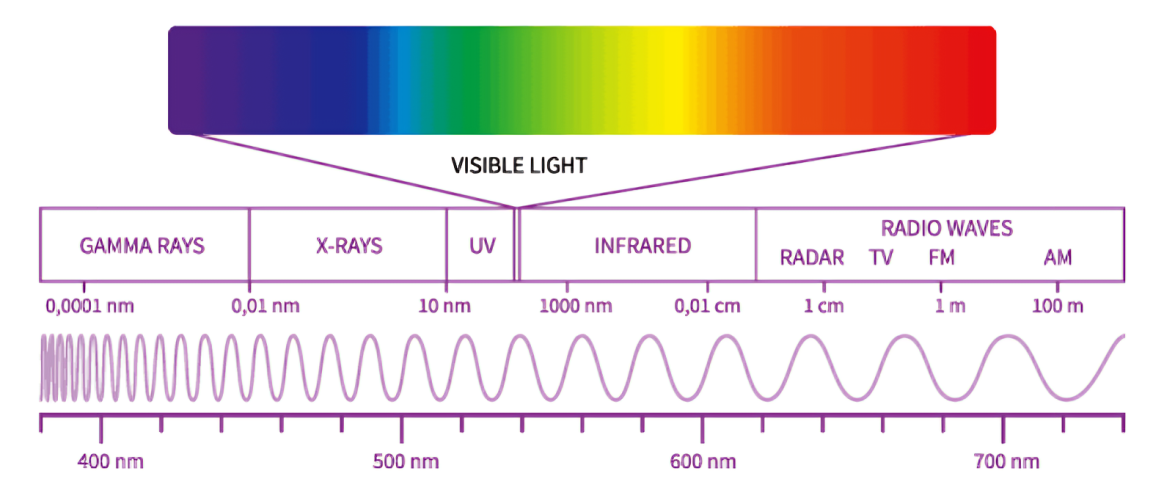 Wavelength increases as we move from violet toward red. Red light has the longest wavelength (approximately 700 nm) and the lowest frequency, while violet has the shortest wavelength (approximately 400 nm) and the highest frequency.
Not clear enough?
Question 2
The power of a lens in diopters is
The power (P) of a lens is defined as the reciprocal of its focal length (f). When the focal length is measured in metres, the power is expressed in diopters (D). The relationship is given by the formula:
\[ P = \frac{1}{f} \]
A lens with a short focal length has a high power because it bends light rays more sharply.
Not clear enough?
Question 3
A man moves 6.0m East and then 10.0m N30ºE. How far is he from his starting point?
This is a vector addition problem. Let the first displacement be \( A = 6.0 \, \text{m} \) East and the second be \( B = 10.0 \, \text{m} \) at a bearing of \( 30^\circ \) from North (which is \( 60^\circ \) from East). Using the Cosine Rule:
\[ R^2 = A^2 + B^2 - 2AB \cos(\theta) \]
In the triangle formed, the interior angle between the 6m vector and the 10m vector is \( 90^\circ + 30^\circ = 120^\circ \).
\[ R^2 = 6^2 + 10^2 - 2(6)(10) \cos(120^\circ) \]
\[ R^2 = 36 + 100 - 120(-0.5) \]
\[ R^2 = 136 + 60 = 196 \]
\[ R = \sqrt{196} = 14.0 \, \text{m} \]
Not clear enough?
Question 4
The density of water is 1g/cm\(^{3}\) while that of ice is 0.9g/cm\(^{3}\). Calculate the change in volume when 90g of ice is completely melted.
Mass remains constant during a change of state. [Image showing the density difference between ice and water molecules]
Initial volume of ice (\( V_{\text{ice}} \)) = \( \frac{\text{Mass}}{\text{Density}} = \frac{90}{0.9} = 100 \, \text{cm}^3 \).
Final volume of water (\( V_{\text{water}} \)) = \( \frac{90}{1.0} = 90 \, \text{cm}^3 \).
Change in volume = \( 100 - 90 = 10 \, \text{cm}^3 \).
Not clear enough?
Question 5
The graphical representation of the pressure law is always a straight line passing through the origin, only if the temperature scale is
The Pressure Law (Gay-Lussac's Law) states that for a constant volume, pressure is directly proportional to temperature (\( P \propto T \)). This direct proportionality (passing through the origin) only holds when temperature is measured on the absolute or thermodynamic scale (Kelvin). On the Celsius scale, the graph would intersect the pressure axis at a non-zero value and cross the temperature axis at \( -273.15^\circ \text{C} \).
Not clear enough?
Question 6
According to the kinetic theory of gases, the pressure exerted by a gas on the walls equals
Pressure is defined as Force divided by Area (\( P = \frac{F}{A} \)). According to Newton's Second Law, Force is the rate of change of momentum. Therefore, pressure is the rate of change of momentum per unit area. When gas molecules collide elastically with the walls, they experience a change in momentum, and the sum of these impacts over time and area constitutes the gas pressure.
Not clear enough?
Question 7
Which of the following is not true about a wave in a plucked string?
When a string is plucked, the displacement of the string particles is perpendicular to the direction of wave travel. This is the definition of a transverse wave, which possesses crests and troughs. It is a mechanical wave because it requires a medium (the string). It is NOT a longitudinal wave, as longitudinal waves (like sound) involve particles moving parallel to the wave direction.
Not clear enough?
Question 8
The emf of a cell is the potential difference across its terminals when it is in
The Electromotive Force (e.m.f.) is the total work done by a cell in moving a unit charge around a complete circuit. When the circuit is 'open' (no current flowing), no voltage is dropped across the internal resistance. Therefore, the measured potential difference across the terminals is equal to the e.m.f. In a closed circuit, the terminal voltage is less than the e.m.f. due to internal resistance losses (\( V = E - Ir \)).
Not clear enough?
Question 9
The thermometric property of mercury is best on the change in
Mercury is used in liquid-in-glass thermometers because it expands linearly with temperature. The 'thermometric property' used here is the change in volume (which results in a change in the length of the mercury column in a narrow capillary tube). While density does change, the measurable property we rely on for the scale is the volume expansion.
Not clear enough?
Question 10
Some of the features of the human eye that greatly help to refract light entering the eyes are
Refraction is the bending of light as it passes through different media. In the human eye, the cornea provides the majority of the eye's total optical power (refractive power), and the lens provides the adjustable focus (accommodation). Together, they ensure that light is focused correctly onto the retina.
Not clear enough?
You might like
But you, son of man, hear what I say to you; be not rebellious like that rebellious house; open your mouth, and eat what I give you. In the statement above, what was Prophet Ezekiel given to eat?
Three teachers shared a packet of chalk. The first teacher got 2/5 of the chalk and the second teacher received 2/15 of the remainder.What fraction did the third teacher receive?