
Physics 2025 Jamb Examination
Physics 2025 Jamb Examination

Question 11
When both the object and its image move together in the same direction relative to the observer, then there is
Parallax is the apparent displacement of an object when viewed from two different positions. In optics experiments, specifically when using pins and mirrors, the 'method of no parallax' is used to locate an image. When the object (the real pin) and the image are exactly at the same position, they appear to move together without any relative displacement as the observer's head moves from side to side. If they move together, it indicates that parallax has been eliminated, meaning there is no parallax error.
Not clear enough?
Question 12
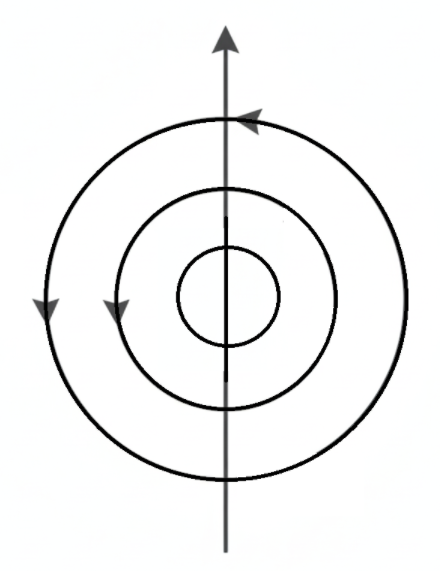
The diagram above shows a magnetic field due to a
This is the characteristic pattern produced by a straight conductor carrying electric current. The direction of these circular lines is determined by the Right-Hand Grip Rule, where the thumb points in the direction of the current and the fingers curl in the direction of the magnetic field lines.
Not clear enough?
Question 13
I. The colour of light depends on its frequency II. When white light is dispersed by a triangular prism, yellow is deviated more than green III. Rainbows are formed when rains fall heavily. Which of the above statements is/are correct about dispersion and colours?
Statement I is correct because colour is fundamentally determined by the frequency of the light wave. Statement II is incorrect; in the visible spectrum (ROYGBIV), deviation increases with frequency. Since green has a higher frequency than yellow, green is deviated more than yellow. Statement III is incorrect because rainbows require sunlight and rain droplets acting as prisms, but they don't specifically require 'heavy' rain—just the right optical conditions. Therefore, only statement I is scientifically accurate.
Not clear enough?
Question 14
A Force 18 N pulls a 40 kg mass on a horizontal floor at 0.3 ms\(^{-2}\). Find the coefficient of friction.
Using Newton's Second Law: \( F_{net} = ma \). The net force is the applied force (\( F_a \)) minus the frictional force (\( F_f \)).
\[ F_a - F_f = ma \]
\[ 18 - F_f = 40 \times 0.3 \]
\[ 18 - F_f = 12 \implies F_f = 6 \, \text{N} \]
The frictional force is also defined as \( F_f = \mu R \), where \( R = mg \) (assuming \( g = 10 \, \text{ms}^{-2} \)).
\[ 6 = \mu (40 \times 10) \]
\[ \mu = \frac{6}{400} = 0.015 \]
Not clear enough?
Question 15
A 500W electric oven plugged into a 220 V source will consume an electric current of
Electric power (P) is related to voltage (V) and current (I) by the formula:
\[ P = IV \]
Rearranging to solve for current:
\[ I = \frac{P}{V} \]
\[ I = \frac{500}{220} \approx 2.2727 \, \text{A} \]
Not clear enough?
Question 16
A hydraulic press consists of two cylinders of cross-sectional radius \( r_1 \) and \( r_2 \). If a force of 200N applied to the smaller piston (\( r_1 \)), causes a force of 3200N to be transmitted onto the larger piston (\( r_2 \)). The ratio \( r_1 : r_2 \) is?
According to Pascal's Principle, pressure is transmitted equally throughout a fluid.
\[ P_1 = P_2 \implies \frac{F_1}{A_1} = \frac{F_2}{A_2} \]
Since Area \( A = \pi r^2 \):
\[ \frac{F_1}{\pi r_1^2} = \frac{F_2}{\pi r_2^2} \implies \frac{200}{r_1^2} = \frac{3200}{r_2^2} \]
\[ \frac{r_1^2}{r_2^2} = \frac{200}{3200} = \frac{1}{16} \]
Taking the square root of both sides:
\[ \frac{r_1}{r_2} = \sqrt{\frac{1}{16}} = \frac{1}{4} \]
So the ratio is 1:4.
Not clear enough?
Question 17
The gravitational pull between two bodies is 20N. Find the gravitational pull when their distance of separation is doubled.
Newton's Law of Universal Gravitation states that the force (F) is inversely proportional to the square of the distance (d) between the bodies: \( F \propto \frac{1}{d^2} \). If the distance is doubled (\( 2d \)), the new force (\( F' \)) becomes:
\[ F' \propto \frac{1}{(2d)^2} = \frac{1}{4d^2} \]
\[ F' = \frac{1}{4} F = \frac{20}{4} = 5 \, \text{N} \]
Not clear enough?
Question 18
The volume of a 1 cm\(^{3}\) metal ball increases by 0.0018 cm\(^{3}\) when heated through temperature \( \theta \). If the linear expansivity of the ball is 2.0 x 10\(^{-5}\)K\(^{-1}\), find \( \theta \).
The cubic (volume) expansivity (\( \gamma \)) is thrice the linear expansivity (\( \alpha \)): \( \gamma = 3\alpha \).
\[ \gamma = 3 \times (2.0 \times 10^{-5}) = 6.0 \times 10^{-5} \, \text{K}^{-1} \]
Using the formula for volume expansion: \( \Delta V = V_0 \gamma \theta \).
\[ 0.0018 = 1 \times (6.0 \times 10^{-5}) \times \theta \]
\[ \theta = \frac{0.0018}{6.0 \times 10^{-5}} = \frac{1.8 \times 10^{-3}}{6.0 \times 10^{-5}} = 0.3 \times 10^2 = 30 \, ^\circ\text{C} \]
Not clear enough?
Question 19
For a gas, which pair of variables is inversely proportional to each other (provided other conditions are constant), where P = pressure, T= temperature, V= volume, and n= number of molecules?
According to Boyle's Law, for a fixed mass of gas at constant temperature, the pressure (P) of the gas is inversely proportional to its volume (V). This is expressed as \( P \propto \frac{1}{V} \) or \( PV = k \).
Not clear enough?
Question 20
A boy uses a single string pulley system to lift a mass of 20kg moving with a velocity of 5ms\(^{-1}\). What is the power developed by the boy if g = 10ms\(^{-2}\)?
Power is the rate of doing work, or Force multiplied by Velocity (\( P = Fv \)). In this case, the force required to lift the mass is its weight:
\[ F = mg = 20 \times 10 = 200 \, \text{N} \]
The power developed is:
\[ P = 200 \, \text{N} \times 5 \, \text{ms}^{-1} = 1000 \, \text{W} \]
Not clear enough?
You might like
A train travels at an average speed of 90 km/h without any stoppages. However, its average speed decreases to 60 km/h on account of stoppages. On an average, how many minutes per hour does the train stop?
For this question, select the option that best explains the information conveyed in the question.
Her death was a bolt from the blue to us
Choose the option that best complete the gap.
Abike must have found the very interesting movies quite _____.
A is husband of M who is sister-in-law of N, N is daughter of R and U, M is daughter-in-law of U. How A is related to U ?
A tank has two pipes. The first pipe can fill it in 4 hours and the second can empty it in 16 hours. If two pipes be opened together at a time, then the tank will be filled in ?