Principles Of Accounts 2025 Jamb Examination

Principles Of Accounts 2025 Jamb Examination

Available Sections
2. Career
4. Job
1234...8

Question 11

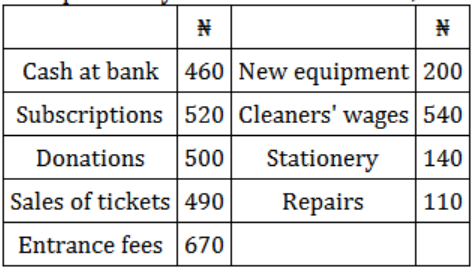
Receipt and Payments: 31st December, 2016
The total income received for the year is
Show explanation Expand Question
To find the total income received for the year, we must sum all the items on the 'Receipts' side of the Receipts and Payments account provided in the image. The receipts include:
Balance b/f: ₦460
Subscriptions: ₦1,420
Donations: ₦240
Sales of tickets: ₦520
Total Income Received = 460 + 1,420 + 240 + 520 = ₦2,640.
The Receipts and Payments account is essentially a summary of the cash book for a non-profit making organisation, recording all cash inflows regardless of whether they are capital or revenue in nature.
Not clear enough?

Question 12

Receipt and Payments: 31st December, 2016
The surplus for the year is
Show explanation Expand Question
Surplus is calculated by subtracting revenue expenditure from revenue income in the Income and Expenditure Account. Unlike the Receipts and Payments account, we exclude the opening balance and capital items.
Revenue Income:
Subscriptions: ₦1,420
Donations: ₦240
Sales of tickets: ₦520
Total Revenue Income = 1,420 + 240 + 520 = ₦2,180.
Revenue Expenditure (from Payments side):
Stationery: ₦120
Rent: ₦170
Total Revenue Expenditure = 120 + 170 = ₦290.
Surplus = Total Revenue Income - Total Revenue Expenditure
Surplus = 2,180 - 290 = ₦1,890.
Note: The balance c/f is a closing cash balance, not an expense, and the opening balance is not income.
Not clear enough?

Question 13

Capital receipt is collected
Show explanation Expand Question
A capital receipt is a non-recurring inflow of funds that either creates a liability or reduces an asset. It is distinct from revenue receipts, which arise from the daily core trading activities of a business. Sales of stock in trade, collections from trade debtors, and general trading activities all generate revenue receipts because they are part of the normal operating cycle. However, the sale of a fixed asset, such as a motor vehicle, is not a regular trading activity and results in the reduction of a non-current asset, making the proceeds a capital receipt.
Not clear enough?

Question 14

Which of the following is a component of prime cost?
Show explanation Expand Question
Prime cost consists of all direct costs incurred during production, namely direct materials, direct labour, and direct expenses. Direct expenses are costs that can be specifically identified with a particular product or cost centre. Royalties paid for the right to manufacture a specific product or use a patent are classified as direct expenses because they vary directly with the volume of production. In contrast, factory rent, factory electricity, and depreciation are indirect costs (factory overheads) as they support the production environment generally rather than being directly traceable to a specific unit of output.
Not clear enough?

Question 15

The accounting principle that states that, in the preparation of an accounting statement, revenue is recognized as soon as goods are passed on to the customer is the
Show explanation Expand Question
The realization concept (also known as the revenue recognition principle) dictates the point at which revenue should be recorded in the accounting books. According to this principle, revenue is recognized and recorded when it is earned, regardless of when the cash is actually received. This typically occurs when the legal title to goods passes from the seller to the buyer or when a service is rendered. This ensures that the financial statements reflect the actual economic activity of the period rather than just the cash flow movement.
Not clear enough?

Question 16

In departmental accounts, rent is apportioned on the basis of
Show explanation Expand Question
In departmental accounting, common expenses that cannot be directly traced to a single department must be apportioned using a logical and equitable base. Rent and rates are related to the physical space used by each department within a building. Therefore, the most appropriate basis for allocating rent is the floor area occupied by each department. Volume of sales is typically used for selling expenses like commissions, while the number of personnel might be used for staff welfare costs.
Not clear enough?

Question 17

The process of recording the financial transactions of government is
Show explanation Expand Question
Public sector accounting (also known as government accounting) is the specialized field of accounting that deals with the recording, analyzing, and reporting of the financial transactions of government entities and agencies. It focuses on the stewardship of public funds, compliance with legal requirements, and budgetary control. While financial accounting is used in the private sector to report to stakeholders, public sector accounting is tailored to the unique needs of government administration and public accountability.
Not clear enough?

Question 18

A business should not lay claim to any profit before it is earned. This is in accordance with the
Show explanation Expand Question
The prudence concept (or conservatism) dictates that a business should exercise caution in its financial reporting. It specifically requires that profits should not be recognized or recorded in the accounts until they are realized or earned. Conversely, all known liabilities and potential losses should be provided for as soon as they are anticipated. This ensure that the financial statements do not present an overly optimistic view of the company's financial health.
Not clear enough?

Question 19

Which of the following errors affects the agreement of a Trial Balance?
Show explanation Expand Question
The Trial Balance only fails to agree when there is a 'one-sided' error that disrupts the equality of debits and credits. A wrong addition in the sales account (an error of cast) results in an incorrect total being transferred to the Trial Balance, causing the totals to differ. Errors like posting a van to purchases (error of principle), failure to enter sales (error of omission), or crediting the wrong person's account (error of commission) involve equal debits and credits, so the Trial Balance will still balance despite the mistakes.
Not clear enough?

Question 20

Which of the following is an advantage of the imprest system?
Show explanation Expand Question
The imprest system is a method used to manage petty cash. Its primary advantage is that it allows the business to handle small, frequent items of expenditure (like stationery, postage, or taxi fares) without having to write a cheque for every minor transaction. This saves the main cashier's time and keeps the main cash book from being cluttered with tiny entries. It also provides a level of control over minor spending by setting a fixed float that must be replenished based on valid receipts.
Not clear enough?

1234...8
In this page
Principles-of-accounts 2025 Jamb Examination
Open Model!