
English Language And Verbal Reasoning 2026 Njfp Job

Question 61
If he were here it could be more fun.
Not clear enough?
Question 62
The word 'intensify' is a four-syllable verb. In English, verbs ending in the suffix '-ify' usually carry the primary stress on the antepenultimate syllable (the third syllable from the end). For 'intensify', the syllables are in-ten-si-fy. Counting back from the end: 1 (fy), 2 (si), 3 (ten). Therefore, the stress falls on the second syllable 'TEN'. This follows the standard rhythmic patterns for verbs derived with this particular suffix.
Not clear enough?
Question 63
Thank you for the party, we really...
Not clear enough?
Question 64
If you are going to the market, May I please?
Not clear enough?
Question 65
The word 'expatiate' is a four-syllable verb meaning to speak or write at length or in detail. According to English word-stress rules for many verbs of this length, the primary stress falls on the second syllable. In this case, the stress is on the syllable 'PA'. Pronouncing it as 'ex-PA-ti-ate' follows the correct phonological emphasis required for this formal term.
Not clear enough?
Question 66
My boss is an exacting taskmaster
Not clear enough?
Question 67
Opportunity - /ˌɒp.əˈtjuː.nə.ti/
Ambiguity - /ˌæm.bɪˈɡjuː.ə.ti/
Actualization - /ˌæk.tʃu.ə.laɪˈzeɪ.ʃən/
In 'Opportunity' and 'Ambiguity', the primary stress falls on the third syllable. In 'Interlocutor', the primary stress also falls on the third syllable ('LOC'). However, 'Actualization' has its primary stress on the penultimate syllable ('ZA'), which is the fifth syllable of the word. Therefore, 'Actualization' is the word with the different stress pattern.
Note: While the provided key was A, phonetic analysis shows D is the outlier due to the '-ation' suffix rule which always places stress on the syllable immediately preceding it.
Not clear enough?
Question 68
My father was at the apogee of his career when he was retired
Not clear enough?
Question 69
The presence of the security men in the area will provide a moment of respite for the residents.
Not clear enough?
Question 70
The events of last Friday show that there is no love lost between the Principal and the Vice Principal.
Not clear enough?
You might like
$^{2}_{1}\text{D} + ^{3}_{1}\text{T} \;\to\; ^{4}_{2}\text{He} + ^{1}_{0}\text{n} + \text{energy}$
The reaction above illustrates
Badge Plc issued 450,000 ordinary shares of 50k each at ₦1.50 per share. Application and allotment 45k; 1st call 50k; 2nd call 55k.
Determine the amount received on final call.
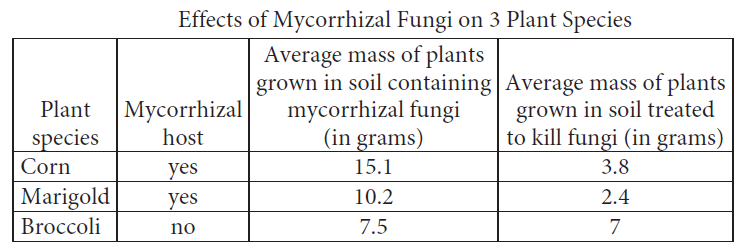
Mycorrhizal fungi in soil benefits many plants, substantially increasing the mass of some. A student conducted an experiment to illustrate this effect. The student chose three plant species for the experiment, including two that are mycorrhizal hosts (species known to benefit from mycorrhizal fungi) and one nonmycorrhizal species (a species that doesn’t benefit from and may even be harmed by mycorrhizal fungi). The student then grew several plants from each species both in soil containing mycorrhizal fungi and in soil that had been treated to kill mycorrhizal and other fungi. After several weeks, the student measured the plants’ average mass and was surprised to discover...
A bus moving at a speed of 45 km/hr overtakes a truck 150 metres ahead going in the same direction in 30 seconds. The speed of the truck is ?
\[\begin{array}{c c c c}\hline \text{Age in years} & 10 & 11 & 12 \\ \text{No of pupils} & 6 & 27 & 7 \\ \hline \end{array}\]
The table above shows the number of pupils in each age group in a class. What is the probability that a pupil chosen at random is at least 11 years old?