
Electrical Engineering All Engineering Career

Question 151
Application of Norton's theorem to a circuit yields?
equivalent current source and impedance in series
Not clear enough?
Question 152
A closed path made by several branches of the network is known as ?
A closed path made by several branches of a network is known as a "loop."
Not clear enough?
Question 153
If the energy is supplied from a source, whose resistance is 1 ohm, to a load of 100 ohms the source will be ?
If the energy is supplied from a source, and its resistance is 1 ohm while powering a load of 100 ohms, the source can be considered as a "voltage source."
Not clear enough?
Question 154
An ideal voltage source has ?
An ideal voltage source has "zero internal resistance."
Not clear enough?
Question 155
Millman's theorem yields ?
Millman's theorem is a useful tool for finding the voltage and current across a load. It is sometimes referred to as the parallel generator theorem and is particularly helpful in reducing a combination of voltage and current sources connected in parallel to a single equivalent voltage or current source.
When dealing with several voltage sources (V1, V2, V3... Vn) in parallel, each with its internal resistance (R1, R2, R3... Rn), the arrangement can be replaced by a single equivalent voltage source V, which is in series with an equivalent series resistance R.
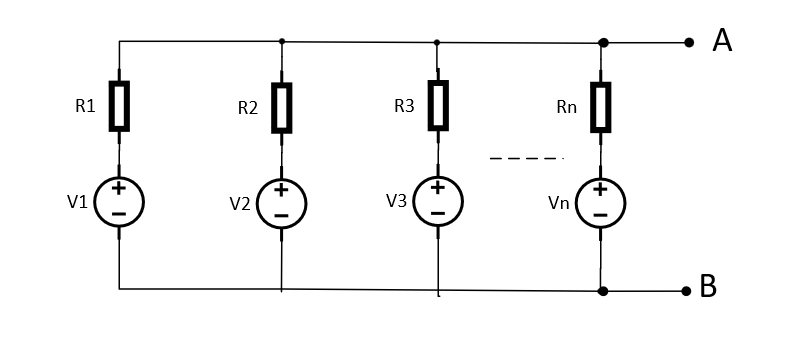
The equivalent circuit:
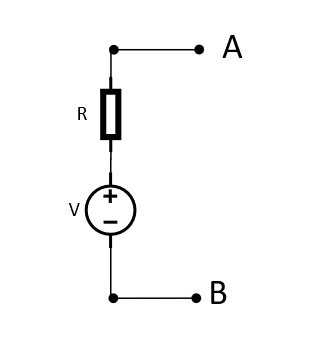
Assuming that we only have 3 resistor components, then V is derived by:
Thus:
2) Current source:
If multiple current sources (I1, I2, I3......In) are connected in series and each of them has internal resistance (R1, R2, R3….Rn), then they can be replaced by a single equivalent current source (I) that is connected in parallel with an equivalent series resistance (R).
Thus
Not clear enough?
Question 156
A terminal where three or more branches meet is known as ?
A terminal where three or more branches meet is known as a "node."
Not clear enough?
Question 157
A star circuit has element of resistance R/2. The equivalent delta elements will be ?
To convert a star (Y) circuit to a delta (Δ) circuit, the resistances are related by the formulas:
\[ R_{\text{Y}} = \dfrac{R_{\text{Δ}}}{3} \]\[ R_{\text{Δ}} = 3 \times R_{\text{Y}} \]
Given that the element resistance in the star circuit is \( \dfrac{R}{2} \), we can substitute this into the formula:
\[ R_{\text{Δ}} = 3 \times \left(\dfrac{R}{2}\right) = \dfrac{3R}{2} \]
So, the equivalent delta elements will be \( \dfrac{3R}{2} \).
Not clear enough?
Question 158
If a circuit does not contain any source of energy or e.m.f. it is known as ?
If a circuit does not contain any source of energy or electromotive force (emf), it is known as a "passive network."
Not clear enough?
Question 159
Kirchhoff's law is applicable to ?
Kirchhoff's laws are applicable to both AC (alternating current) and DC (direct current) circuits. They are fundamental principles in circuit analysis and apply to circuits regardless of whether they are AC or DC. So, the correct option is "both AC and DC circuits."
Not clear enough?
Question 160
A capacitor is generally a ?
A capacitor is generally a passive, linear, and bilateral component. It is passive because it does not generate energy, it only stores and releases it. It is linear because its behavior follows linear relationships between voltage and current. It is bilateral because its behavior remains the same regardless of the direction of the applied voltage. So, the correct option is "linear and bilateral component."