
Biology 2005 Jamb Examination

Question 1
The organelle common to both plant and animal cells is the
B. plasmalemma
Both plant and animal cells have a plasmalemma (cell membrane), while centrioles are usually absent in plant cells, and cell wall and chloroplasts are absent in animal cells.
Not clear enough?
Question 2
Which of the following is likely to have a higher concentration of the mitochondria?
A. Sperm cell
Sperm cells require a lot of energy for movement, so they have a higher concentration of mitochondria.
Not clear enough?
Question 3
The hyphal wall of fungi is rigid owing to the
D. chitin
The rigidity of the hyphal wall of fungi is due to chitin, not cellulose or lignin.
Not clear enough?
Question 4
Angiosperms and gymnosperms belong to the class
B. spermatophyta
Both angiosperms and gymnosperms are seed-bearing plants, hence they belong to the class Spermatophyta.
Not clear enough?
Question 5
An example of radially symmetric organism is
B. Hydra
Hydra exhibits radial symmetry, while planaria, tapeworm, and roundworm are bilaterally symmetrical.
Not clear enough?
Question 6
The leech and the earthworm belong to the
D. annelids
Both leech and earthworm are segmented worms, hence they belong to the phylum Annelida.
Not clear enough?
Question 7
I. Rattus rattus II. Agama agama III. Bufo regularis IV. tilipia zilli
the order of evolutionary advancement to the above vertebrates is
D. IV, III, II, I
Evolutionary trend: fish (Tilapia) → amphibian (Bufo) → reptile (Agama) → mammal (Rattus).
Not clear enough?
Question 8
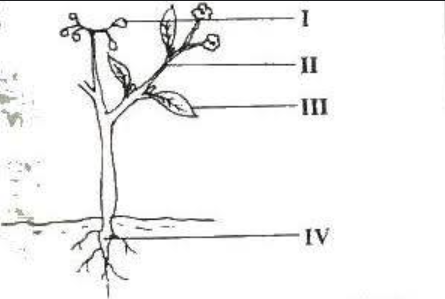
From the diagram above the angle between the parts labelled II and III is the
D. axil
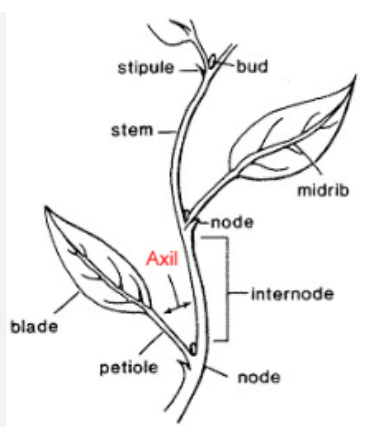
In plants, an axil refers to the angle where a leaf or branch joins the stem or another branch, and it's often the location where buds, and potentially new shoots or flowers, develop.
Not clear enough?
Question 9
The part of the plant where photosynthesis is least likely to take place is
D. IV
The roots are generally the least suitable place for photosynthesis to occur because they are typically underground, lacking sunlight and the necessary chlorophyll for photosynthesis.
Not clear enough?
Question 10
The stage in the life history of a moth responsible for the destruction of agricultural crops is the
D. caterpillar
The caterpillar (larval stage) of a moth feeds on and destroys agricultural crops.
Not clear enough?
You might like
The reduction in the value of a country’s currency in relation to the value of the currencies of other nations is known as____________
The quantity theory of money states that a reduction in the quantity of money in circulation would bring about
Introducing a boy, I said, "His mother is the only daughter of my mother in law". How am I related to the boy ?
Choose the option nearest in meaning to the word underlined?
The debt the company incurred became rather intolerable.