
Biology 2005 Jamb Examination

Question 31
Which of the following is a homostatic response in humans?
D. shivering in a cold environment
Shivering is a homeostatic response, because it helps regulate body temperature. When the environment is cold, involuntary muscle contractions generate heat, maintaining the body’s internal temperature.
The other options are reflex actions or conditioned responses, not mechanisms of homeostasis.
Not clear enough?
Question 32
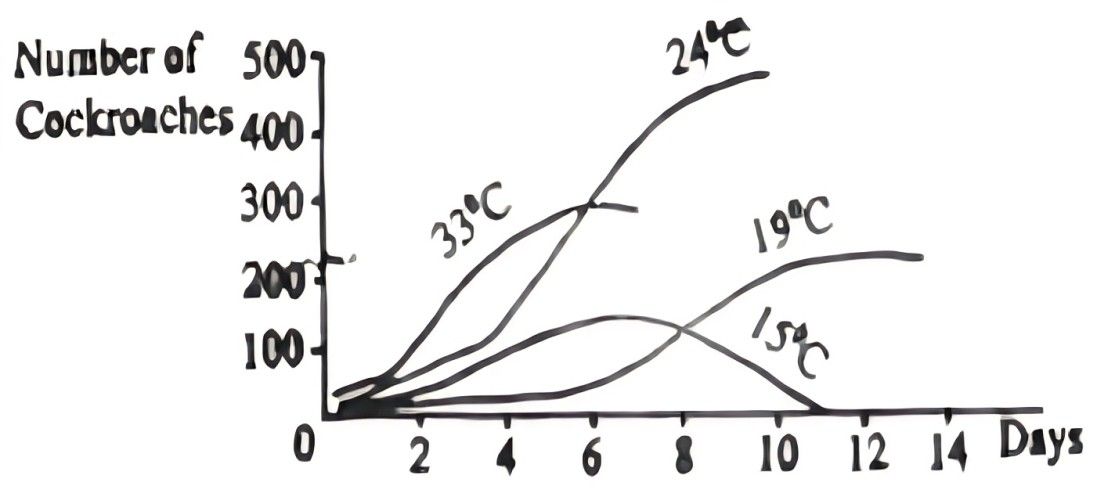
From the diagram above the optimal temperature for breeding cockroaches is
C. 24 °C
From the graph, you can observe how cockroach numbers change over time at different temperatures:
-
At 15 °C, the population rises very slowly and never exceeds around 100 before declining—clearly not optimal.
-
At 19 °C, there’s a moderate growth, peaking at about 200 cockroaches before plateauing.
-
At 24 °C, population growth is most dramatic: cockroach numbers surge past 400, reaching the highest level among the temperatures shown.
-
At 33 °C, while initial growth is rapid and surpasses that at 19 °C for a time, it doesn’t reach the same zenith as at 24 °C and begins to decline sooner.
Therefore, the optimal temperature for breeding cockroaches—where their population grows highest and fastest—is clearly 24 °C, so the correct answer is:
Not clear enough?
Question 33
At which temperature will cockroaches not survive after 10 days
From the diagram, after 10 days:
-
At 15 °C, cockroaches hardly increase in number and their population declines sharply — they do not survive beyond this point.
-
At 19 °C, 24 °C, and 33 °C, their populations are still present and relatively higher compared to 15 °C.
So, the temperature at which cockroaches will not survive after 10 days is:
A. 15 °C
Not clear enough?
Question 34
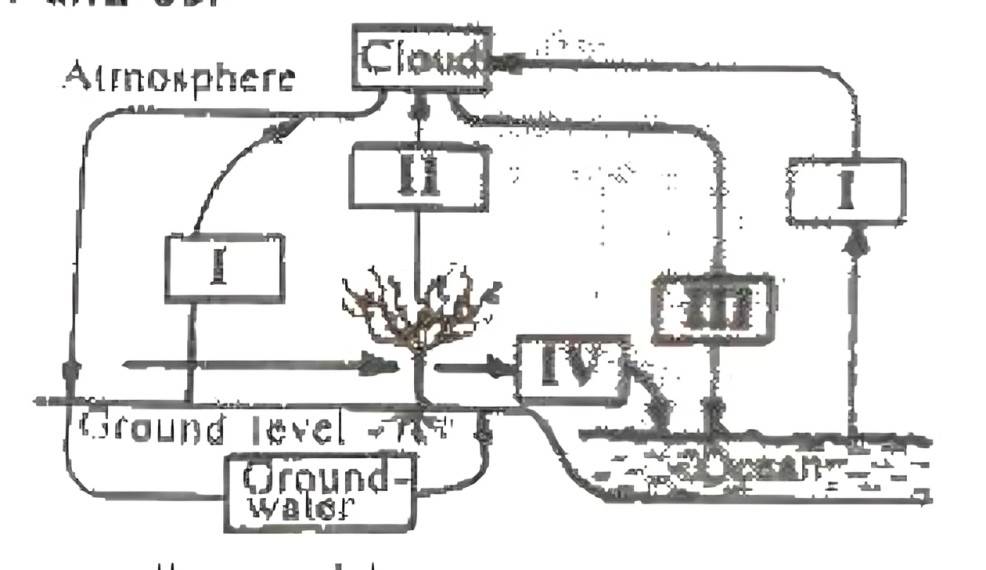
Evaporation and transpiration are respectively represented by the components labelled
Correct Answer: Option A
Evaporation is taking place in the part labelled I as the ocean is being evaporated to the cloud.
Transpiration which takes place in the leaves of the plants is taking place in the part labelled II.
Not clear enough?
Question 35
The main reservoir of water in the circle is the
D. ocean
While clouds are a crucial part of the water cycle, acting as a temporary storage location for water, they are not considered the major reservoir in the water cycle; that distinction belongs to the oceans. The oceans are by far the largest reservoir, holding about 97% of Earth's water.
Not clear enough?
Question 36
The Mambila plateau is a unique Nigerian biome located in
C. Taraba state
The Mambila Plateau is a distinct Nigerian biome found in Taraba State, known for its high elevation, cool climate, and rich biodiversity.
Not clear enough?
Question 37
In Nigeria, the guinea savanna belt borders the
B. rainforests and the sudan savanna
In Nigeria, the Guinea savanna belt lies between the southern rainforests and the northern Sudan savanna, serving as a transitional vegetation zone.
Not clear enough?
Question 38
The population density of Tridex in an abandoned square farm land of side 200 m was found to be 5 plants per m2. The population size of the plant on the farm is
Correct answer: D. 200000
Side of farmland = 200 m
Area of farmland = 200 × 200
= 40,000 m2
Density = 5 plants per m²
Population size = Density × Area
= 5 × 40,000 = 200,000
Not clear enough?
Question 39
Secondary succession is much faster than primary succession because
B. soil is already present
Secondary succession proceeds faster because the area has been previously occupied, so soil, organic matter, and nutrients are already available, unlike in primary succession where soil must first develop on bare surfaces like rocks.
Not clear enough?
Question 40
which of the following is used to test for the presence of lime in a soil sample?
C. HCl(aq)
The presence of lime (CaCO₃) in soil is tested by adding dilute hydrochloric acid. If lime is present, the reaction releases carbon (IV) oxide gas with effervescence:
CaCO3 + 2HCl → CaCl2 + H2O + CO2 ↑
This fizzing confirms the presence of lime.
Not clear enough?
You might like

If an increase in the price of crude oil led to an increase in the prices of kerosene and grease, then kerosene and grease are in
The C/C++ language standard has not specified whether the implementation of __________ is arithmetic or logical, leading to potential portability issues.
Kruskal's algorithm (choosing the best non-cycle edge) is better than Prim's (choosing the best tree edge) when the graph has relatively few edges.
Ensuring that appointment into federal establishment in Nigeria reflect geographical spread is the sole function of the ____?