
Biology 2005 Jamb Examination

Question 21
The urinary tubules of the kidney function through
C. ultrafiltration and selective reabsorption
The kidney’s urinary tubules (nephrons) work mainly through two key processes. First, ultrafiltration occurs in the glomerulus, where blood is filtered under pressure, allowing water, salts, glucose, urea, and other small molecules to pass into the Bowman’s capsule while retaining larger molecules like proteins and blood cells. Next, as the filtrate moves through the tubules, selective reabsorption takes place. Useful substances such as glucose, amino acids, and much of the water and salts are reabsorbed back into the blood, while waste products like urea remain in the filtrate to form urine. This combination ensures that essential materials are conserved while metabolic wastes are excreted.
Not clear enough?
Question 22
Excess water in plants is excreted as water vapour and droplets respectively through
B. transpiration and guttation
Plants lose excess water mainly in two ways. Through transpiration, water evaporates as vapour from the stomata, lenticels, and cuticle surfaces. This process is continuous and helps regulate temperature and water balance. On the other hand, when soil water content is high and transpiration is low (usually at night or early morning), plants excrete excess water as liquid droplets from the edges of leaves. This process is called guttation, which occurs through specialized structures known as hydathodes. Together, transpiration and guttation ensure that plants can eliminate excess water effectively.
Not clear enough?
Question 23
When bacteria swim from cold to warm regions this is known as
B. positive thermotaxis
Taxis refers to the directional movement of an organism in response to a stimulus. When bacteria swim from a colder region toward a warmer one, they are moving toward the stimulus (heat). Movement toward a stimulus is termed positive taxis, while movement away is negative taxis. Since the stimulus here is temperature, the correct term is positive thermotaxis. This behavior helps bacteria seek environments more suitable for their metabolism and survival.
Not clear enough?
Question 24
Hydrostatic skeleton is the type of supporting system found in
C. oligochaetes
A hydrostatic skeleton is a support system that relies on fluid pressure within a closed body cavity. It is common in soft-bodied invertebrates such as oligochaetes (e.g., earthworms). In these organisms, the coelomic fluid acts like a skeleton by maintaining shape and providing rigidity when the muscles contract against it, enabling movement and burrowing. Mammals and reptiles have bony endoskeletons, while arthropods possess an exoskeleton made of chitin, so the hydrostatic skeleton is characteristic of oligochaetes.
Not clear enough?
Question 25
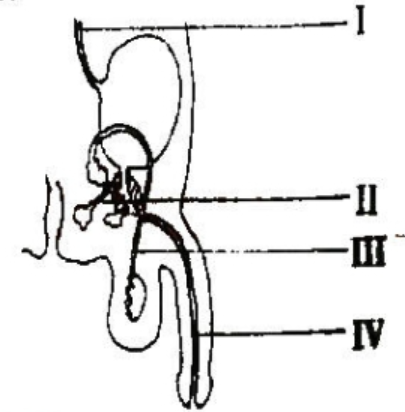
From the diagram above the structure labelled I originates from the
B. kidney
The part labelled I is the ureter which transports the urine from the kidney straight to the bladder where the urine is stored before passing out through the urethra.
Not clear enough?
Question 26
From the diagram above Birth control by vasectomy is achieved by severing the structure labelled
C. III
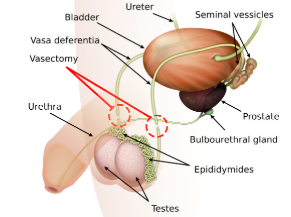
Vasectomy, also known as male sterilization, is a highly effective and permanent form of birth control for men achieved by surgically cutting or blocking the vas deferens, the tubes that carry sperm..
The Vas deferens is labelled III
Not clear enough?
Question 27

The main function of the structure labelled I is to
A. store food for the young plant
The part labelled I represents the cotyledons. In many plants, these are the first leaves to appear after germination and, in cases of epigeal germination (where they rise above the soil), they may even carry out photosynthesis.
Cotyledons, also known as seed leaves, are embryonic structures within the seed that serve as food storage organs. They provide vital nutrients such as starch, fats, and proteins to support the young seedling’s initial growth until it can establish true leaves and begin photosynthesis on its own.
Not clear enough?
Question 28
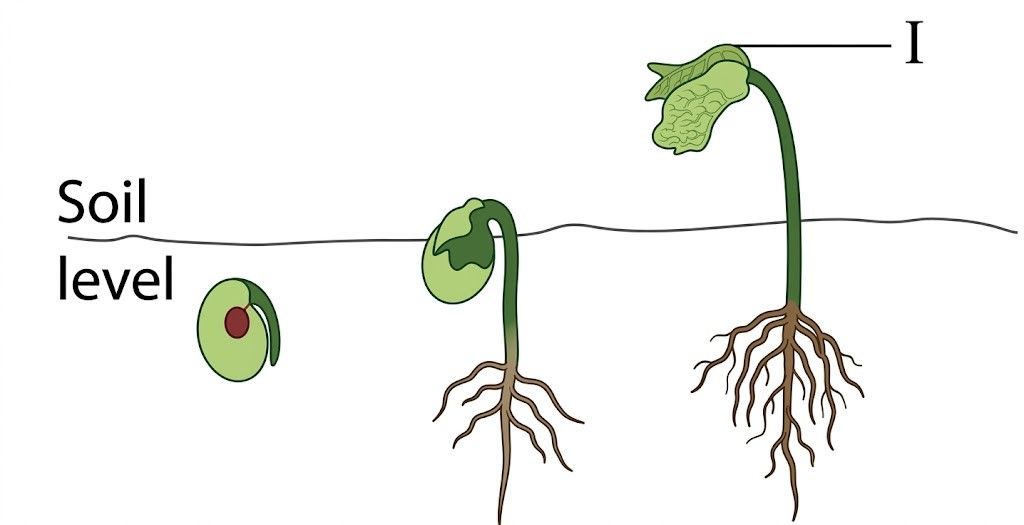
The type of germination illustrated is termed
C. epigeal
Seed germination is generally divided into epigeal, where the cotyledons rise above the soil surface, and hypogeal, where the cotyledons stay underground. A special case, vivipary, occurs when seeds germinate while still attached to the parent plant.
The hypocotyl is the embryonic stem below the cotyledons, linking the root (radicle) to the seed leaves, whereas the epicotyl is the embryonic stem above the cotyledons that develops into the plant’s shoot system.
Not clear enough?
Question 29
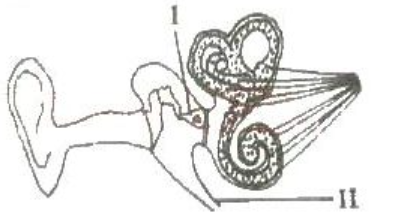
From the diagram above the structure labelled I is the
D. stapes
The stapes is one of the three tiny bones in the middle ear, collectively called the ossicles (the others are the malleus and incus). It is the smallest bone in the human body and is shaped like a stirrup, which is why it’s sometimes called the “stirrup bone.”
Its main function is to transmit sound vibrations from the middle ear to the inner ear. Specifically, the stapes receives vibrations from the incus and presses them against the oval window, a membrane leading to the fluid-filled cochlea in the inner ear. By doing this, the stapes amplifies the sound waves and helps convert them into nerve impulses that the brain can interpret as sound.
Not clear enough?
Question 30
A function of the part labelled II is to
A. equalize pressure on both sides of the tympanum
The part labelled II is the eustachian tube and it's function is to balance or equalize air pressure between the middle ear and the outside environment, ventilate the middle ear, and protect it from nasopharyngeal secretions and sound pressures.
Not clear enough?
You might like
The capacitance C is charged through a resistance R. The time constant of the charging circuit is given by ?
The hot resistance of the bulb's filament is higher than its cold resistance because the temperature co-efficient of the filament is ?
A body of mass m moving with velocity 4 km/h collides with a body of mass 3 m at rest. Now the coalesced mass starts to move with a velocity of ?
A zoo keeper counted the heads of the animals in a zoo and found it to be 80. When he counted the legs of the animals he found it to be 260. If the zoo had either pigeons or horses, how many horses were there in the zoo?
If Aboki Holdings Limited issued 120, 000 ordinary share of N2.00 each at market value of 5.50k each, the share premium would?
A computer program that can replicate and spread itself without having to attach itself to other files or programs is called a:
Choose the option nearest in meaning to the underlined word(s).
The greatness of the creator of the universe is always inexpressible to many adherents of certain faiths.
Myasthenia gravis is an autoimmune neuromuscular disease caused by the destruction or blocking of which specific type of receptors by antibodies?