
Biology 2018 Jamb Examination
Biology 2018 Jamb Examination

Question 61
The reason why the flow of blood through the capillaries is very slow is
The flow of blood through capillaries is slow to allow sufficient time for the exchange of gases, nutrients, and waste products between the blood and surrounding tissues. Thin walls alone do not slow the flow; the narrow diameter and branching network also contribute.
Not clear enough?
Question 62
Which of the following groups of organisms has kidney as the excretory organ?
Kidneys are the primary excretory organs in vertebrates such as fishes, amphibians, birds, and mammals. They filter metabolic wastes from the blood to maintain osmotic balance, unlike annelids or insects which use nephridia or Malpighian tubules.
Not clear enough?
Question 63
Which of the following features is not a characteristic of arteries? Arteries
Arteries generally do not possess valves along their length; valves are characteristic of veins to prevent backflow. Arteries have thick, elastic walls to withstand high pressure and usually carry oxygenated blood away from the heart, except for the pulmonary artery.
Not clear enough?
Question 64
The graph below shows the results of a laboratory investigation which measured the body temperatures of a lizard and a bird under changing artificial conditions.
Use it to answer the question.
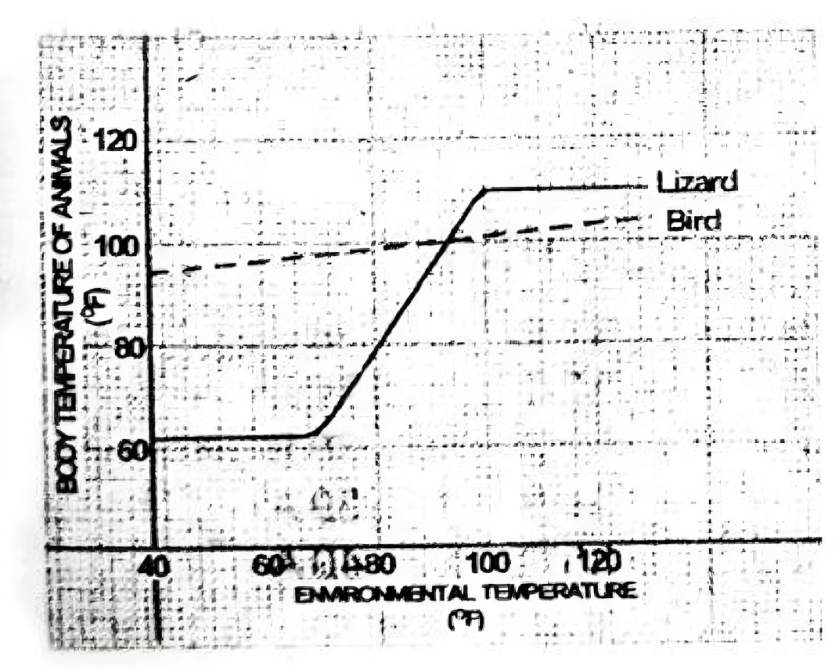
Use it to answer the question.
Birds are homeothermic organisms, meaning they maintain a relatively constant body temperature despite fluctuations in environmental temperature. In contrast, the lizard is poikilothermic, and its body temperature varies with the surrounding environment.
Not clear enough?
Question 65
The graph below shows the results of a laboratory investigation which measured the body temperatures of a lizard and a bird under changing artificial conditions.
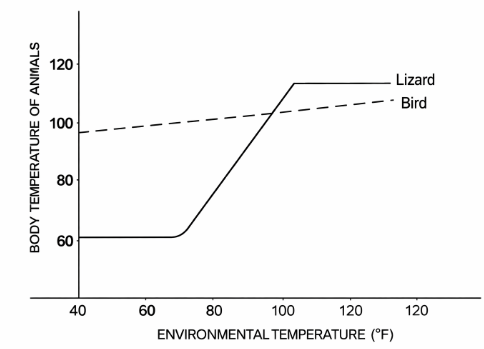
Use it to answer the question.
What physiological term can be used to describe the regulation of the body temperature of the lizard?
Use it to answer the question.
What physiological term can be used to describe the regulation of the body temperature of the lizard?
Lizards are poikilothermic organisms, meaning their internal body temperature fluctuates with environmental temperature. They rely on behavioral adaptations like basking in the sun to regulate their temperature, unlike homeotherms that maintain constant temperature internally.
Not clear enough?
Question 66
The reason why hospitals use saline solutions as drip instead of water is
Saline solutions are isotonic with body fluids, which helps maintain proper osmotic balance and prevents red blood cells from bursting or shrinking. Using pure water could cause haemolysis due to osmotic imbalance, making saline essential for intravenous therapy.
Not clear enough?
Question 67
The part of the ear which contains nerve cells sensitive to sound vibrations is the
The cochlea in the inner ear contains hair cells that act as mechanoreceptors. These cells convert sound vibrations into nerve impulses, which are transmitted to the brain, allowing perception of sound frequency and intensity.
Not clear enough?
Question 68
Spectacles with convex lenses correct long-sightedness by
Convex lenses converge light rays before they enter the eye, allowing them to focus on the retina. This corrects hyperopia (long-sightedness), a condition where the eyeball is too short or the lens cannot bend light sufficiently to focus near objects.
Not clear enough?
Question 69
A seed of a flowering plant can best be described as
A seed is the mature, fertilized ovule of a flowering plant. It contains the embryo and nutrient reserves, protected by a seed coat. This structure allows dispersal and germination under favorable conditions to give rise to a new plant.
Not clear enough?
Question 70
Which of the following processes removes carbon from the atmosphere?
Photosynthesis by plants, algae, and some bacteria removes carbon dioxide from the atmosphere, converting it into glucose and oxygen. This process is essential for regulating atmospheric CO2 levels and supporting life on Earth by providing energy-rich organic molecules.