
Chemistry 2013 Jamb Examination
Chemistry 2013 Jamb Examination

Question 1
Calculate the volume in cm3 of oxygen evolved at s.t.p when a current of 5A is passed through acidified water for 193s?
[F = 96500 C mol-1, Molar volume of a gas at s.t.p = 22.4 dm3]
[F = 96500 C mol-1, Molar volume of a gas at s.t.p = 22.4 dm3]
During electrolysis of acidified water, oxygen is liberated at the anode according to the equation:\[ 2H_2O(l) \rightarrow O_2(g) + 4H^+(aq) + 4e^- \]
Four moles of electrons produce one mole of O2.
Calculate total charge passed:\[ Q = I \times t = 5 \times 193 = 965 \; \text{C} \]Moles of electrons:\[ n(e^-) = \dfrac{Q}{F} \]\[= \dfrac{965}{96500} = 0.01 \; \text{mol of electrons} \]Moles of oxygen produced:\[ n(O_2) = \dfrac{0.01}{4} = 0.0025 \; \text{mol} \]Volume of oxygen at s.t.p:\[ V = n \times 22.4 \]\[= 0.0025 \times 22.4 = 0.056 \; \text{dm}^3 \]\[ \therefore \; 0.056 \; \text{dm}^3 = 56 \; \text{cm}^3 \] Thus, 0.056 dm³ of oxygen gas is evolved.
Calculate total charge passed:\[ Q = I \times t = 5 \times 193 = 965 \; \text{C} \]Moles of electrons:\[ n(e^-) = \dfrac{Q}{F} \]\[= \dfrac{965}{96500} = 0.01 \; \text{mol of electrons} \]Moles of oxygen produced:\[ n(O_2) = \dfrac{0.01}{4} = 0.0025 \; \text{mol} \]Volume of oxygen at s.t.p:\[ V = n \times 22.4 \]\[= 0.0025 \times 22.4 = 0.056 \; \text{dm}^3 \]\[ \therefore \; 0.056 \; \text{dm}^3 = 56 \; \text{cm}^3 \] Thus, 0.056 dm³ of oxygen gas is evolved.
Not clear enough?
Question 2
The radioisotope used in industrial radiography for the rapid checking of faults in welds and casting is
Cobalt-60 emits high-energy gamma rays which can penetrate metals and thick materials. These rays expose photographic films placed on the opposite side of a metal object, revealing flaws or internal cracks without damaging the material. This non-destructive testing technique is essential in quality control during welding and casting. Other isotopes such as Iodine-131 and Phosphorus-32 are used in medicine and biological studies, while Carbon-14 is used in dating ancient remains, not in industrial radiography.
Not clear enough?
Question 3
2SO2(g) + O2(g) ⇌ 2SO3(g)
ΔH = −395.7 kJ mol−1
In the reaction above, the concentration of SO3(g) can be increased by
ΔH = −395.7 kJ mol−1
In the reaction above, the concentration of SO3(g) can be increased by
The reaction is exothermic (ΔH = −395.7 kJ mol⁻¹). According to Le Chatelier’s principle, a decrease in temperature favours the formation of products in an exothermic reaction because heat is considered a product. Lowering the temperature shifts equilibrium towards SO3 formation. Pressure also affects equilibrium, but since temperature directly influences exothermic balance, decreasing temperature yields more SO3. Catalysts only speed up the rate but do not affect the equilibrium position.
Not clear enough?
Question 4
How many unpaired electrons are in the p-orbitals of a fluorine atom?
The atomic number of fluorine is 9. Its electronic configuration is 1s² 2s² 2p⁵.
In the 2p subshell, there are 3 orbitals which can hold up to 6 electrons. For fluorine, the 5 electrons fill as follows: one electron in each of the three orbitals, then pairing begins. This leaves one unpaired electron in the p-orbitals.
Hence, fluorine has one unpaired electron in its p-orbitals.
Not clear enough?
Question 5
The radioactive emission with the least ionisation power is
Gamma (γ) rays are high-energy electromagnetic radiations with no mass or charge, allowing them to penetrate deeply through materials but making them the least ionising. Alpha particles are the most ionising due to their double positive charge and large mass, followed by beta particles and X-rays. Gamma rays, however, can travel long distances and require dense materials such as lead for shielding, reflecting their weak ionising but strong penetrating ability.
Not clear enough?
Question 6
Zn(s) + CuSO4(aq) → ZnSO4(aq) + Cu(s)
In the reaction above, the oxidising agent is
In the reaction above, the oxidising agent is
Oxidation involves loss of electrons while reduction involves gain. Zinc displaces copper from CuSO4 because zinc is more electropositive.
Zn → Zn²⁺ + 2e⁻ (oxidation)
Cu²⁺ + 2e⁻ → Cu (reduction)
The substance reduced (Cu²⁺ in CuSO4) acts as the oxidising agent since it gains electrons. Therefore, CuSO4(aq) is the oxidising agent.
Zn → Zn²⁺ + 2e⁻ (oxidation)
Cu²⁺ + 2e⁻ → Cu (reduction)
The substance reduced (Cu²⁺ in CuSO4) acts as the oxidising agent since it gains electrons. Therefore, CuSO4(aq) is the oxidising agent.
Not clear enough?
Question 7
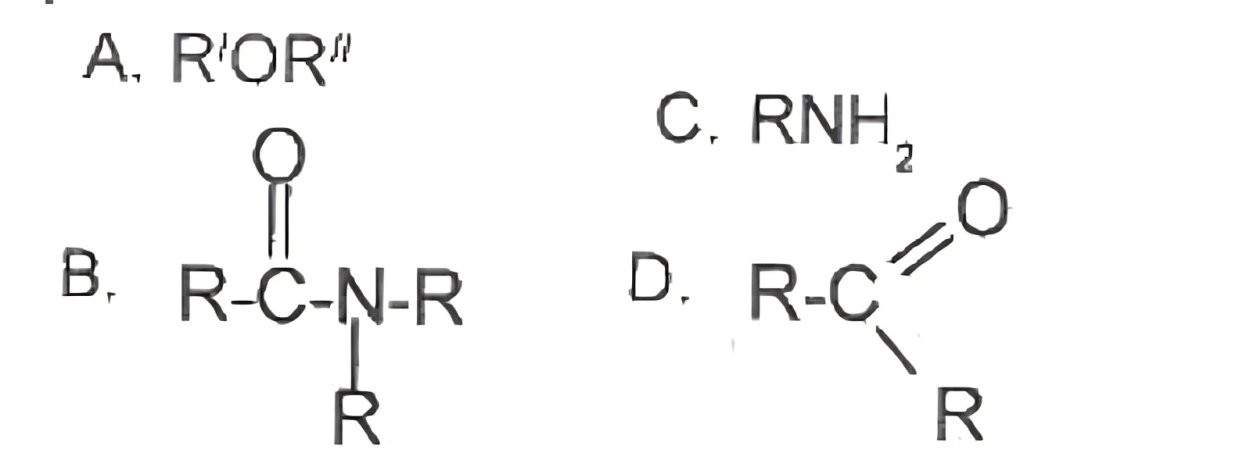
Use the following option above to answer this question. Which of the following compounds in solution will turn red litmus paper blue?
Not clear enough?
Question 8
H O H
| || |
H — C — C — C — H
| |
H H
The compound above is an
The structure contains a carbonyl group (C=O) bonded to two alkyl groups, characteristic of ketones (alkanones). Alkanals have the C=O group at the end of the carbon chain, while alkanones have it within the chain. The compound thus represents propanone (CH₃COCH₃), making it an alkanone.
Not clear enough?
Question 9
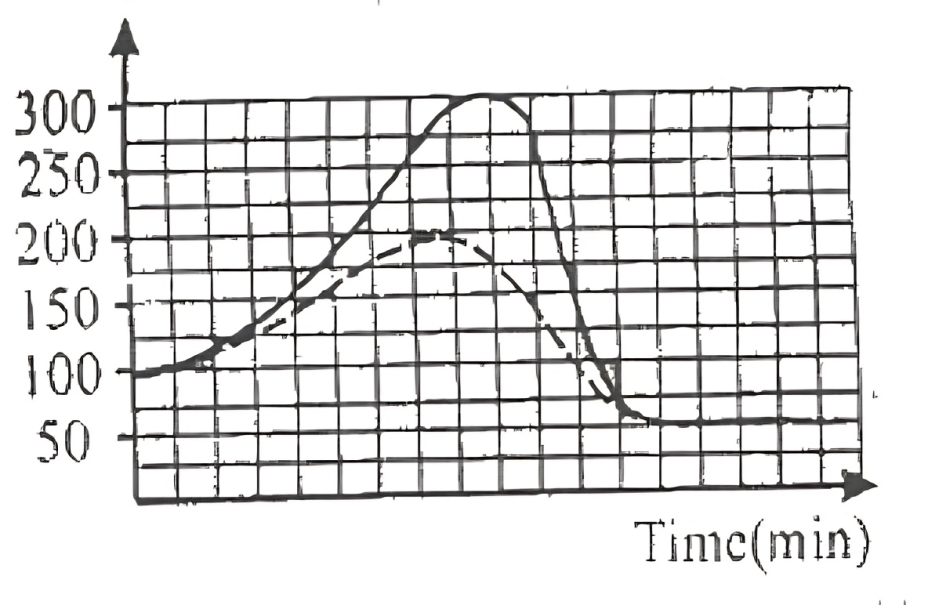
In the graph above, the activation energy of the catalysed reaction is
The activation energy represents the minimum energy required for reactant molecules to undergo a successful reaction. In the graph, the catalysed reaction has a lower peak compared to the uncatalysed one, indicating a reduction in activation energy. The difference corresponds to 100 kJ, showing that the catalyst provides an alternative pathway with a lower energy barrier, thereby increasing the rate of reaction without being consumed.
Not clear enough?
Question 10
3Fe(s) + 4H2O(g) ⇌ Fe3O4(s) + 4H2(g). The equilibrium constant, K, of the reaction above is represented as
In equilibrium expressions, only gaseous and aqueous species are included; solids are excluded because their concentrations are constant. For the reaction:
3Fe(s) + 4H2O(g) ⇌ Fe3O4(s) + 4H2(g)
Only H2O and H2 appear in the equilibrium expression:\[ K = \dfrac{[H_2]^4}{[H_2O]^4} \]This shows that option C correctly represents the equilibrium constant.
3Fe(s) + 4H2O(g) ⇌ Fe3O4(s) + 4H2(g)
Only H2O and H2 appear in the equilibrium expression:\[ K = \dfrac{[H_2]^4}{[H_2O]^4} \]This shows that option C correctly represents the equilibrium constant.
Not clear enough?
You might like
Which of the following operational problems can be directly attributed to a failing or unstable power supply unit (PSU)?
When two ends of a circular uniform wire are joined to the terminals of a battery, the field at the centre of the circle ?
Which of the following is NOT typically considered a physical factor affecting the type of farming practiced in a region?
In a code language if FRIDGE is written as GTLHLK, then in the same language, how will you write the word KETTLE ?