
Chemistry 2013 Jamb Examination
Chemistry 2013 Jamb Examination

Question 11
The IUPAC nomenclature for the compound below is
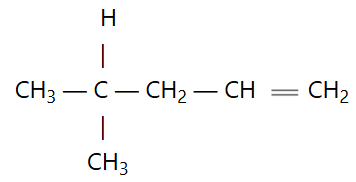
The structure consists of a five-carbon chain with a double bond at carbon 1 and a methyl substituent at carbon 4. Numbering starts from the end nearest to the double bond to give the lowest possible number to the double bond. The methyl group is then attached to the fourth carbon atom, giving 4-methylpent-1-ene as the name. The suffix 'ene' indicates the presence of a double bond, and 'pent' denotes a five-carbon chain. This naming follows IUPAC rules for alkenes where the double bond has priority in numbering.
Not clear enough?
Question 12
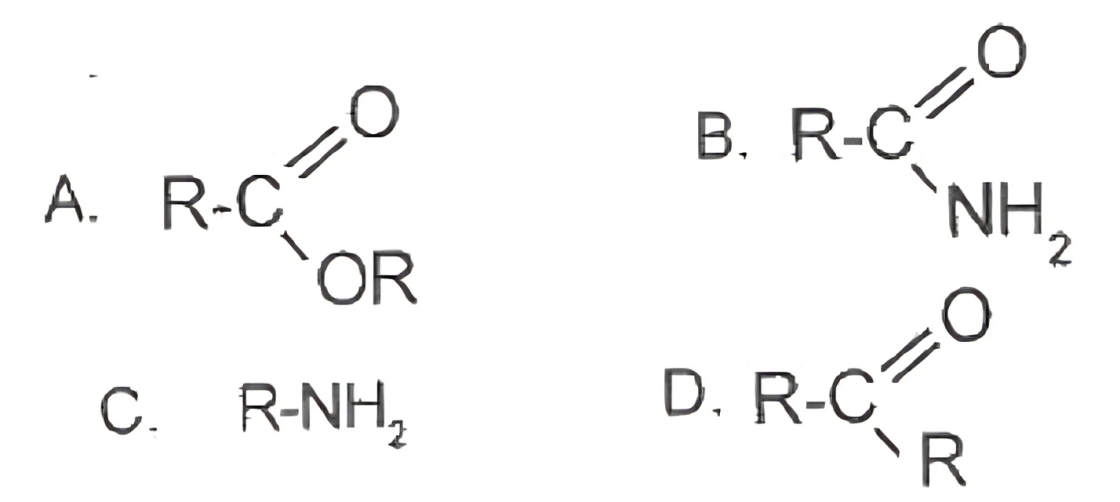
Use the above option to answer this question. The dehydration of ammonium salt of alkanoic acids produces a compound with the general formula
Dehydration of an ammonium salt of an alkanoic acid involves heating the salt formed from a carboxylic acid and ammonia. The process removes a molecule of water to produce an amide. The general reaction is \(RCOONH_4 \rightarrow RCONH_2 + H_2O\). Hence, the compound formed has the general formula \(RCONH_2\), which corresponds to an amide. Amides are produced when the -OH group of the carboxylic acid and a hydrogen atom from the ammonium ion are eliminated as water during heating.
Not clear enough?
Question 13
An organic compound contains 60% carbon, 13.3% hydrogen and 26.7% oxygen. Calculate the empirical formula
(C = 12, H = 1, O = 16)
(C = 12, H = 1, O = 16)
Assume 100 g of the compound.
Carbon = 60 g → \(\dfrac{60}{12} = 5\) mol
Hydrogen = 13.3 g → \(\dfrac{13.3}{1} = 13.3\) mol
Oxygen = 26.7 g → \(\dfrac{26.7}{16} = 1.67\) mol
To get the simplest ratio, divide through by the smallest value (1.67):
C : H : O = \(\dfrac{5}{1.67} : \dfrac{13.3}{1.67} : \dfrac{1.67}{1.67} = 3 : 8 : 1\)
Therefore, the empirical formula is C3H8O. This represents a molecule containing three carbon atoms, eight hydrogen atoms, and one oxygen atom in the simplest whole-number ratio.
Not clear enough?
Question 14
2-methylbutan-2-ol is an example of a
In 2-methylbutan-2-ol, the hydroxyl group (-OH) is attached to a carbon atom that is connected to three other carbon atoms, making it a tertiary alcohol. The naming shows that the -OH group is on the second carbon of the chain and the methyl group is also attached to the same carbon. Tertiary alcohols are those where the hydroxyl-bearing carbon has no hydrogen atoms directly attached to it, confirming its classification as a tertiary alkanol.
Not clear enough?
Question 15
The reaction between ammonia and ethyl ethanoate produces
Ammonia reacts with an ester such as ethyl ethanoate in a nucleophilic substitution reaction. The ammonia attacks the carbonyl carbon, leading to the replacement of the ethoxy group (-OC2H5) with an amino group (-NH2). The products are ethanol and ethanamide. The overall reaction is:
CH3COOC2H5 + NH3 → CH3CONH2 + C2H5OH
Hence, the organic amide formed is ethanamide and the alcohol is ethanol.
CH3COOC2H5 + NH3 → CH3CONH2 + C2H5OH
Hence, the organic amide formed is ethanamide and the alcohol is ethanol.
Not clear enough?
Question 16
The decarboxylation of ethanoic acid will produce carbon (IV) oxide and
Decarboxylation is the removal of a carbon dioxide molecule from a carboxylic acid. When ethanoic acid (CH3COOH) undergoes decarboxylation, it loses the -COOH group, producing methane (CH4) and carbon dioxide (CO2). The reaction is represented as:
CH3COOH → CH4 + CO2
This occurs because the remaining carbon atom is bonded to hydrogen atoms only, forming the simplest alkane, methane.
CH3COOH → CH4 + CO2
This occurs because the remaining carbon atom is bonded to hydrogen atoms only, forming the simplest alkane, methane.
Not clear enough?
Question 17
A primary amide is generally represented by the formula
Primary amides are derived from carboxylic acids where the hydroxyl group is replaced by an amino group (-NH2). Hence, their general formula is RCONH2. In this structure, R represents an alkyl or aryl group, and the amide nitrogen is attached to two hydrogen atoms. The carbonyl carbon is directly bonded to the nitrogen atom, forming the amide linkage (CONH2).
Not clear enough?
Question 18
Which of the following fractions is used as raw material for the cracking process?
Cracking is used to convert long-chain hydrocarbons into shorter, more useful ones such as petrol and alkenes. Diesel oil, which contains long-chain hydrocarbons, is suitable for this process. It is heated to high temperatures and subjected to catalysts or steam to break the large molecules into smaller ones. This makes diesel oils an ideal raw material for cracking.
Not clear enough?
Question 19
Sulphur (IV) oxide is a strong reducing agent in the presence of water due to the formation of
When sulphur (IV) oxide (SO2) dissolves in water, it forms sulphurous acid (H2SO3), which ionises to give trioxosulphate (IV) ions. These ions act as reducing agents by readily donating electrons to other substances. The reaction proceeds as:
SO2 + H2O → H2SO3
H2SO3 ⇌ 2H+ + SO32−
The trioxosulphate (IV) ion, SO32−, is therefore responsible for the reducing properties of sulphur (IV) oxide in aqueous solution.
SO2 + H2O → H2SO3
H2SO3 ⇌ 2H+ + SO32−
The trioxosulphate (IV) ion, SO32−, is therefore responsible for the reducing properties of sulphur (IV) oxide in aqueous solution.
Not clear enough?
Question 20
A metal that forms soluble trioxosulphate (IV) ion is
Potassium forms soluble trioxosulphate (IV) salts such as potassium trioxosulphate (IV) (K2SO3). The solubility of trioxosulphate (IV) salts depends on the metal ion; salts of Group I elements like potassium and sodium are generally soluble in water, while those of Group II metals like barium are insoluble. This solubility arises from the high lattice energy of potassium salts being overcome by hydration energy in aqueous solution.
Not clear enough?
You might like
The process of placing text, characters, or images from the system's clipboard into your document is known as __________.
In keeping with his own ____ in international diplomacy, Churchill proposed a personal meeting of heads of government, but the effort was doomed to failure, as the temper of the times was ____ .
Sona is sister of Ramesh and daughter of Mohit. Rama is wife of Mohit and mother of Prabhat. How Ramesh is related to Prabhat ?
This question is from the novel 'The Last Days at Forcados High school'.
Who were the two people Seyi lawal and Jimi met coming out of the principal office?