
Chemistry 2017 Jamb Examination
Chemistry 2017 Jamb Examination

Question 21
\[^{226} _{88}Ra → ^x _{86} Rn + \text{alpha particle}\]
In an alpha decay, the nucleus emits an alpha particle \( ^4_2\text{He} \), which reduces the mass number by 4 and the atomic number by 2.
Given:\[ ^{226}_{88}\text{Ra} \rightarrow ^{x}_{86}\text{Rn} + ^{4}_{2}\text{He} \]Applying the law of conservation of mass number:\[ 226 = x + 4 \Rightarrow x = 226 - 4 = 222 \]Thus, the resulting element is radon-222.
Given:\[ ^{226}_{88}\text{Ra} \rightarrow ^{x}_{86}\text{Rn} + ^{4}_{2}\text{He} \]Applying the law of conservation of mass number:\[ 226 = x + 4 \Rightarrow x = 226 - 4 = 222 \]Thus, the resulting element is radon-222.
Not clear enough?
Question 22
The shape of ammonia molecules is
Ammonia (NH3) has three bonding pairs and one lone pair of electrons on the nitrogen atom.
According to VSEPR theory, the electron pairs repel each other, resulting in a trigonal pyramidal geometry with bond angle approximately 107°.
The lone pair compresses the bond angles slightly from the tetrahedral angle (109.5°).
According to VSEPR theory, the electron pairs repel each other, resulting in a trigonal pyramidal geometry with bond angle approximately 107°.
The lone pair compresses the bond angles slightly from the tetrahedral angle (109.5°).
Not clear enough?
Question 23
The mass of silver deposited when a current of 10A is passed through a solution of silver salt for 4830s is – (Ag = 108, F = 96500 C mol−1)
Using Faraday’s first law of electrolysis:\[ m = \dfrac{EIt}{F} \]where \(E = 108\), \(I = 10\,A\), \(t = 4830\,s\), and \(F = 96500\).\[ m = \dfrac{108 \times 10 \times 4830}{96500} \]\[ m = 54.0\,g \]Hence, 54 g of silver will be deposited.
Not clear enough?
Question 24
Tin is unaffected by air at ordinary temperature due to its?
Tin forms a thin, protective layer of oxide (SnO2) when exposed to air at room temperature.
This oxide coating prevents further oxidation, showing that tin has a weak electropositive character compared to other metals.
Thus, it resists corrosion in ordinary air conditions.
This oxide coating prevents further oxidation, showing that tin has a weak electropositive character compared to other metals.
Thus, it resists corrosion in ordinary air conditions.
Not clear enough?
Question 25
Calculate the amount in moles of silver deposited when 9650C of electricity is passed through a solution of silver salt (F = 96500 C mol−1).
From Faraday’s law:\[ n = \dfrac{Q}{F} \]where \( Q = 9650 \; C \) and \( F = 96500 \; C \; mol^{-1} \).\[ n = \dfrac{9650}{96500} = 0.10 \; mol \]Hence, 0.10 mole of silver is deposited.
Not clear enough?
Question 26
The reaction of halogens with alkanes in the presence of sunlight is an example of
Halogens react with alkanes under ultraviolet light through a free radical mechanism.
In this process, a hydrogen atom in the alkane is replaced by a halogen atom, forming haloalkanes.
This is a typical substitution reaction known as halogenation of alkanes.
In this process, a hydrogen atom in the alkane is replaced by a halogen atom, forming haloalkanes.
This is a typical substitution reaction known as halogenation of alkanes.
Not clear enough?
Question 27
The enzyme used in the hydrolysis of starch to dextrin and maltose is?
Amylase catalyses the breakdown of starch (a polysaccharide) into simpler sugars such as dextrin and maltose.
It acts on the α-1,4-glycosidic bonds present in starch.
Lipase acts on fats, invertase acts on sucrose, and zymase functions in fermentation.
It acts on the α-1,4-glycosidic bonds present in starch.
Lipase acts on fats, invertase acts on sucrose, and zymase functions in fermentation.
Not clear enough?
Question 28
The alkyl group is represented by the general formula
Alkyl groups are derived from alkanes by the removal of one hydrogen atom.
The general formula for alkanes is CnH2n+2.
Removing one hydrogen gives CnH2n+1.
Hence, the alkyl group formula is CnH2n+1.
The general formula for alkanes is CnH2n+2.
Removing one hydrogen gives CnH2n+1.
Hence, the alkyl group formula is CnH2n+1.
Not clear enough?
Question 29
Cu2S(g) + O2(g) → 2Cu + SO2(g)
What is the change in the oxidation number of copper in the reaction?
What is the change in the oxidation number of copper in the reaction?
In Cu2S, each copper atom has an oxidation number of +1 because sulphur has −2.
Cu2S
2 Cu - 2(1) = 0
2 Cu = 2$$Cu = \dfrac{2}{2} = +1$$ In the products, copper exists as the free metal with an oxidation number of 0.
Therefore, copper is reduced from +1 to 0, indicating a reduction process.
Cu2S
2 Cu - 2(1) = 0
2 Cu = 2$$Cu = \dfrac{2}{2} = +1$$ In the products, copper exists as the free metal with an oxidation number of 0.
Therefore, copper is reduced from +1 to 0, indicating a reduction process.
Not clear enough?
Question 30
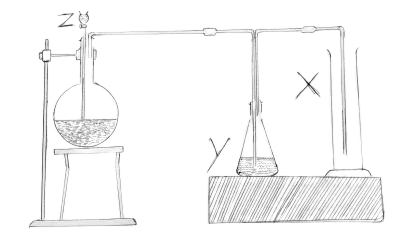
In the diagram above, X is
The setup represents the production of sulfur dioxide. And the cylinder marked X is SO2
Not clear enough?
You might like
Select the word-pair in which two words are related in the same way as the two words in the given word-pair. Word:Letter ?
A person invests money in three different schemes for 6 years, 10 years and 12 years at 10 per cent, 12 per cent and 15 per cent simple interest respectively. At the completion of each scheme, he gets the same interest. The ratio of his investment is ?