
Chemistry 2017 Jamb Examination

Question 31
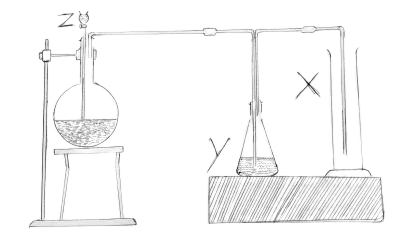
The diagram above. Y is
Not clear enough?
Question 32
[Cu = 64, F = 96500 \text{ C mol}^{-1}]
Not clear enough?
Question 33
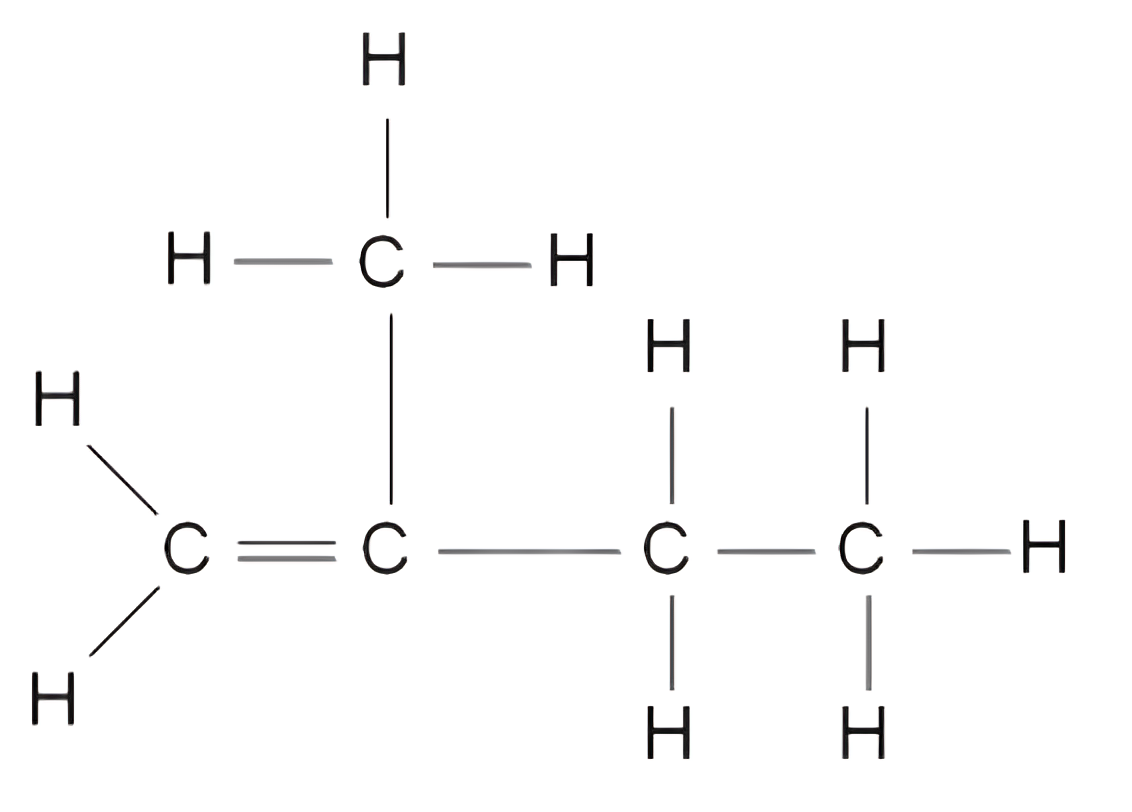
The IUPAC nomenclature of the structure above is
Identify the longest continuous carbon chain containing the double bond. The given structure is CH₂=C(CH₃)-CH₂-CH₃. Let's expand it: CH₃ | CH₂ = C - CH₂ - CH₃
Starting from the left (CH₂) and including the double bond, the chain goes through the C with the methyl group, then to the CH₂, and finally to the CH₃. This gives a chain of 4 carbons: C-C-C-C.
Number the carbon chain to give the double bond the lowest possible number. If we number from left to right: ¹CH₂ = ²C(CH₃) - ³CH₂ - ⁴CH₃ The double bond is between C1 and C2, so it starts at C1 (but-1-ene).
If we number from right to left: ⁴CH₂ = ³C(CH₃) - ²CH₂ - ¹CH₃ The double bond would be between C3 and C4, so it starts at C3 (but-3-ene).
According to IUPAC rules, we choose the numbering that gives the double bond the lower position. So, the double bond is at position 1. The parent chain is but-1-ene.
Identify and name any substituents. There is a methyl group (-CH₃) attached to the carbon chain. In our chosen numbering (left to right), the methyl group is on carbon 2.
Combine the substituent name and position with the parent chain name. The methyl group is at position 2, and the parent chain is but-1-ene. Therefore, the name is 2-methylbut-1-ene.
Not clear enough?
Question 34
Not clear enough?
Question 35
Not clear enough?
Question 36
Not clear enough?
Question 37
Not clear enough?
Question 38
Let atomic mass of X = M.
M + 2(16) = 64
M = 64 − 32 = 32
Hence, the atomic mass of X is 32.
Not clear enough?
Question 39
Not clear enough?
Question 40
NaNO3 + H2SO4 → NaHSO4 + HNO3
To remove it, air is bubbled through the acid. The oxygen in air oxidises NO₂ to NO, which then escapes, purifying the acid solution.
Not clear enough?
You might like
A cell whose internal resistance is 0.55\(\Omega\) delivers a current of 4 A to an external resistor. The lost voltage of the cell is?
Fats and oils are esters of fatty organic acids combined with a trihydric alkanol commonly referred to as
An element having the atomic number 17 will resemble which of the following elements having atomic number as given below?
This question is based on selected poems from Ker, D, et al (eds.): New Poetry from Africa; Syinka, W. (ed.): Poems of Black African; Senanu, K.E. and Vincent, T. (eds.): A Selection of African Poetry; Umukoro, M. et al (eds.): Exam Focus: Literature-in-Enghish; Eruvbetine, A. E. et al (eds.): Longman Examination Guides and Nwoga, D. I. (ed.)west African Verse. Arthur Nortje's Nightfall is written against the backdrop of