
Chemistry 2018 Jamb Examination
Chemistry 2018 Jamb Examination

Question 11
Which of the following gases may not be dried with concentrated sulphuric acid?
Concentrated sulphuric acid acts as a strong dehydrating agent but also as an acid. It reacts with basic gases such as ammonia (NH₃) to form ammonium sulphate \((NH_4)_2SO_4\).
Therefore, ammonia cannot be dried using concentrated sulphuric acid because it reacts chemically with it.
Other gases like hydrogen chloride (HCl), chlorine (Cl₂), and sulphur dioxide (SO₂) can be safely dried by the acid without chemical reaction.
Therefore, ammonia cannot be dried using concentrated sulphuric acid because it reacts chemically with it.
Other gases like hydrogen chloride (HCl), chlorine (Cl₂), and sulphur dioxide (SO₂) can be safely dried by the acid without chemical reaction.
Not clear enough?
Question 12
The consecutive members of an alkane homologous series differ by
Each successive member of the alkane homologous series differs from the previous one by a \(CH_2\) group. This means that as you move from methane \((CH_4)\) to ethane \((C_2H_6)\), and so on, the molecular formula increases by one carbon and two hydrogens each time.
Thus, the difference between consecutive alkanes is a methylene group (\(CH_2\)).
Thus, the difference between consecutive alkanes is a methylene group (\(CH_2\)).
Not clear enough?
Question 13
A correct electrochemical series can be obtained from Na, Ca, Al, Mg, Zn, Fe, Pb, H, Cu, Hg, Ag, Au by interchanging
In the correct electrochemical (activity) series, metals are arranged in decreasing order of reactivity. Magnesium (Mg) is more reactive than aluminium (Al).
In the given sequence, aluminium appears before magnesium, which is incorrect. By interchanging Al and Mg, the series becomes correctly ordered from most to least reactive.
Therefore, the correct adjustment is interchanging Al and Mg.
In the given sequence, aluminium appears before magnesium, which is incorrect. By interchanging Al and Mg, the series becomes correctly ordered from most to least reactive.
Therefore, the correct adjustment is interchanging Al and Mg.
Not clear enough?
Question 14
A basic postulate of the kinetic theory of gases is that the molecules of a gas move in straight lines between collisions. This implies that
According to the kinetic theory of gases, gas molecules move randomly in straight lines between collisions. This motion indicates that there are no attractive or repulsive forces acting between them, and collisions are perfectly elastic.
Perfectly elastic collisions mean that kinetic energy is conserved during collisions, and molecules change direction only when they collide with each other or the container walls.
Perfectly elastic collisions mean that kinetic energy is conserved during collisions, and molecules change direction only when they collide with each other or the container walls.
Not clear enough?
Question 15
On which of the following is the solubility of a gaseous substance dependent?
I. Nature of solvent
II. Nature of solute
III. Temperature
IV. Pressure
I. Nature of solvent
II. Nature of solute
III. Temperature
IV. Pressure
The solubility of a gas in a liquid depends on several factors. It is influenced by the nature of both the solvent and solute (since chemical interactions matter), temperature (since solubility generally decreases with increasing temperature), and pressure (by Henry’s law, solubility increases with pressure).
Hence, all four factors — I, II, III, and IV — affect gas solubility.
Hence, all four factors — I, II, III, and IV — affect gas solubility.
Not clear enough?
Question 16
Which of the following statements is correct about the periodic table?
In the periodic table, elements are arranged in periods (rows) and groups (columns). Across a period, the number of valence electrons increases progressively from left to right, while the number of shells remains the same.
Therefore, the correct statement is that the valence electrons of elements in the same period increase progressively across the period.
Therefore, the correct statement is that the valence electrons of elements in the same period increase progressively across the period.
Not clear enough?
Question 17
The periodic classification is an arrangement of the elements
The modern periodic table is arranged according to increasing atomic numbers, not atomic weights. This arrangement resolves anomalies that were present in Mendeleev’s version which was based on atomic weights.
Moseley’s work established that atomic number, representing the number of protons in an atom, is the fundamental property determining an element’s position in the periodic table.
Moseley’s work established that atomic number, representing the number of protons in an atom, is the fundamental property determining an element’s position in the periodic table.
Not clear enough?
Question 18
If 1 litre of 2.2M sulphuric acid is poured into a bucket containing 10 litres of water and the resulting solution mixed thoroughly, the resulting sulphuric acid concentration will be
Using the dilution formula M1V1 = M2V2: M1 = 2.2 M, V1 = 1 L, V2 = 1 + 10 = 11 L\[M_2 = \dfrac{M_1V_1}{V_2} = \dfrac{2.2 \times 1}{11} = 0.2M\]The resulting solution has a concentration of 0.2M.
Not clear enough?
Question 19
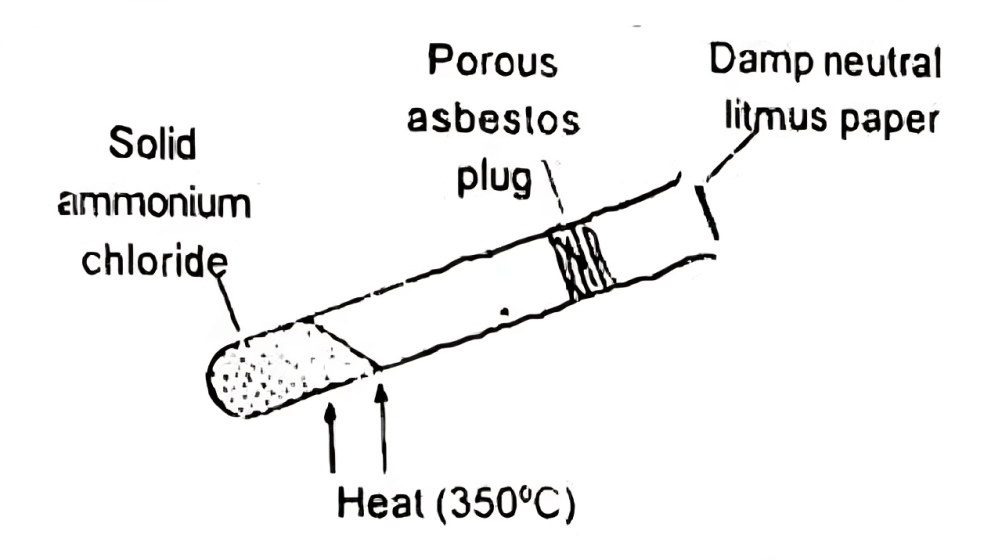
In the shown experiment (Fig. 1) the litmus paper will initially
On heating ammonium chloride \((NH_4Cl)\), it decomposes into ammonia \((NH_3)\) and hydrogen chloride \((HCl)\):\[NH_4Cl(s) \rightarrow NH_3(g) + HCl(g)\]Ammonia is basic and turns red litmus paper blue, while hydrogen chloride is acidic and turns blue litmus paper red.
Since the HCl gas diffuses faster initially due to its lower molecular mass, the damp neutral litmus paper first turns red.
Since the HCl gas diffuses faster initially due to its lower molecular mass, the damp neutral litmus paper first turns red.
Not clear enough?
Question 20
The boiling of fat and aqueous caustic soda is referred to as
When fats (esters of glycerol and long-chain fatty acids) are boiled with aqueous sodium hydroxide, they undergo a reaction that produces glycerol and sodium salts of fatty acids (soap).
This process is known as saponification.
It is the reverse of esterification and is a form of alkaline hydrolysis.
This process is known as saponification.
It is the reverse of esterification and is a form of alkaline hydrolysis.
Not clear enough?
You might like
| Stock 1/1/09: Raw materials | 2000 |
| Work-in-progress | 5000 |
| Stock 31/12/09: Raw materials | 500 |
| Work-in-progress | 4000 |
| Raw materials purchased | 18000 |
| Direct labour | 7500 |
| Direct expenses | 3000 |
| Factory expenses | 10000 |
The value of raw materials consumed is
The latitude and departure of a traverse line are both positive when the whole circle bearing of (d) the line lies in the ?
A student sitting on a tower 68 metres high observes his principal's car at the angle of depression of 20°. How far is the car from the bottom of the tower to the nearest metre?
Choose the most appropriate option for the gap labelled [....20.....] in the passage.
...punches that have been thrown at them during their ....20....
The simple interest on Rs. 36,000 for the period from 5th January to 31st May, 2013 at 9.5% per annum is ?