
Chemistry 2025 Jamb Examination
Chemistry 2025 Jamb Examination

Question 61
The process that illustrates reformation of petroleum product is
Catalytic reforming is a chemical process used to convert petroleum refinery naphthas distilled from crude oil into high-octane liquid products. This usually involves converting straight-chain alkanes into branched-chain alkanes or cyclic hydrocarbons (aromatics).
The conversion of cyclohexane (a cycloalkane) to benzene (an aromatic hydrocarbon) is a classic example of dehydrogenation, which is a key reaction in the reforming process to improve the octane rating of fuel.
The conversion of cyclohexane (a cycloalkane) to benzene (an aromatic hydrocarbon) is a classic example of dehydrogenation, which is a key reaction in the reforming process to improve the octane rating of fuel.
Not clear enough?
Question 62
The source of carbon(II) oxide that acts as an air pollutant is
Carbon(II) oxide, or carbon monoxide (CO), is a highly toxic gas produced primarily by the incomplete combustion of carbon-containing fuels such as petrol, coal, and wood.
When engines or furnaces do not have enough oxygen to completely convert carbon to carbon(IV) oxide (CO2), CO is formed as a major pollutant. Photochemical smog is a result of pollutants, respiration produces CO2, and sewage decomposition mainly produces methane and hydrogen sulphide.
When engines or furnaces do not have enough oxygen to completely convert carbon to carbon(IV) oxide (CO2), CO is formed as a major pollutant. Photochemical smog is a result of pollutants, respiration produces CO2, and sewage decomposition mainly produces methane and hydrogen sulphide.
Not clear enough?
Question 63
If there is no change in volume in a gaseous reaction, the pressure will
According to Le Chatelier's Principle, a change in pressure only affects a gaseous system at equilibrium if there is a difference in the number of moles of gas between the reactants and the products.
If the number of moles of gas is the same on both sides (meaning there is no change in volume), then increasing or decreasing the pressure will not shift the equilibrium position in either direction. The system remains balanced because both sides are affected equally.
If the number of moles of gas is the same on both sides (meaning there is no change in volume), then increasing or decreasing the pressure will not shift the equilibrium position in either direction. The system remains balanced because both sides are affected equally.
Not clear enough?
Question 64
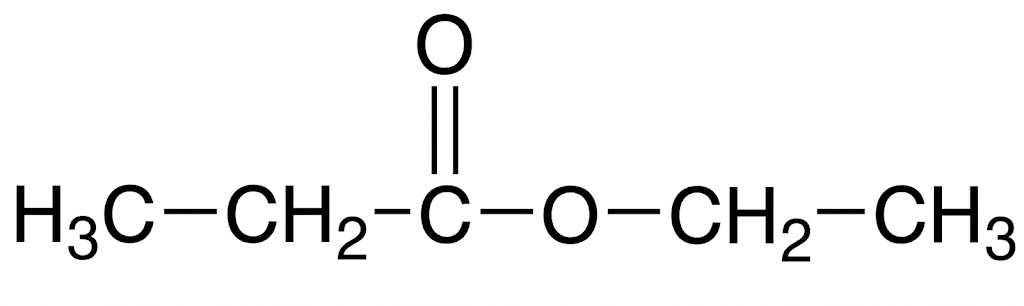
The IUPAC nomenclature of the compound above is
To name an ester, we identify the alkyl group derived from the alkanol and the acyl group derived from the alkanoic acid.
Looking at the structure (CH3CH2COOCH2CH3):
1. The part attached to the single-bonded oxygen is \(-CH_2CH_3\), which is an ethyl group.
2. The part containing the carbonyl group (C=O) has three carbons (CH3CH2CO-), which is derived from propanoic acid.
Combining these, the name is ethyl propanoate.
Looking at the structure (CH3CH2COOCH2CH3):
1. The part attached to the single-bonded oxygen is \(-CH_2CH_3\), which is an ethyl group.
2. The part containing the carbonyl group (C=O) has three carbons (CH3CH2CO-), which is derived from propanoic acid.
Combining these, the name is ethyl propanoate.
Not clear enough?
Question 65
If 5g of Iron filing was reacted with excess dilute H2SO4 to evolve hydrogen gas, which came to completion after 10 min, calculate the rate of reaction in g/hr.
The rate of reaction can be calculated as the amount of reactant used divided by the time taken. We need the final answer in grams per hour (g/hr).
First, convert the time from minutes to hours:\[\text{Time} = 10 \text{ min} = \frac{10}{60} \text{ hr} = \frac{1}{6} \text{ hr}\]Now, calculate the rate:\[\text{Rate} = \frac{\text{Mass}}{\text{Time}} = \frac{5 \text{ g}}{1/6 \text{ hr}}\]\[\text{Rate} = 5 \times 6 = 30 \text{ g/hr}\]
First, convert the time from minutes to hours:\[\text{Time} = 10 \text{ min} = \frac{10}{60} \text{ hr} = \frac{1}{6} \text{ hr}\]Now, calculate the rate:\[\text{Rate} = \frac{\text{Mass}}{\text{Time}} = \frac{5 \text{ g}}{1/6 \text{ hr}}\]\[\text{Rate} = 5 \times 6 = 30 \text{ g/hr}\]
Not clear enough?
Question 66
The evaluation of petrol from crude oil before it is put on sale is to prevent
Pinking, also known as 'knocking', is the sharp metallic noise produced in an internal combustion engine when the fuel-air mixture ignites prematurely or unevenly.
To prevent this, petrol is evaluated and assigned an 'octane rating'. Fuels with higher octane ratings burn more smoothly. Processes like reforming and cracking are actually used to *improve* the quality of petrol to prevent pinking, but the purpose of the final evaluation is to ensure the fuel meets the necessary standards to avoid engine damage.
To prevent this, petrol is evaluated and assigned an 'octane rating'. Fuels with higher octane ratings burn more smoothly. Processes like reforming and cracking are actually used to *improve* the quality of petrol to prevent pinking, but the purpose of the final evaluation is to ensure the fuel meets the necessary standards to avoid engine damage.
Not clear enough?
Question 67
The metal used as a packaging material is
Aluminium (Al) is widely used as a packaging material, especially in the form of aluminium foil and beverage cans.
This is because it is lightweight, non-toxic, and highly resistant to corrosion due to the formation of a protective oxide layer. Copper is too expensive and heavy, Iron (in the form of steel) is used but often needs coating to prevent rust, and Sodium is far too reactive to be used for any structural or packaging purpose.
This is because it is lightweight, non-toxic, and highly resistant to corrosion due to the formation of a protective oxide layer. Copper is too expensive and heavy, Iron (in the form of steel) is used but often needs coating to prevent rust, and Sodium is far too reactive to be used for any structural or packaging purpose.
Not clear enough?
Question 68
The expression \(
rac{V_1}{T_1} =
rac{V_2}{T_2} \) represents
Charles' Law states that for a fixed mass of gas at constant pressure, the volume is directly proportional to its absolute temperature (measured in Kelvin).
Mathematically, this is expressed as \( V \propto T \) or \( rac{V}{T} = k \). When comparing two states of the same gas, it is written as:\[ rac{V_1}{T_1} = rac{V_2}{T_2}\]
Mathematically, this is expressed as \( V \propto T \) or \( rac{V}{T} = k \). When comparing two states of the same gas, it is written as:\[ rac{V_1}{T_1} = rac{V_2}{T_2}\]
Not clear enough?
Question 69
The basicity of C2H2O4 is
The basicity of an acid is the number of replaceable hydrogen ions (H+) present in one molecule of the acid.
C2H2O4 is the molecular formula for oxalic acid, which has the structural formula (COOH)2. Each of the two carboxyl groups can release one hydrogen ion. Since it has two replaceable hydrogen atoms, its basicity is 2, making it a dibasic acid.
C2H2O4 is the molecular formula for oxalic acid, which has the structural formula (COOH)2. Each of the two carboxyl groups can release one hydrogen ion. Since it has two replaceable hydrogen atoms, its basicity is 2, making it a dibasic acid.
Not clear enough?
Question 70
Enzymatic conversion of glucose to ethanol is
Fermentation is the biochemical process in which enzymes (specifically zymase from yeast) convert sugars like glucose into ethanol and carbon(IV) oxide in the absence of oxygen.
The chemical equation is:\[C_6H_{12}O_6 \xrightarrow{\text{zymase}} 2C_2H_5OH + 2CO_2\]This process is used extensively in the production of alcoholic beverages and biofuels.
The chemical equation is:\[C_6H_{12}O_6 \xrightarrow{\text{zymase}} 2C_2H_5OH + 2CO_2\]This process is used extensively in the production of alcoholic beverages and biofuels.
Not clear enough?
You might like
'Will college make you a better Olokun priest?
Will it make you serve our ancestors better?
Look at me. An able-bodied, strong-hearted priest of Olokun.
Did I go to college?'
Gracy Osifo: Dizzy Angel
The literary device used in the passage above is
The leaders who spearheaded the transformation of the Organization of African Unity into the African Union are from
| Particulars | Dept A (₦) | Dept B (₦) |
|---|---|---|
| Opening stock | 100 | 800 |
| Purchases | 1,500 | 2,000 |
| Wages of workers | 50 | 100 |
| Sales | 3,000 | 5,000 |
What was the cost of goods sold for the entire business?