
Chemistry 2025 Jamb Examination
Chemistry 2025 Jamb Examination

Question 71
Gold does not require extraction because it is
Gold is a noble metal located at the very bottom of the electrochemical (reactivity) series. Because it is chemically unreactive (inert), it does not easily form compounds with oxygen or sulphur under normal geological conditions.
As a result, gold is often found in its elemental form, mixed with rock or sand, rather than as an ore that requires chemical reduction. In chemistry, this state is referred to as being found 'free' or 'native' in nature.
As a result, gold is often found in its elemental form, mixed with rock or sand, rather than as an ore that requires chemical reduction. In chemistry, this state is referred to as being found 'free' or 'native' in nature.
Not clear enough?
Question 72
The process employed in the industrial preparation of tetraoxosulphate(VI) acid is
The industrial manufacture of tetraoxosulphate(VI) acid (sulphuric acid, H2SO4) is known as the Contact Process.
It involves the catalytic oxidation of sulphur(IV) oxide to sulphur(VI) oxide using a vanadium(V) oxide catalyst, followed by the absorption of SO3 in concentrated sulphuric acid to form oleum, which is then diluted. Other processes listed include the Haber process for ammonia and the Bosch process for hydrogen.
It involves the catalytic oxidation of sulphur(IV) oxide to sulphur(VI) oxide using a vanadium(V) oxide catalyst, followed by the absorption of SO3 in concentrated sulphuric acid to form oleum, which is then diluted. Other processes listed include the Haber process for ammonia and the Bosch process for hydrogen.
Not clear enough?
Question 73
The catalytic hydrogenation of benzene produces
Benzene (C6H6) is a cyclic aromatic hydrocarbon. When it undergoes catalytic hydrogenation, three molecules of hydrogen gas are added across the delocalised pi-system in the presence of a nickel catalyst at high temperatures.
This reaction breaks the aromaticity and converts the unsaturated ring into a saturated cyclic alkane called cyclohexane (C6H12).
This reaction breaks the aromaticity and converts the unsaturated ring into a saturated cyclic alkane called cyclohexane (C6H12).
Not clear enough?
Question 74
A by-product of the alkaline hydrolysis of tristearin is a
Tristearin is a triglyceride (a fat). When it undergoes alkaline hydrolysis (saponification) with a base like NaOH, the ester bonds are broken.
The products are sodium stearate (soap) and propane-1,2,3-triol, commonly known as glycerol. Glycerol contains three hydroxyl (-OH) groups, making it a trihydric alkanol. This is the standard by-product of all soap-making processes involving natural fats and oils.
The products are sodium stearate (soap) and propane-1,2,3-triol, commonly known as glycerol. Glycerol contains three hydroxyl (-OH) groups, making it a trihydric alkanol. This is the standard by-product of all soap-making processes involving natural fats and oils.
Not clear enough?
Question 75
2SO2(g) + O2(g) \(\rightleftharpoons\) 2SO3(g); \(\Delta G^\circ\) = -ve
For the above reaction to be feasible
For the above reaction to be feasible
A reaction is feasible or spontaneous if the Gibbs free energy change (\(\Delta G\)) is negative. The relationship is given by \(\Delta G = \Delta H - T\Delta S\).
In the production of SO3, three moles of gas react to form two moles of gas, which means entropy decreases (\(\Delta S\) is negative). For \(\Delta G\) to be negative when \(\Delta S\) is negative, the reaction must be exothermic (\(\Delta H\) is negative). However, checking the provided options, if \(\Delta H\) were positive and \(\Delta S\) negative (Option C), \(\Delta G\) would always be positive (not feasible). The feasibility of this specific industrial reaction relies on it being exothermic (negative enthalpy).
In the production of SO3, three moles of gas react to form two moles of gas, which means entropy decreases (\(\Delta S\) is negative). For \(\Delta G\) to be negative when \(\Delta S\) is negative, the reaction must be exothermic (\(\Delta H\) is negative). However, checking the provided options, if \(\Delta H\) were positive and \(\Delta S\) negative (Option C), \(\Delta G\) would always be positive (not feasible). The feasibility of this specific industrial reaction relies on it being exothermic (negative enthalpy).
Not clear enough?
Question 76
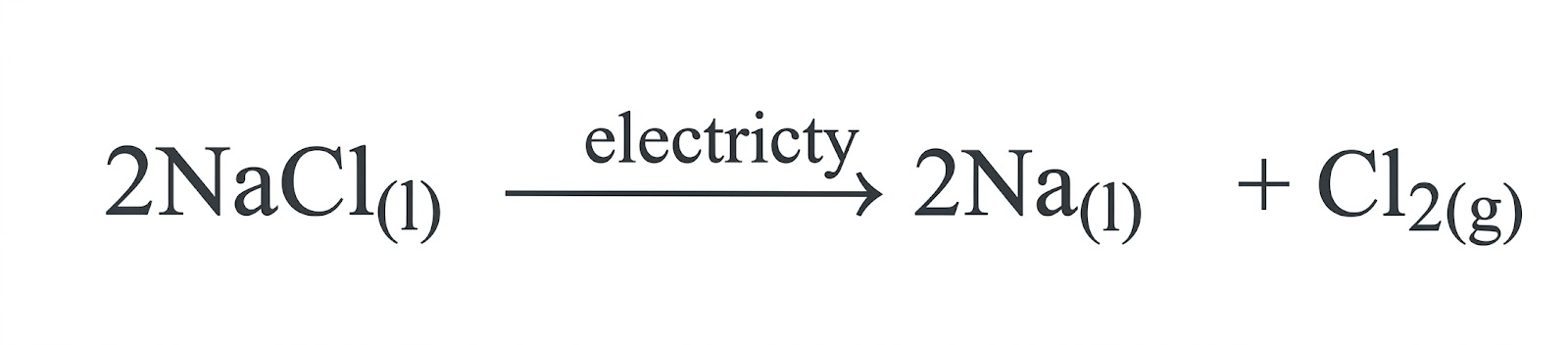
Sodium in the above reaction is produced by
Sodium metal is industrially produced by the electrolysis of molten sodium chloride in a specially designed cell.
This process is known as the Downs Process. It uses a graphite anode and a cylindrical steel cathode, with calcium chloride added to the electrolyte to lower the melting point of the sodium chloride.
This process is known as the Downs Process. It uses a graphite anode and a cylindrical steel cathode, with calcium chloride added to the electrolyte to lower the melting point of the sodium chloride.
Not clear enough?
Question 77
The use of CFCs as a blowing agent has application in
Chlorofluorocarbons (CFCs) were traditionally used as 'blowing agents' in the manufacture of expanded plastic foams (like styrofoam or polyurethane foam).
In this context, a blowing agent is a substance capable of producing a cellular structure via a foaming process in a polymer that is in a liquid state. While CFCs are also used as refrigerants and propellants, the term 'blowing agent' specifically refers to their application in the foam industry.
In this context, a blowing agent is a substance capable of producing a cellular structure via a foaming process in a polymer that is in a liquid state. While CFCs are also used as refrigerants and propellants, the term 'blowing agent' specifically refers to their application in the foam industry.
Not clear enough?
Question 78
The metal that will liberate H2 gas from dilute HNO3 is
Nitric acid (HNO3) is a powerful oxidising agent. Typically, when it reacts with metals, it produces nitrogen oxides (NO or NO2) and water instead of hydrogen gas.
However, very dilute nitric acid reacts with very active metals like Magnesium (Mg) and Manganese (Mn) to liberate hydrogen gas. Among the options provided, Magnesium is the classic textbook example of a metal that can achieve this under specific dilute conditions.
However, very dilute nitric acid reacts with very active metals like Magnesium (Mg) and Manganese (Mn) to liberate hydrogen gas. Among the options provided, Magnesium is the classic textbook example of a metal that can achieve this under specific dilute conditions.
Not clear enough?
Question 79
An atom with the electron configuration of 1s2 2s2 2p6 3s2 belongs to
The position of an element in the periodic table is determined by its electron configuration:
1. The highest principal quantum number (n) indicates the Period. Here, n=3, so it is in Period 3.
2. The number of valence electrons (electrons in the outermost shell) indicates the Group. Here, the 3rd shell has 2 electrons (3s2), so it is in Group 2.
This element is Magnesium (Mg).
1. The highest principal quantum number (n) indicates the Period. Here, n=3, so it is in Period 3.
2. The number of valence electrons (electrons in the outermost shell) indicates the Group. Here, the 3rd shell has 2 electrons (3s2), so it is in Group 2.
This element is Magnesium (Mg).
Not clear enough?
Question 80
The relative molecular mass of an alkanoic acid with the empirical formula of CH2O is [H = 1, C = 12, O = 16]
Alkanoic acids follow the general molecular formula CnH2nO2. The simplest empirical formula for this series is CH2O.
Ethanoic acid (CH3COOH) has the molecular formula C2H4O2, which simplifies to the empirical formula CH2O. Its relative molecular mass is calculated as:\[(2 \times 12) + (4 \times 1) + (2 \times 16) = 24 + 4 + 32 = 60\]Therefore, 60 is the molecular mass that fits the empirical formula for a common alkanoic acid.
Ethanoic acid (CH3COOH) has the molecular formula C2H4O2, which simplifies to the empirical formula CH2O. Its relative molecular mass is calculated as:\[(2 \times 12) + (4 \times 1) + (2 \times 16) = 24 + 4 + 32 = 60\]Therefore, 60 is the molecular mass that fits the empirical formula for a common alkanoic acid.
Not clear enough?
You might like
If P varies inversely as the square root of q, where p = 3 and q = 16, find the value of q when p = 4.
The Nigeria-Cameroon crisis over Bakassi peninsula occurred owing to the interpretation of the treaty of 1913 and the ________.
These question are based on selected poems from Johnson, R. et al (eds.): New Poetry from Africa; Soyinka, W. (ed.): Poems of Black Africa; Senanu, K.E. and Vincent, T. (eds): A Selection of African Poetry; Umukoro M. et al: Exam Focus: Literature in English; Eruvbetine, A.E. et al (eds.): Longman Examination Guides: Poetry for Senior Secondray Schools NWOGA, d.i. (ED.) wEST aFRICAN vERSE.
Acquah's In The Navel of the Soul describes the