
Mathematics 2004 Jamb Examination

Question 1
4 2 4 3 (base 5)
- 1 3 x 4 (base 5)
_____________
y 3 4 4 (base 5)
Find x and y respectively in the subtraction above carried out in base 5
\[ \begin{array}{rrrr}
& 4 & 2 & 4 & 3 \\
- & 1 & 3 & 4 & 4 \\
\hline
& y & 3 & 4 & 4 \\
\end{array}\] Column 4: 3 - 4 = 4 after borrow ⇒ OK
Column 3: 4 - x = 4 ⇒ x = 4
Column 2: (2 - 1 = 1), then borrow ⇒ 6 - 3 = 3 OK
Column 1: 4 - 1 = 2 = y\[\boxed{x = 4,\ y = 2}\]
Not clear enough?
Question 2
Find p, if 4516 – p7 = 305
The correct answer is C. 1167
Given 4516 – p7 = 3056
First we collect the like base
4516 – 3056 = p7
Next we convert the base 6 to base 10
(4*62 + 5*61 + 1*60) - (3*62 + 0*61 + 5*60) = p7
(144 + 30 +1) - (108 + 0 + 5) = p7
175 - 113 = p7
p7 = 6210
Next convert 6210 to base 7
7 | 62
7 | 8 | 6
7 | 1 | 1
7 | 0 | 1
Thus p7 = 1167
Not clear enough?
Question 3
Simplify \(\dfrac{\dfrac{1}{10}×\dfrac{2}{3} + \dfrac{1}{4}}{\dfrac{1}{2} ÷ \dfrac{3}{5} - \dfrac{1}{4}}\)
Not clear enough?
Question 4
A farmer planted 5000 grains of maize and harvested 5000 cobs, each bearing 500 grains.What is the ratio of the number of grains sowed to the number harvested?
To find the ratio of the number of grains sown to the number of grains harvested, follow these steps:
1. Determine the total number of grains harvested
- The farmer harvested 5000 cobs, each bearing 500 grains.
- The total number of grains harvested is:
\[
5000 \times 500 = 2,500,000 \text{ grains}
\]
2. Set up the ratio of grains sown to grains harvested:
- The number of grains sown was 5000.
- The number of grains harvested is 2,500,000.
- The ratio is:
\[
\dfrac{\text{Number of grains sown}}{\text{Number of grains harvested}} = \dfrac{5000}{2,500,000}
\]
3. Simplify the ratio:
- Simplify \( \dfrac{5000}{2,500,000} \) by dividing both the numerator and the denominator by 5000:
\[
\dfrac{5000 \div 5000}{2,500,000 \div 5000} = \dfrac{1}{500}
\]
The ratio of the number of grains sown to the number of grains harvested is 1:500
Final Answer:
The correct answer is A. 1:500
Not clear enough?
Question 5
Three teachers shared a packet of chalk. The first teacher got 2/5 of the chalk and the second teacher received 2/15 of the remainder.What fraction did the third teacher receive?
To determine the fraction of the chalk that the third teacher received, follow these steps:
1. Calculate the fraction of the chalk remaining after the first teacher received their share:The first teacher received \( \dfrac{2}{5} \) of the total chalk. Thus, the remaining chalk is:
\[ 1 - \dfrac{2}{5} = \dfrac{5}{5} - \dfrac{2}{5} = \dfrac{3}{5}
\]
2. Calculate the fraction of the remaining chalk that the second teacher received: The second teacher received \( \dfrac{2}{15} \) of the remaining chalk. To find out how much this is, multiply \( \dfrac{2}{15} \) by the remaining \( \dfrac{3}{5} \):\[\dfrac{2}{15} \times \dfrac{3}{5} = \dfrac{6}{75} = \dfrac{2}{25}\]
3. Calculate the fraction of the chalk that the third teacher received: The third teacher received the remainder of the chalk. Subtract the amounts received by the first and second teachers from the total: \[\text{Amount received by third teacher} = 1 - \left(\dfrac{2}{5} + \dfrac{2}{25}\right)\]To combine \( \dfrac{2}{5} \) and \( \dfrac{2}{25} \), find a common denominator. The least common denominator is 25:\[\dfrac{2}{5} = \dfrac{10}{25}\]\[\dfrac{2}{5} + \dfrac{2}{25} = \dfrac{10}{25} + \dfrac{2}{25} = \dfrac{12}{25}\]Thus, the fraction of chalk left for the third teacher is: \[1 - \dfrac{12}{25} = \dfrac{25}{25} - \dfrac{12}{25} = \dfrac{13}{25}\]
So, the third teacher received \( \dfrac{13}{25} \) of the chalk, which corresponds to option C.
Not clear enough?
Question 6
Given that \(\sqrt[3]{4^{2x}} = 16\), find the value of \(x\).
The correct answer is B. 3
Given the equation \( \sqrt[3]{4^{2x}} = 16 \), let's solve for \( x \):
1. Cube both sides to eliminate the cubic root:
\[ 4^{2x} = 16^3
\]
2. Simplify \( 16^3 \):
\[ 16^3 = (2^4)^3 = 2^{12}
\]
So, the equation becomes:
\[ 4^{2x} = 2^{12}
\]
3. Express \( 4 \) as \( 2^2 \):
\[ (2^2)^{2x} = 2^{12}
\]
Simplifying further:
\[ 2^{4x} = 2^{12}
\]
4. Since the bases are the same, equate the exponents:
\[ 4x = 12
\]
5. Solve for \( x \):
\[ x = \dfrac{12}{4} = 3
\]
Not clear enough?
Question 7
Not clear enough?
Question 8
If 6logx2 - 3logx3 = 3log50.2, find x.
6logx2 - 3logx3 = 3log50.2
= logx26 - 3logx33 = log5(0.2)3
= logx(64/27) = log5(1/5)3
logx(64/27) = log5(1/125)
let logx(64/27) = y
∴xy = 64/27
and log5(1/125) = y
∴ 5y = 1/125
5y = 125-1
5y = 5-3
∴ y = -3
substitute y = -3 in xy = 64/27
implies x-3 = 64/27
1/x3 = 64/27
64x3 = 27
x3 = 27/64
x = 3√(27/64)
x = 3/4
Not clear enough?
Question 9
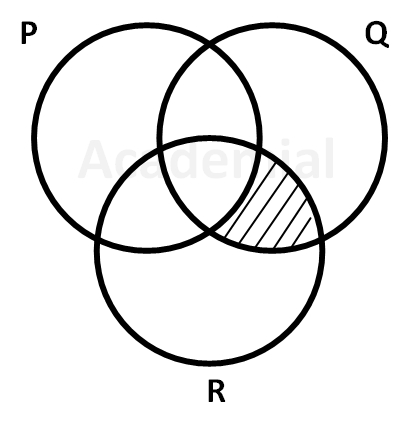
The shaded region in the venn diagram above
D. Pc ∩ (Q ∩ R)
Not clear enough?
Question 10
In a class of 40 students, each student offers at least one of Physics and Chemistry. If the number of students that offer Physics is three times the number that offer both subjects and the number that offers Chemistry is twice the number that offer Physics, find the number of students that offer Physics only.
Let
N = Total number of students.
P = Number of students that offers Physics.
P' = Number of students offering physics only.
C = Number of students that offers Chemistry.
X = Number of students that offers both.
P = 3X; X = P/3
C = 2P
P + C - X = N
3X + 2(3X) - X = 40
X = 5
P = 3X = 3(5) = 15
P' = P - X
P' = 15 - 5 = 10.
Not clear enough?
You might like
Transformers are designed so that energy losses are reduced to a minimum. This is achieved through which of these process?
I. Using a soft iron ore
II. Laminating the iron core to reduce energy loses due to eddy current
III. Designing an efficient iron core
Choose the option that best completes the gap(s).
Did you have ....... when you went to visit the medical doctor?
Choose the word that is nearest in meaning to the underlined word:
Bisi has become an indispensable member of staff.
The best means of sending unwritten messages simultaneously to many branches of an organization within a country is the?