
Mathematics 2004 Jamb Examination

Question 11
Find the values of x where the curve
y = x3 + 2x2 – 5x – 6 crosses the x-axis.
Given:
\(y = x^3 + 2x^2 - 5x - 6\)
Try rational root theorem
Possible rational roots: \( \pm1, \pm2, \pm3, \pm6 \)
Test x = -1:
\((-1)^3 + 2(-1)^2 - 5(-1) - 6 = -1 + 2 + 5 - 6 = 0\)
\(\Rightarrow x = -1\) is a root.
Polynomial division
Divide \(x^3 + 2x^2 - 5x - 6\) by \(x + 1\):\[
\begin{array}{r|rrr}
& x^2 & + x & -6 \\
x + 1 & x^3 & + 2x^2 & -5x & -6 \\
& x^3 & + x^2 & & \\
\hline
& & x^2 & -5x & \\
& & x^2 & + x & \\
\hline
& & & -6x & -6 \\
& & & -6x & -6 \\
\hline
& & & 0 & 0 \\
\end{array}\]
Quotient: \(x^2 + x - 6\)
Factor the quadratic
\(
x^2 + x - 6 = (x - 2)(x + 3)
\)
Final factorized form
\(y = (x + 1)(x - 2)(x + 3)\)
Solve y = 0
\((x + 1)(x - 2)(x + 3) = 0\)
Roots:
\(x = -1, \quad x = 2, \quad x = -3\)
Therefore, the curve crosses the x-axis at:-3, -1, 2
\[\boxed{\text{Correct answer: C. } 2, -1 \text{ and } -3}\]
Not clear enough?
Question 12
Find the remainder when 3x3 + 5x2 – 11x + 4 is divided by x + 3
Not clear enough?
Question 13
Factorize completely ac – 2bc – a2 + 4b2
\[ ac - 2bc - a^2 + 4b^2\] Group terms\[(ac - 2bc) + (-a^2 + 4b^2)\] Factor each group: \[= c(a - 2b) - (a^2 - 4b^2)\] Recall that: \[a^2 - 4b^2 = (a - 2b)(a + 2b)\] So: \[= c(a - 2b) - (a - 2b)(a + 2b)\]
Factor out the common factor (a - 2b)\[= (a - 2b)\left(c - (a + 2b)\right)\] Simplify the expression inside the parentheses:\[ = (a - 2b)(c - a - 2b)\]
Final Answer\[\boxed{(a - 2b)(c - a - 2b)}\]
Not clear enough?
Question 14
y is inversely proportional to x and y = 4 when x = 1/2 . find x when y = 10
Given: \( y \propto \dfrac{1}{x} \Rightarrow y = \dfrac{k}{x} \)
We are told that:\[y = 4 \quad \text{when} \quad x = \dfrac{1}{2}\]
Find the constant \(k\)
\[
4 = \dfrac{k}{\dfrac{1}{2}} \Rightarrow k = 4 \cdot \dfrac{1}{2} = 2\]
Find \(x\) when \(y = 10\)\[
y = \dfrac{2}{x}, \quad \text{so} \quad 10 = \dfrac{2}{x}
\Rightarrow x = \dfrac{2}{10} = \dfrac{1}{5}
\]
Final Answer: \[ \boxed{\dfrac{1}{5}} \]
Not clear enough?
Question 15
The length L of a simple pendulum varies directly as the square of its period T. if a pendulum with period 4 secs is 64cm long, find the length of a pendulum whose period is 9 sec.
The length \(L\) of a simple pendulum varies directly as the square of its period \(T\), i.e.,\[L \propto T^2 \Rightarrow L = kT^2\]
Find the constant k
We are told that when \(T = 4\) seconds, \(L = 64\) cm:\[64 = k \cdot 4^2 = k \cdot 16 \Rightarrow k = \dfrac{64}{16} = 4\]
Find the length when \(T = 9\) seconds\[L = 4 \cdot 9^2 = 4 \cdot 81 = 324 \text{ cm}\]
Final Answer:\[\boxed{324\ \text{cm}}\]
Not clear enough?
Question 16
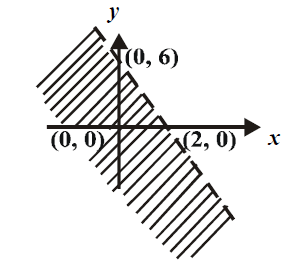
The shaded area in the diagram above is represented by
The line passes through the points \((0, 6)\) and \((2, 0)\), and the shaded region is below the line.
Find the equation of the line
Calculate the slope:\[\text{slope} = \dfrac{0 - 6}{2 - 0} = \dfrac{-6}{2} = -3\] Use the point-slope form with point \((0, 6)\):\[y - 6 = -3(x - 0) \Rightarrow y = -3x + 6\] Rewriting the equation:\[y + 3x = 6\] Determine the inequality
Since the shaded region lies \textbf{below} the line, we use:\[y + 3x < 6\]
Final Answer:\[\boxed{\{(x, y) : y + 3x < 6\}}\]
Not clear enough?
Question 17
What are the integral values of x which satisfy the inequality –1 < 3 – 2x ≤ 5?
The inequality is \[-1 < 3 - 2x \leq 5\] Subtract 3 from all parts: \[-1 - 3 < 3 - 2x - 3 \leq 5 - 3\]\[-4 < -2x \leq 2\] Divide all parts by \(-2\), and reverse the inequality signs: \[\dfrac{-4}{-2} > x \geq \dfrac{2}{-2}\]\[2 > x \geq -1\] This simplifies to: \[-1 \leq x < 2\] Integral values of \(x\): \[\boxed{-1,\ 0,\ 1}\]
Not clear enough?
Question 18
The nth terms of two sequences are Qn – 3.2n-2 and Um = 3.22m– 3. find the product of Q2 and U2
We are given:
\[Q_n = 3 \cdot 2^{n - 2}, \quad U_m = 3 \cdot 2^{2m - 3}\]
We are to find:\[Q_2 \cdot U_2\] Evaluate \(Q_2\):\[Q_2 = 3 \cdot 2^{2 - 2} = 3 \cdot 2^0 = 3 \cdot 1 = 3\] Evaluate \(U_2\):\[U_2 = 3 \cdot 2^{2 \cdot 2 - 3} = 3 \cdot 2^1 = 3 \cdot 2 = 6\] Product:\[Q_2 \cdot U_2 = 3 \cdot 6 = \boxed{18}\]
Not clear enough?
Question 19
Given that the first and fourth terms of a G.P are 6 and 162 respectively, find the sum of the first three terms of the progression.
Not clear enough?
Question 20
Find the sum to infinity of the series ½, 1/6, 1/18,……………
We are given the geometric series:\[\dfrac{1}{2},\ \dfrac{1}{6},\ \dfrac{1}{18},\ \ldots\]Find the first term and common ratio: \[a = \dfrac{1}{2}, \quad r = \dfrac{\dfrac{1}{6}}{\dfrac{1}{2}} = \dfrac{1}{6} \cdot \dfrac{2}{1} = \dfrac{1}{3}\]Since \( |r| < 1 \), the sum to infinity is given by:\[S_\infty = \dfrac{a}{1 - r} = \dfrac{\dfrac{1}{2}}{1 - \dfrac{1}{3}} = \dfrac{\dfrac{1}{2}}{\dfrac{2}{3}} = \dfrac{1}{2} \cdot \dfrac{3}{2} = \dfrac{3}{4}\]\[\boxed{\dfrac{3}{4}}\]
Not clear enough?
You might like
A given volume ofmethane diffuses in 20s. How long will it take same volume of sulphur (V1) oxide to diffuse
under the same conditions?
[C=12,H=1, S=32,O=16]
This question is based on selected poems from Johnson, R. et al (eds): New Poetry African; Soyinka W. (ed): Poems of Black Africa; Senanu, K.E. and Vincent. T. (eds): A Selection of African Poetry; U. Maduka, C. T et al: Exam Focus: Literature in English; Eruvbetine, A. E. et al (eds): Longman Examination Guides; Nwoga D. I. (ed): West African verse; and Adeoti G: Naked Soles.
The excerpt below from Marvell's To His Coy Mistress is an example of
'Pataki and Mustard flowers like blue and yellow eyes peep through the green grass'
The literary devices used in these lines from Mohan Singh's 'A Village Girl' are________
| Marks | 1 | 2 | 3 | 4 | 5 |
|---|---|---|---|---|---|
| Frequency | 2 | 2 | 8 | 4 | 4 |
The table above shows the marks obtained in a given test.
How many students took the test?