
Mathematics 2004 Jamb Examination

Question 21
If the operation * on the set of integers is defined by \(p * q = \sqrt{pq}\), find the value of 4*(8*32).
We are given that the operation \(*\) on integers is defined as:\[p * q = \sqrt{pq}\]We are to evaluate:\[4 * (8 * 32)\]Compute the inner operation\[8 * 32 = \sqrt{8 \cdot 32} = \sqrt{256} = 16\]Compute the outer operation\[4 * 16 = \sqrt{4 \cdot 16} = \sqrt{64} = \boxed{8}\]
Not clear enough?
Question 22
The inverse of the matrix \(\begin{pmatrix} 2 & 1 \\ 1 & 1 \end{pmatrix}\)
We are given the matrix:\[A = \begin{pmatrix} 2 & 1 \\ 1 & 1 \end{pmatrix}\]To find the inverse of a \(2 \times 2\) matrix:\[A^{-1} = \dfrac{1}{\det(A)} \begin{pmatrix} d & -b \\ -c & a \end{pmatrix}\quad \text{for} \quad A = \begin{pmatrix} a & b \\ c & d \end{pmatrix}\]Identify the elements \[a = 2, \quad b = 1, \quad c = 1, \quad d = 1\]Compute the determinant \[\det(A) = ad - bc = (2)(1) - (1)(1) = 2 - 1 = 1\]Compute the inverse \[A^{-1} = \dfrac{1}{1} \begin{pmatrix} 1 & -1 \\ -1 & 2 \end{pmatrix}= \begin{pmatrix} 1 & -1 \\ -1 & 2 \end{pmatrix}\]\[\boxed{\begin{pmatrix}1 & -1 \\-1 & 2\end{pmatrix}}\]
Not clear enough?
Question 23
If then |P|
We are given the matrix:\[P = \begin{bmatrix}1 & 0 & -1 \\3 & 4 & 5 \\-1 & 0 & 1\end{bmatrix}\]We are to find the determinant \(|P|\).Expand along the first row:\[|P| = 1 \cdot \begin{vmatrix}4 & 5 \\0 & 1\end{vmatrix}- 0 \cdot \begin{vmatrix}3 & 5 \\-1 & 1\end{vmatrix}+ (-1) \cdot \begin{vmatrix}3 & 4 \\-1 & 0\end{vmatrix}\]Compute the 2×2 determinants:\[\begin{vmatrix}4 & 5 \\0 & 1\end{vmatrix} = (4)(1) - (5)(0) = 4\]\[\begin{vmatrix}3 & 4 \\-1 & 0\end{vmatrix} = (3)(0) - (4)(-1) = 0 + 4 = 4\]Now substitute back:\[|P| = 1(4) - 0 + (-1)(4) = 4 - 4 = \boxed{0}\]
Not clear enough?
Question 24
The sum of the interior angles of a pentagon is 6x + 6y. find y in terms of x
Not clear enough?
Question 25
PQRSTV is a regular polygon of side 7cm inscribed in a circle. Find the circumference of the circle PQRSTV.
We are told that \(PQRSTV\) is a regular polygon inscribed in a circle.Since there are 6 letters, it is a regular hexagon:\[\text{Number of sides} = 6\]Each side is given as:\[\text{Side length} = 7\, \text{cm}\]Compute the perimeter of the hexagon:\[\text{Perimeter} = 6 \times 7 = 42\, \text{cm}\]Since the regular hexagon is inscribed in a circle, its perimeter approximates the circumference of the circle.\[\text{Circumference of the circle} = \boxed{42\, \text{cm}}\]
Not clear enough?
Question 26

P, R and S lie on a circle centre O as shown above while Q lies outside the circle. Find ∠PSO
Not clear enough?
Question 27
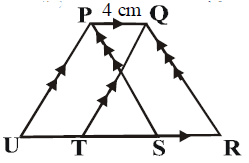
In the diagram above, PQ =4cm and TS = 6cm, if the area of parallelogram PQTU is 32cm2, find the area of the trapezium PQRU
Recall that:
Area of parallelogram A = base * height
PQTU: 32 = 4 * h
h = 32/4
h = 8
∴ = Area of Trapezium PQRU = (1/2)(4 + 14) *8
= 1/2 * (18 * 8)
= 72 cm2
Not clear enough?
Question 28
An arc of a circle of length 22cm subtends an angle of 3x0 at the centre of the circle. Find the value of x if the diameter of the circle is 14cm.
We are given: \[l = 22\,\text{cm}, \quad \theta = 3x^\circ, \quad \text{Diameter} = 14\,\text{cm} \Rightarrow r = \dfrac{14}{2} = 7\,\text{cm}\]Using the arc length formula: \[l = \dfrac{\theta}{360} \times 2\pi r\]Substitute values: \[22 = \dfrac{3x}{360} \times 2\pi \times 7 = \dfrac{42\pi x}{360}\]Multiply both sides by 360: \[22 \times 360 = 42\pi x \Rightarrow 7920 = 42\pi x\]Solve for \(x\): \[x = \dfrac{7920}{42\pi} = \dfrac{7920}{131.9469} \approx 60\]Since \(\theta = 3x = 3 \times 20 = \boxed{60^\circ}\), \[\boxed{x = 20^\circ}\]
Not clear enough?
Question 29
Determine the locus of a point inside a square PQRS which is equidistant from PQ and QR
Not clear enough?
Question 30
The locus of a point which is 5cm from the line LM is a
The locus of a point that is a fixed distance (e.g. 5 cm) from a line LM is:
A set of two lines, each parallel to LM,
One on each side of LM,
Each at a distance of 5 cm from LM.
A. pair of lines on opposite sides of LM and parallel to it, each distances 5cm form LM
Not clear enough?
You might like
A complete set of digital instructions written to direct a computer to perform a specific job or task is known as a __________.
When information is illegally copied or taken from a business or an individual, it is called __________.
The city of Salt Lake City, known for its connection to the Mormon religion and outdoor recreation, is located in which state?
The weights of 15 students in a class are given as 25, 30, 32, 30, 42, 45, 48, 50, 52, 51, 42, 38, 40, and 42. What is the mode of the given data?
In a family of eight persons, there are two couples, each having two children. B and D are brothers and each has two children. E is the aunt of A. who is the cousin brother of C. C is the sister of H, who is the cousin brother of G, F is the wife of B. How is H related to F ?