
Mathematics 2004 Jamb Examination

Question 41
I. Rectangular bars of equal width
II. The height of each rectangular bar is proportional to the frequency of the 3 corresponding class interval.
III. Rectangular bars have common sides with no gaps in between.
A histogram is described by
A histogram is described by:
\[ \boxed{\text{C. I, II and III}}\]
Not clear enough?
Question 42
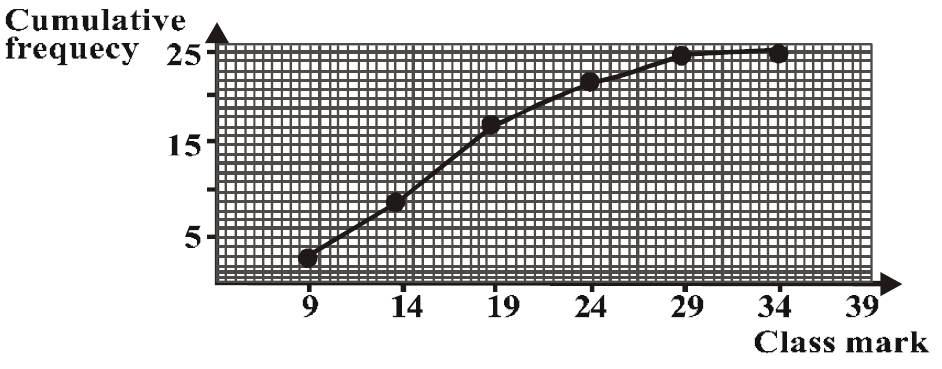
The graph above shows the cumulative frequency curve of the distribution ofmarks in a class test.
What percentage of the students scored more than 20 marks?
\[
\begin{array}{|c|c|c|}
\hline
\text{Class mark } (x) & \text{Cumulative Frequency} & \text{Frequency} \\
\hline
9 & 1 & 1 \\
14 & 6 & 5 \\
19 & 15 & 9 \\
24 & 17 & 2 \\
29 & 24 & 7 \\
34 & 25 & 1 \\
\hline
\end{array}\]
Total number of students = 25
Students who scored more than 20 marks:\[
2\ (\text{from }24) + 7\ (\text{from }29) + 1\ (\text{from }34) = 10\]
\[ \text{Percentage} = \dfrac{10}{25} \times 100 = \boxed{40\%}\]
Not clear enough?
Question 43
The mean age of a group of students is 15 years. When the age of a teacher, 45 years old, is added to the ages of the students, the mean of their ages becomes 18 years. Find the number of students in the group.
Not clear enough?
Question 44
The weights of 10 pupils in a class are 15kg, 16kg, 17kg, 18kg, 16kg, 17kg, 17kg, 17kg, 18kg and 16kg.
What is the range of this distribution?
Range = Max value - Min value = 18 - 15 = 3
Not clear enough?
Question 45
Find the mean deviation of 1, 2, 3 and 4
Not clear enough?
Question 46
In how many ways can 2 students be selected from a group of 5 students in a debating competition?
Number of ways to choose 2 from 5\[ {}^5C_2 = \dfrac{5!}{2!(5 - 2)!} = \dfrac{5 \times 4}{2 \times 1} = \boxed{10}\]
Not clear enough?
Question 47
A committee of six is to be formed by a state governor from nine state commissioners and three members of the state house of assembly. In how many ways can the members of the committee be chosen so as to include one member of the house of assembly?
Not clear enough?
Question 48
Some white balls were put in a basket containing twelve red balls and sixteen black balls. If the probability of picking a white ball from the basket is 3/7, how many white balls were introduced?
Let the number of white balls be x.
\[ \text{Total balls} = 12 + 16 + x = 28 + x\]\[ \text{Given: } \dfrac{x}{28 + x} = \dfrac{3}{7}\] Cross-multiply:\[7x = 3(28 + x) \Rightarrow 7x = 84 + 3x\]\[\Rightarrow 4x = 84 \Rightarrow x = \boxed{21}\]
Not clear enough?
Question 49
Some white balls were put in a basket containing twelve red balls and sixteen black balls. If the probability of picking a white ball from the basket is 3/7, how many white balls were introduced?
Not clear enough?
Question 50
An unbiased die is rolled 100 times and the outcome is tabulated as follows:
\[
\begin{array}{|c|c|c|c|c|c|c|}
\hline
\textbf{Outcome} & 1 & 2 & 3 & 4 & 5 & 6 \\
\hline
\textbf{Frequency} & 13 & 15 & 22 & 14 & 20 & 16 \\
\hline
\end{array}
\]
What is the probability of obtaining 5?
Number of times 5 was obtained = 20
P(obtaining 5) = 20/100
= 1/5
Not clear enough?
You might like
Choose the option that has the same consonant sound as the one represented by the letter(s) underlined.
garage
The goals scored by 40 football teams from three league divisions are recorded below
| No of goals | 0 | 1 | 2 | 3 | 4 | 5 | 6 |
|---|---|---|---|---|---|---|---|
| Frequency | 4 | 3 | 15 | 16 | 1 | 0 | 1 |
What is the total number of goals scored by all the teams?
A real image three times the size of an object is formed 24cm from a converging mirror. what is the focal length of the mirror.