
Mathematics 2005 Jamb Examination

Question 41
With replacement, \(P(\text{blue})=\dfrac{5}{10}=\dfrac{1}{2}\), \(P(\text{red})=\dfrac{3}{10}\).
Required probability = \(P(\text{blue})^2 + P(\text{red})^2 \)
\( = \left(\dfrac{1}{2}\right)^2 + \left(\dfrac{3}{10}\right)^2 \)
\(= \dfrac{1}{4} + \dfrac{9}{100} \)
\(= \dfrac{25}{100} + \dfrac{9}{100} \)
\(= \dfrac{34}{100} = \dfrac{17}{50}.\)
Therefore option A is correct.
Not clear enough?
Question 42
An integer is divisible by both 2 and 3 iff divisible by lcm(2,3)=6. The numbers in \(1..20\) divisible by 6 are \(6,12,18\) — three numbers.
Total possible integers = 20, so probability = \(\dfrac{3}{20}\).
Therefore option C is correct.
Not clear enough?
Question 43

In the diagram above, calculate the value of x.
FROM the diagram above
100 + a = 180 (sum of angles on a straight line)
a = 180 - 100 = 80º
Z = 80 + 40 = 120º (exterior angles of a triangle = sum of the two opp. interior angles)
Z = x = 120º (corresponding angles are equal).
Not clear enough?
Question 44
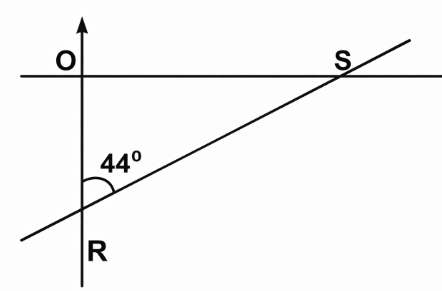
From the diagram given, find the bearing of R from S.
Since the bearing of S from R is 44o, we use the alternate interior angles property between the north-south parallel lines to find that the bearing of R from S is 180o+44o=224o.
Not clear enough?
Question 45
A father decided to give 20% of his monthly income to his three children as their monthly allowance. The eldest child got 45% of the allowance and the youngest got 25%. How much was the father's monthly income if the second child got ₦3,000?
Not clear enough?
Question 46
Divide $\dfrac{6x^2 - 13x + 5}{2x - 1} $.
& 3x - 5 \\
2x - 1 & 6x^2 - 13x + 5 \\
& -(6x^2 - 3x) \\
& \underline{-10x + 5} \\
& -(-10x + 5) \\
& \underline{0}
\end{array}\]
Not clear enough?
Question 47
Compute determinant by expansion along the first row:
\[ \det(P)=1\begin{vmatrix}5 & -1\\[4pt]2 & 0\end{vmatrix} -3\begin{vmatrix}4 & -1\\[4pt]-3 & 0\end{vmatrix} +2\begin{vmatrix}4 & 5\\[4pt]-3 & 2\end{vmatrix}. \]
Evaluate minors:
\(\begin{vmatrix}5 & -1\\2 & 0\end{vmatrix}=5\cdot0 -(-1)\cdot2 = 2.\)
\(\begin{vmatrix}4 & -1\\-3 & 0\end{vmatrix}=4\cdot0 -(-1)(-3)= -3.\)
\(\begin{vmatrix}4 & 5\\-3 & 2\end{vmatrix}=4\cdot2 -5(-3)=8+15=23.\)
So \(\det(P)=1\cdot2 -3(-3) +2\cdot23 \)\(= 2 +9 +46 = 57.\)
Not clear enough?
Question 48
Elements of \(U\) are \(\{1,2,3,4,5,6,7,8,9\}\). Prime factors of 30 are \(2,3,5\), so \(P=\{2,3,5\}\).
The complement \(U\setminus P = \{1,4,6,7,8,9\}\), which is option A.
Not clear enough?
Question 49
Midpoint formula: for points \((x_1,y_1)\) and \((x_2,y_2)\), midpoint is \(\left(\dfrac{x_1+x_2}{2},\dfrac{y_1+y_2}{2}\right)\).
Here \(\dfrac{3+(-1)}{2}=\dfrac{2}{2}=1\) and \(\dfrac{-4+10}{2}=\dfrac{6}{2}=3\). So midpoint is \((1,3)\).
Not clear enough?
Question 50
Compute \(2M\) and \(3N\) elementwise:
\(2M=\begin{pmatrix}2 & 6 & 4\\ 8 & 10 & -2\\ -6 & 4 & 0\end{pmatrix},\quad 3N=\begin{pmatrix}3 & -6 & 9\\ 12 & -3 & 15\\ 6 & -9 & -3\end{pmatrix}.\)
Subtract: \(2M-3N=\begin{pmatrix}2-3 & 6-(-6) & 4-9\\ 8-12 & 10-(-3) & -2-15\\ -6-6 & 4-(-9) & 0-(-3)\end{pmatrix} \)
\(= \begin{pmatrix}-1 & 12 & -5\\ -4 & 13 & -17\\ -12 & 13 & 3\end{pmatrix}.\)
Not clear enough?
You might like
A Tink car is taken on a test drive for 90 minutes around the city. If the average speed is 34 miles per hour how much fuel is consumed?
The identifiable spheres of control which the central government exercise over local government is known as ____?
Consider a system where a heat sensor detects an intrusion and alerts the security company. What kind of a requirement the system is providing?
If 1 man or 2 women or 3 boys can complete a piece of work in 88 days, then 1 man, 1 woman and 1 boy together will complete it in ?