
Mathematics 2005 Jamb Examination

Question 31
Write the quadratic in standard form. Since \(f(x)= -x^2 + x + 2\) is a downward-opening parabola (coefficient of \(x^2\) is negative), it has a maximum at its vertex.
Vertex abscissa: \[x_v = -\dfrac{b}{2a} \]\[= -\dfrac{1}{2(-1)} = \dfrac{1}{2}.\]
Evaluate \(f\) at \(x_v\):
\[f\left(\dfrac12\right) = 2 + \dfrac12 - \left(\dfrac12\right)^2 \]\[= 2 + 0.5 - 0.25 = 2.25 = \dfrac{9}{4}.\]
Therefore the maximum value is \(\dfrac{9}{4}\).
Not clear enough?
Question 32
Find intersection points: solve \(x^2 - x + 3 = 3\) :
\[x^2 - x = 0 \Rightarrow x(x-1)=0 \Rightarrow x=0,\;1.\]
Area between curves (upper minus lower) on \([0,1]\):
\[A = \int_0^1 \bigl(3 - (x^2 - x + 3)\bigr)\,dx = \int_0^1 (-x^2 + x)\,dx.\]
Compute integral:
\[\int_0^1 (-x^2 + x)\,dx = \left[-\tfrac{x^3}{3} + \tfrac{x^2}{2}\right]_0^1 = -\tfrac{1}{3} + \tfrac{1}{2} = \tfrac{1}{6}.\]
Therefore the area is \(\tfrac{1}{6}\) square units, which matches option D.
Not clear enough?
Question 33
Evaluate \(\displaystyle \int_{0}^{\pi/2} \sin^2 x\,dx\).
We evaluate the integral:
\[\int \sin 2x\,dx = -\tfrac{1}{2}\cos 2x + C.\]
Now compute between \(\pi\) and \(\tfrac{\pi}{2}\):
\[\Bigl(-\tfrac{1}{2}\cos 2x\Bigr)\Big|_{\pi}^{\tfrac{\pi}{2}} = -\tfrac{1}{2}\Bigl(\cos(\pi) - \cos(2\pi)\Bigr).\]
\[= -\tfrac{1}{2}((-1) - 1) = -\tfrac{1}{2}(-2) = 1.\]
Therefore the correct answer is \(1\).
Not clear enough?
Question 34
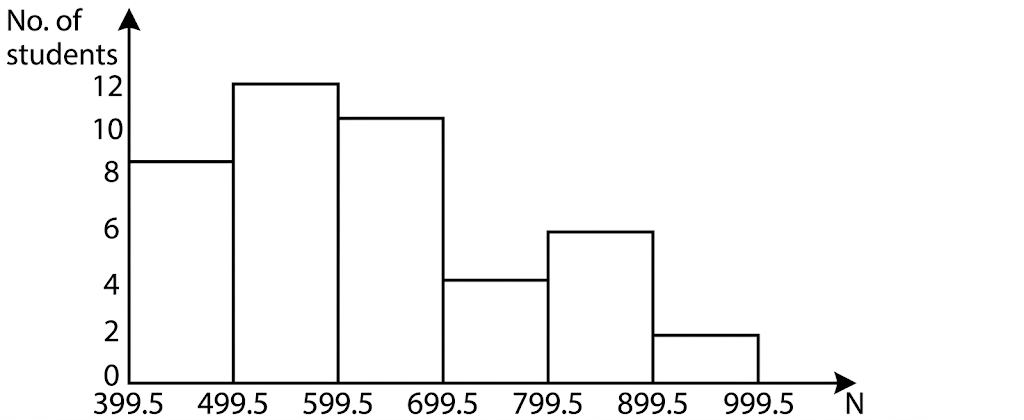
The histogram above shows the distribution of monthly incomes of the workers in a company. How many workers earn more than N700.00?
From the histogram: count all bars strictly to the right of the N700 mark.
Workers who earn above #700 = 4 + 6 + 2 = 12
Not clear enough?
Question 35

The grades of 36 students in a test are shown in the pie chart above. How many students had excellent?
Angle of Excellent
= 360 - (120+80+90)
= 360 - 290
= 70o
If 360o represents 36 students
1o will represent 36/360
50o will represent 36/360 * 70/1
= 7
Not clear enough?
Question 36
\[
\begin{array}{|c|c|c|c|c|c|c|}
\hline
\text{Scores} & 1 & 2 & 3 & 4 & 5 & 6 \\ \hline
\text{No. of students} & 1 & 4 & 5 & 6 & x & 2 \\ \hline
\end{array}
\]
The table above shows the scores of a group of students in a test. If the average score is 3.5, find the value of x
Total students = \(1+4+5+6+x+2 = 18 + x\). Sum of scores = \(1\cdot1 + 2\cdot4 + 3\cdot5 + 4\cdot6 + 5\cdot x + 6\cdot2\).
Compute the numeric part: \(1+8+15+24+12 = 60\). So total sum = \(60 + 5x\).
Average = \(\dfrac{\text{sum}}{\text{number}} = \dfrac{60+5x}{18+x} = 3.5 = \dfrac{7}{2}.\)
Solve: \[2(60+5x)=7(18+x) \Rightarrow 120+10x\]
\[= 126 +7x \Rightarrow 3x = 6 \Rightarrow x = 2.\]
Answer: \(x=2\).
Not clear enough?
Question 37
The modal height and range of heights 1.35, 1.25, 1.35, 1.40, 1.35, 1.50, 1.35, 1.50, and 1.20 are m and r, respectively. Find m+2r.
1.35, 1.25, 1.35, 1.40, 1.35, 1.50, 1.35, 1.50, and 1.20
Modal height = 1.35
Range (r) = 1.50 - 1.20
= 0.30
∴m + 2r = 1.35 + 2(0.30)
= 1.35 + 0.60
= 1.95
Not clear enough?
Question 38
Find the value of t if the standard deviation of 2t, 3t, 4t, 5t, and 6t is $\sqrt{2}$.
\[mean(x) = \dfrac{20t}{5} = 4t\]
\[standard\hspace{1mm}deviation=\sqrt{\dfrac{10t^2}{5}}\]
\[\sqrt{2}=\sqrt{\dfrac{10t^2}{5}}\\\sqrt{2}\]
\[=\sqrt{2t^2}\\2 = 2t^2\\t^2=1\\t=1\]
Not clear enough?
Question 39
Step 1 — model the problem. We have 6 objects where 2 are identical and the other 4 are distinct. The number of distinct permutations is:
\[\dfrac{6!}{2!} = \dfrac{720}{2} = 360.\]
The division by \(2!\) accounts for swapping the two identical chalks which does not create a new arrangement.
Answer: 360 (option D).
Not clear enough?
Question 40
For circular arrangements of \(n\) distinct people, number of distinct seatings (up to rotation) is \((n-1)!\). Here \(n=7\), so:
\[(7-1)! = 6! = 720.\]
We regard two seatings that can be rotated to match as the same arrangement (standard circular-counting convention).
Answer: 720 (option B).
Not clear enough?
You might like
A. (CH3)3N B. CH3NH2
C. CH3C—NH2 D. (CH3)2NH
||
O
Choose the correct answer in the option above.
Which of the following is a primary amine?
A substance has half-life of 3 min. After 6 min, the count rate was observed to be 400. What was its count rate at zero time?
An individual pays 30% income tax. On this tax he has to pay a surcharge of 10%. Thus, the net tax rate, he has to pay, is ?