
Mathematics 2005 Jamb Examination

Question 21
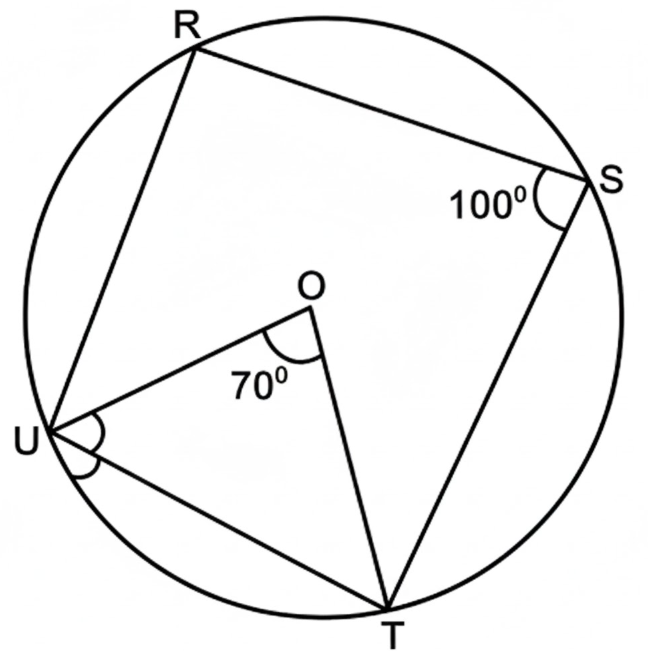
In the diagram above, O is the center of the circle, ∠UOT = 70° and ∠RST = 100°. Calculate ∠RUO.
Using circle theorems: since O is the center, the central angle ∠UOT = 70° subtends arc UT. In triangle UOT (two radii), it is isosceles with base angles\[\angle OUT = \angle UT O = \dfrac{180\deg - 70\deg}{2} = 55\deg.\]
The inscribed angle ∠RST = 100° subtends arc RT not containing S, so the minor central angle \(\angle ROT\) over arc RT is
\[\angle ROT = 2\times \angle RST = 2\times 100\deg = 200\deg,\]
hence the minor arc RT is \(360\deg - 200\deg = 160\deg\), so the inscribed angle at U on chord RT is
\[\angle RUT = \tfrac12\times 160\deg = 80\deg.\]
Finally, at U the angle between UR and UO is the difference between the angle \(\angle RUT\) and the angle between UT and UO (which is 55°):
\[\angle RUO = \angle RUT - \angle OUT = 80\deg - 55\deg = 25\deg.\]
Not clear enough?
Question 22
A sector of a circle has an area of \(55 cm^2\). If the radius of the circle is 10 cm, calculate the angle of the sector [$\pi = \dfrac{22}{7}$].
Use the sector area formula
\[A = \dfrac{\theta}{360\deg}\,\pi r^2.\]
Given \(A=55\,\text{cm}^2\), \(r=10\,\text{cm}\) and \(\pi=\dfrac{22}{7}\), solve for \(\theta\):
\[55 = \dfrac{\theta}{360\deg}\cdot \dfrac{22}{7}\cdot 100 \quad \Rightarrow \quad \theta = \dfrac{55\cdot 360\deg}{(22/7)\cdot 100} \]
\[= \dfrac{19800\deg}{\dfrac{2200}{7}} = 198\cdot \dfrac{7}{22}\,\deg = 9\cdot 7\,\deg = 63\deg.\]
Therefore, the angle of the sector is 63°.
Not clear enough?
Question 23
Find the curved surface area of a cone with circular base diameter 10 cm and height 12 cm.
Curved surface area (CSA) of a cone is
\[\text{CSA} = \pi r\ell,\]
where \(r\) is the base radius and \(\ell\) is the slant height. Given diameter \(=10\,\text{cm}\Rightarrow r=5\,\text{cm}\) and height \(h=12\,\text{cm}\). Compute \(\ell\) using Pythagoras:
\[\ell = \sqrt{r^2 + h^2} = \sqrt{5^2 + 12^2} = \sqrt{25 + 144} \]\[= \sqrt{169} = 13.\]
Hence,
\[\text{CSA} = \pi\cdot 5\cdot 13 = 65\,\pi\,\text{cm}^2.\]
Not clear enough?
Question 24
Points equidistant from two intersecting lines lie on the angle bisectors of the pair. When two lines cross (here at 75°), there are two bisectors: one bisects the acute angle (37.5°) and the other bisects the obtuse angle (180° - 75° = 105°, halved to 52.5°).
Thus, the required locus is the set of points on the bisectors of the angles between PQ and ST.
Not clear enough?
Question 25
Rewrite the given line in slope–intercept form: \(y = -2x + 5\). Its slope is \(m_1 = -2\). A line perpendicular to it has slope \(m_2 = -\tfrac{1}{m_1} = \tfrac{1}{2}\).
Using point–slope form through \((4,3)\):
\[y - 3 = \tfrac{1}{2}(x - 4) \;\Rightarrow\; y = \tfrac{x}{2} + 1.\]
Multiply through by 2: \(2y = x + 2\), so \(2y - x = 2\).
Not clear enough?
Question 26
Formula for chord length corresponding to central angle \(\theta\) (in degrees):
\[\text{chord} = 2r\sin\left(\dfrac{\theta}{2}\right).\]
Here \(r=14\,\text{cm}\) and \(\theta=60°\). Compute:
\[\text{chord} = 2\times 14\times \sin\left(\dfrac{60°}{2}\right) = 28\sin 30° .\]
Since \(\sin 30° = \tfrac{1}{2}\),
\[\text{chord} = 28 \times \tfrac{1}{2} = 14\,\text{cm}.\]
Thus the chord length is 14 cm.
Not clear enough?
Question 27
We solve \(\sin\theta = -\tfrac{1}{2}\). The reference angle for \(|\sin\theta|=\tfrac{1}{2}\) is \(30°\).
\(\sin\theta\) is negative in quadrants III and IV, so the solutions in \(0<\theta<360°\) are:
Quadrant III: \(\theta = 180° + 30° = 210°\).
Quadrant IV: \(\theta = 360° - 30° = 330°\).
Therefore \(\theta = 210°,\; 330°.\)
Not clear enough?
Question 28
Differentiate using the chain rule. Let \(u=1-2x\), so \(y=u^3\). Then:
\[\dfrac{dy}{dx} \]\[= 3u^2\dfrac{du}{dx} \]\[= 3(1-2x)^2\cdot(-2) \]\[= -6(1-2x)^2.\]
Evaluate at \(x=-1\):
\[1-2(-1)=1+2\]\[=3\quad\Rightarrow\quad \dfrac{dy}{dx}\Big|_{x=-1}\]\[ = -6(3)^2 = -6\times 9 = -54.\]
Thus the derivative at \(x=-1\) is \(-54\).
Not clear enough?
Question 29
Use the chain rule. Let \(u = 2x^3 + 3x -4\), so \(y=\sin u\). Then
\[\dfrac{dy}{dx} = \cos u \cdot \dfrac{du}{dx}.\]
Compute \(\dfrac{du}{dx} = 6x^2 + 3\). Therefore
\[\dfrac{dy}{dx} = (6x^2+3)\cos(2x^3+3x-4).\]
This is the required derivative.
Not clear enough?
Question 30
The radius \(r\) of a circular disc is increasing at the rate of 0.5 cm/s. At what rate is the area of the disc increasing when its radius is 6 cm?
Area of a disc: \(A=\pi r^2\). Differentiate with respect to time \(t\):
\[\dfrac{dA}{dt} = 2\pi r \dfrac{dr}{dt}.\]
Given \(\dfrac{dr}{dt}=0.5\ \text{cm/s}\) and \(r=6\ \text{cm}\), substitute:
\[\dfrac{dA}{dt} = 2\pi \times 6 \times 0.5 = 6\pi\ \text{cm}^2/\text{s}.\]
Hence the area is increasing at \(6\pi\ \text{cm}^2/\text{s}\).
Not clear enough?
You might like
Choose the option nearest in meaning to the underlined word(s).
Fila has always been described as belligerent.
Choose the option that completes the gap(s).
Didn’t ___ draw your attention to the entry requirements?
Slow sorting algorithms, such as Bubble Sort or Selection Sort, typically have a worst-case running time in the order of:
The principle which states that no two electrons in the same orbitals of an atom have the same value for all four quantum numbers is the